



In plastic, aesthetic, and reconstructive surgery, wound closure is judged not merely by structural coaptation, but by final aesthetic outcome. A conspicuous "railroad track" cross-hatch scar or hypertrophic suture line represents a clinical failure regardless of deep healing success. Achieving fine, imperceptible scar lines requires selecting suture materials with minimal biological reactivity, exceptional knot security, and precise tissue gliding dynamics.
For facial plastic surgeons, dermatologic surgeons, and hospital operating theater buyers, standardizing suture selection across epidermal, subcuticular, and deep muscular layers is essential. While synthetic monofilaments like nylon monofilament sutures and polypropylene sutures remain the standard for cutaneous closure, modern rapidly absorbing synthetics have transformed pediatric and facial wound closure. In this clinical guide, we compare absorbable and non-absorbable materials in aesthetic surgery, analyze anatomical facial tension vectors, and detail scar mitigation protocols (surgical consumables from China guide).
Table of Contents
- 1. Layer-Specific Closure Principles in Facial Surgery
- 2. Cutaneous Closure: Nylon vs. Polypropylene Monofilament
- 3. Subcuticular Approximation: Poliglecaprone 25 vs. Polyglactin 910
- 4. Rapid-Absorption Options: Eliminating Painful Suture Removal
- 5. Precision Needle Geometries: Reverse Cutting vs. Micro-Curvature
- 6. Suture Removal Timelines & Scar Prevention Protocols
- 7. Frequently Asked Questions (FAQ)
1. Layer-Specific Closure Principles in Facial Surgery
The primary principle of aesthetic wound closure is layer-by-layer tension relief. The superficial epidermal layer must be re-approximated with zero active tension. All wound-separating tension must be borne by deep subcutaneous and fascial retention sutures:
- Deep Fascial / SMAS Layer: Requires high-tensile, long-term absorbable or non-absorbable sutures (PDS II or Polypropylene USP 3-0/2-0) to maintain structural support against facial mimetic muscle pull.
- Subcuticular Dermis: Requires mid-term absorbable monofilaments (Poliglecaprone 25 or PGA USP 4-0/5-0) with inverted buried knots to achieve dermal eversion.
- Epidermal Skin: Requires ultra-fine non-absorbable monofilaments (Nylon or Polypropylene USP 5-0 to 7-0) purely for edge-to-edge alignment.
2. Cutaneous Closure: Nylon vs. Polypropylene Monofilament
Synthetic monofilaments are the definitive choice for surface skin closure due to low tissue reactivity:
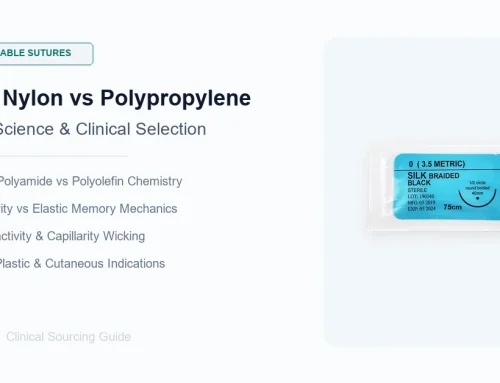
- Nylon (Polyamide Monofilament): The clinical standard in facial laceration repair. Its smooth, non-porous surface passes through skin without dragging epidermal cells. It elicits minimal cellular infiltration and is removed atraumatically without pain.
- Polypropylene (Prolene Equivalent): Preferred for continuous subcuticular pull-out sutures. Polypropylene exhibits zero tissue adherence, enabling a 15 cm running subcuticular strand to slide out effortlessly at post-op day 7 to 10 without breaking.
3. Subcuticular Approximation: Poliglecaprone 25 vs. Polyglactin 910
When selecting buried sutures beneath the dermis:
- Poliglecaprone 25 (Monocryl Equivalent): A synthetic monofilament that passes smoothly and causes virtually zero tissue reaction. It retains 50% tensile strength at 7 days and absorbs completely via hydrolysis by 90 to 120 days.
- Polyglactin 910 (Vicryl Equivalent): A coated braided suture offering superior knot security. However, in very thin facial skin, braided sutures can provoke localized inflammation or "knot spitting" if placed too superficially.
4. Rapid-Absorption Options: Eliminating Painful Suture Removal
In pediatric plastic surgery or uncooperative patients, suture removal causes psychological distress. Fast-absorbing irradiated polyglactin or fast-absorbing gut loses tensile strength in 5 to 7 days and sloughs off naturally with gentle washing, preventing cross-hatch marks without requiring sharp removal tools.
5. Precision Needle Geometries: Reverse Cutting vs. Micro-Curvature
Plastic surgery demands high needle precision:
- Reverse Cutting Needles (3/8 Circle, USP 5-0/6-0): The third cutting edge is located on the outer convex curvature. This design prevents the needle from cutting through the delicate wound edge toward the margin.
- Micro-Point Hand-Honed Needles: For delicate periorbital and blepharoplasty procedures, needles undergo electrochemical honing to minimize puncture resistance.
6. Suture Removal Timelines & Scar Prevention Protocols
| Anatomical Region | Preferred Material & Size | Recommended Removal Window |
|---|---|---|
| Eyelids & Periorbital | Nylon Monofilament (USP 6-0 or 7-0) | 3 to 5 days |
| Facial Skin (Cheek, Forehead) | Nylon or Polypropylene (USP 5-0 or 6-0) | 5 to 7 days |
| Scalp & High-Tension Neck | Nylon Monofilament (USP 4-0 or 3-0) | 7 to 10 days |
| Extremities & Trunk | Nylon Monofilament (USP 4-0 or 3-0) | 10 to 14 days |
7. Frequently Asked Questions (FAQ)
Q1: Why should braided silk be avoided in facial cosmetic closures?
Silk is an animal protein fiber that elicits an inflammatory tissue reaction. In addition, its braided structure wicks skin fluids and bacteria, leading to cellular edema and prominent cross-hatch scarring. Nylon or polypropylene monofilament is clinically preferred.
Q2: What is "knot spitting" and how is it prevented in plastic surgery?
"Knot spitting" occurs when a buried absorbable suture knot is placed too close to the epidermal junction. As the skin heals, the body treats the knot as a foreign body, extruding it through the incision line. It is prevented by placing deep dermal knots inverted (knot facing downward) and trimming knot ears to 1 to 2 mm.
Source Plastic Surgery Grade Sutures in Wholesale Quantities
Partner with Shevenmed for premium USP 5-0 to 7-0 nylon, polypropylene, and fast-absorbing sutures paired with micro-honed precision reverse cutting needles. We support medical distributors and surgical centers worldwide.