
(function(c,l,a,r,i,t,y){ c[a]=c[a]||function(){(c[a].q=c[a].q||[]).push(arguments)}; t=l.createElement(r);t.async=1;t.data-privacy-src="https://www.clarity.ms/tag/"+i; y=l.getElementsByTagName(r)[0];y.parentNode.insertBefore(t,y); })(window, document, "clarity", "script", "gn944t9uep");

EvenMedical

About EvenMedical

This author has not yet filled in any details.
So far EvenMedical has created 143 blog entries.

Tissue Adhesives vs Surgical Sutures: Wound Closure Selection Guide

In emergency trauma wound management, pediatric laceration repair, and elective plastic surgery, closing surgical incisions efficiently while minimizing operative time and scarring is a paramount objective. While conventional sterile surgical sutures remain the bedrock of tissue approximation across deep layers, topical cyanoacrylate tissue adhesives (skin glues) have surged as a high-speed alternative for epidermal closure. This comparative surgical engineering analysis [...]

By |2026-11-18T15:45:00+08:00November 18, 2026|Categories: Surgical Consumables & Wound Closure|Comments Off on Tissue Adhesives vs Surgical Sutures: Wound Closure Selection Guide

Dental Impression Trays: Perforated vs Rim-Lock & Alginate Retention SOP

In fixed and removable prosthodontics, orthodontic diagnostics, and study cast fabrication, achieving an accurate anatomical negative requires synergy between the impression material and the carrier vehicle. While irreversible hydrocolloid formulations have advanced, clinical failure rates remain elevated due to a preventable mechanical flaw: alginate detachment from the impression tray during intraoral removal. Understanding the mechanical retention dynamics between perforated plastic [...]

By |2026-11-17T10:35:00+08:00November 17, 2026|Categories: Dental Materials & Impression|Comments Off on Dental Impression Trays: Perforated vs Rim-Lock & Alginate Retention SOP

Medical Syringe Plunger Lubricants: Silicone Oil Viscosity & Protein Aggregation

In disposable hypodermic syringes and prefilled glass/plastic syringe systems, plunger siliconization is an indispensable tribological requirement: without an optimal lubricant, rubber stoppers experience extreme static break-loose force and dynamic stick-slip friction, causing erratic dosage delivery and needle dislodgement. However, in modern biopharmaceutical delivery, silicone oil migration introduces serious risks of protein aggregation and sub-visible particulate contamination. This engineering guide details [...]

By |2026-10-27T14:10:15+08:00November 16, 2026|Categories: Infusion, Phlebotomy & Diagnostics|Comments Off on Medical Syringe Plunger Lubricants: Silicone Oil Viscosity & Protein Aggregation

Antibacterial Coated Sutures: Triclosan vs Polyglactin 910 Plus for SSI Prevention

Surgical Site Infections (SSIs) represent up to 20% of all healthcare-associated infections globally, escalating inpatient stays, re-admission rates, and antibiotic resistance pressure. The choice of wound closure biomaterial directly influences bacterial adherence and biofilm pathogenesis along the incision line. This clinical specification guide provides a rigorous surgical and material analysis of antibacterial-coated sutures—specifically comparing Triclosan-coated Polyglactin 910 Plus against conventional [...]

By |2026-10-27T14:10:21+08:00November 15, 2026|Categories: Surgical Consumables & Wound Closure|Comments Off on Antibacterial Coated Sutures: Triclosan vs Polyglactin 910 Plus for SSI Prevention

Dental Alginate Shelf Life and Storage: Packaging, Moisture Barriers & Lab Economics

Dental irreversible hydrocolloid (alginate) remains the global benchmark for preliminary impressions, diagnostic study casts, and orthodontic aligner manufacturing due to its cost-efficiency, rapid setting kinetics, and patient tolerance. However, dental laboratories and clinic purchasing departments frequently face unexplained material deterioration—characterized by shortened working times, lumpy consistency, reduced tear strength, and chalky stone model surfaces. This comprehensive engineering guide examines the [...]

By |2026-10-27T14:10:26+08:00November 14, 2026|Categories: Dental Materials & Impression|Comments Off on Dental Alginate Shelf Life and Storage: Packaging, Moisture Barriers & Lab Economics

Blood Collection Tube Additives: Gel Separators vs Clot Activators in Clinical Serum Centrifugation

In modern clinical laboratory pathology, accurate biochemical profiling—including electrolyte panels, cardiac enzymes (Troponin, CK-MB), therapeutic drug monitoring (TDM), and endocrine assays—demands high-purity serum free from cellular contamination and in vitro metabolic consumption. Selecting the correct serum vacuum blood collection tube architecture—specifically comparing SST Gel Separator Tubes (Gold / Yellow Top) against Plain Clot Activator Tubes (Red Top)—is a decisive operational [...]

By |2026-10-26T14:02:08+08:00November 13, 2026|Categories: Infusion, Phlebotomy & Diagnostics|Comments Off on Blood Collection Tube Additives: Gel Separators vs Clot Activators in Clinical Serum Centrifugation

Hospital Disinfection Wipes: 70% Isopropyl Alcohol vs Quaternary Ammonium Compounds in Surface Germicidal Protocols

Healthcare-associated infections (HAIs) transmitted via non-critical environmental surfaces—such as bed rails, infusion pump keypads, diagnostic monitors, and hemodialysis stations—impose immense clinical and financial burdens on modern hospitals. Surface disinfection wipes serve as the frontline defense against pathogen persistence. However, selecting between 70% Isopropyl Alcohol (IPA) wipes and Quaternary Ammonium Compound (Quat) wipes involves a critical balance between rapid germicidal evaporation, [...]

By |2026-10-26T13:49:54+08:00November 12, 2026|Categories: Infection Control & Disinfection|Comments Off on Hospital Disinfection Wipes: 70% Isopropyl Alcohol vs Quaternary Ammonium Compounds in Surface Germicidal Protocols

Surgical Scalpel Blade Shapes and Incision Geometry: Clinical Matching for #10, #11, #12 and #15

In operating room precision surgery, tissue incision geometry dictates not only the initial entry dynamics and visibility of the operative field, but directly governs postoperative tensile wound healing, epidermal edge approximation, and cosmetic scar formation. While all surgical blades comply with the fitment standards of ISO 7740, their curved bellies, angled tips, and specialized cutting radii create vastly divergent biomechanical [...]

By |2026-10-26T13:38:16+08:00November 11, 2026|Categories: Surgical Consumables & Wound Closure|Comments Off on Surgical Scalpel Blade Shapes and Incision Geometry: Clinical Matching for #10, #11, #12 and #15

Butterfly Blood Collection Needles vs Straight Multi-Sample Needles: Pediatric Vein Access, Hemolysis Prevention & Sharps Safety

In hospital pathology laboratories and outpatient phlebotomy clinics, diagnostic accuracy hinges upon the integrity of the pre-analytical phase. Over 60%–70% of laboratory specimen errors originate prior to analyzer testing, with in vitro sample hemolysis, insufficient draw volume (QNS), and accidental needle stick injuries (NSIs) presenting chronic clinical and financial challenges. Choosing between Winged Blood Collection Sets (Butterfly Needles) and Straight [...]

By |2026-10-26T14:01:46+08:00November 10, 2026|Categories: Infusion, Phlebotomy & Diagnostics|Comments Off on Butterfly Blood Collection Needles vs Straight Multi-Sample Needles: Pediatric Vein Access, Hemolysis Prevention & Sharps Safety

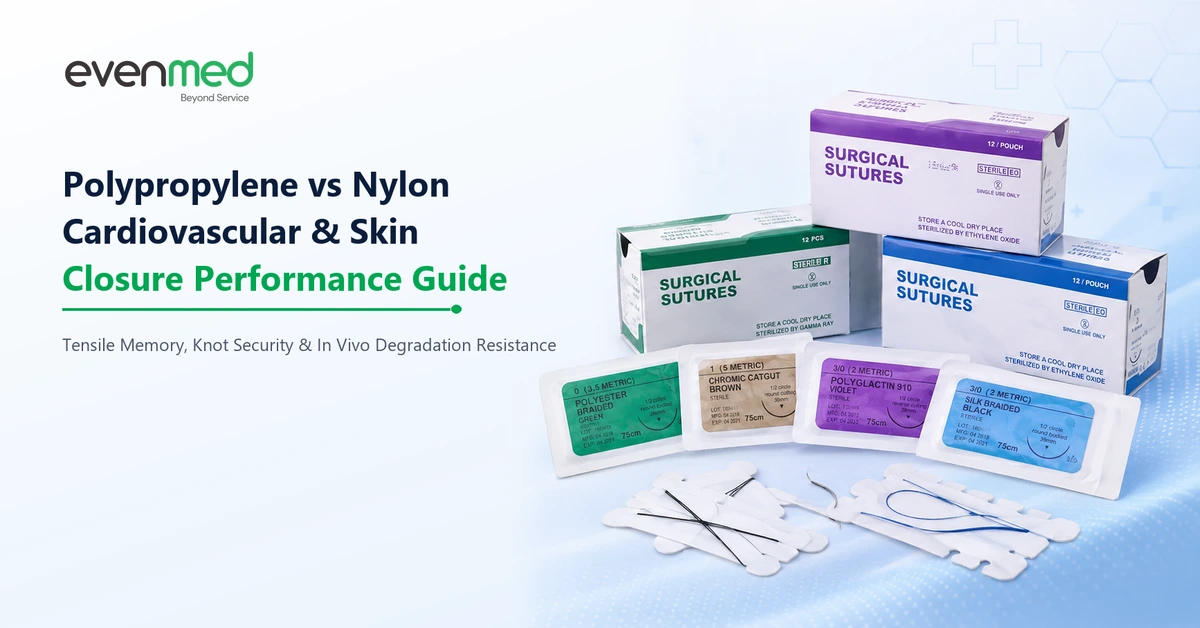
Polypropylene vs Nylon Sutures in Cardiovascular and Cuticular Closure: Tensile Memory, Knot Security & In Vivo Stability

In soft tissue surgery, selecting the ideal non-absorbable monofilament suture is a fundamental balance between handling ergonomics and permanent mechanical stability. While both Polypropylene (e.g., Prolene equivalent) and Nylon / Polyamide (e.g., Ethilon equivalent) provide smooth monofilament tissue glide and low biological reactivity, their molecular structure, knot security, tensile retention in vivo, and handling memory diverge substantially. For operating theatre [...]

By |2026-10-26T13:42:03+08:00November 9, 2026|Categories: Surgical Consumables & Wound Closure|Comments Off on Polypropylene vs Nylon Sutures in Cardiovascular and Cuticular Closure: Tensile Memory, Knot Security & In Vivo Stability
Go to Top