



In hospital centralized procurement, ministerial health authority tenders (MOH), and multinational medical distribution contracts, surgical sutures represent one of the most critical high-volume sterile consumables. A failure in suture performance—whether manifesting as intraoperative needle pull-off, premature tensile degradation in deep fascia, knot slippage during cardiac vascular anastomosis, or trace moisture hydrolysis inside absorbable packaging—can trigger catastrophic clinical complications and multi-million-dollar institutional liabilities. Sourcing export-grade sutures at scale requires moving beyond cosmetic catalog specifications. This comprehensive technical procurement white paper and hospital tender audit manual establishes an objective, evidence-based evaluation framework conforming to United States Pharmacopeia (USP) and European Pharmacopoeia (EP) compendial standards, tensile mechanical testing protocols, primary moisture-barrier packaging physics, and warehouse arrival lot acceptance SOPs.

1. The Anatomy of a High-Stakes Suture Tender: Eliminating Clinical Vulnerabilities
Public and private hospital tender committees frequently encounter severe disparities between supplier quotation samples and mass-production shipping containers. Suture manufacturing demands extreme metallurgical, polymer chemical, and cleanroom packaging discipline. Bulk procurement officers typically navigate three critical vulnerabilities:
- Needle-to-Thread Swage Pull-Off Failures: In manual deep cavity suturing, if the mechanical swaging pressure applied to join the stainless steel drill-end needle to the suture strand is inconsistent, the needle can detach prematurely inside tissue, requiring emergency radiological exploration and prolonged operating room time.
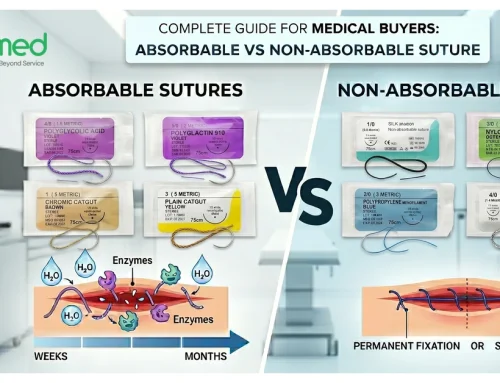
- Hydrolytic Degradation of Absorbable Polymers: Synthetic absorbable sutures—such as Polyglycolic Acid (PGA), Polyglactin 910 (Vicryl equivalent), and Polydioxanone (PDS)—degrade via hydrolytic ester cleavage. Exposure to as little as 0.05% relative humidity inside defective primary foil packs initiates premature chain scission in warehouse storage, resulting in total loss of tensile retention prior to clinical use.
- Inconsistent Needle Alloy Ductility: Substandard needles fabricated from low-grade 302/304 stainless steels suffer ductile bending under heavy fascial counter-pressure or brittle snapping when challenged by calcified cardiovascular tissue, necessitating high-yield 300-series (AISI 302/304V) or 400-series (AISI 420/455) medical alloys.
To eliminate these hazards, procurement directors must standardize their tender specifications around non-negotiable physical and biological performance thresholds from certified surgical suture manufacturers.
2. Hospital Tender Specifications: Mandatory Chemical & Metallurgical Benchmarks
When drafting institutional tender dossiers or B2B supply agreements, hospital procurement committees should mandate the following chemical, physical, and packaging parameters across major product lines:
| Product Category & Suture Type | Material Architecture & Polymer Backbone | Required Coating / Lubricant | Tensile Retention Profile (In Vivo) | Primary Clinical Specialty |
|---|---|---|---|---|
| PGA / Polyglactin 910 (Rapid) | Braided copolymer of glycolide and L-lactide (90/10) | Poly(glycolide-co-lactide) + Calcium Stearate | 50% tensile strength at 5–7 days; complete absorption in 42 days | Episiotomy, pediatric laceration, oral mucosa closure |
| PGA / Polyglactin 910 (Standard) | Braided homopolymer (PGA) or 90/10 copolymer | Polycaprolactone / Calcium Stearate (low drag) | 75% at 14 days, 50% at 21 days; complete absorption in 56–70 days | General surgery, gastrointestinal, gynecological, urological |
| Polydioxanone (PDS Equivalent) | Monofilament poly(p-dioxanone) polymer | Uncoated (inherent low-friction monofilament) | 75% at 14 days, 60% at 28 days; absorption profile 180–210 days | Abdominal wall fascia, pediatric cardiovascular, orthopedic tendon |
| Polypropylene (Prolene Equivalent) | Monofilament isotactic polypropylene | Uncoated, biologically non-reactive | Permanent non-absorbable; < 2% tensile loss over 10 years | Vascular anastomosis, cardiac bypass, plastic subcuticular |
| Polyamide / Nylon (Ethilon Equivalent) | Monofilament extruded Polyamide 6 or 6/6 | Uncoated, high-memory elasticity | Non-absorbable; gradual hydrolytic loss (~15–20% per year) | Cuticular skin closure, neurosurgical microsurgery, ophthalmic |
| Braided Virgin Silk | Natural protein filament derived from Bombyx mori | Medical-grade silicone or beeswax impregnation | Gradual loss over 1–2 years; encapsulated by fibrous tissue | Gastrointestinal tract, dental extractions, deep vessel ligation |
3. Mechanical Laboratory Testing: Tensile Strength & Needle Attachment SOP
Hospital quality assurance teams and national regulatory laboratories must verify production lots using standardized universal tensile testing instruments (Instron / Lloyd texture analyzers) following USP <861> and EP guidelines:
A. Straight-Pull and Knot Tensile Strength (USP <861>)
The suture strand is knotted with a standardized surgeon’s knot (throw followed by square knot) over a polished mandril. The sample is clamped into pneumatic tensile grips operating at a constant crosshead displacement rate of 250 mm/min to 300 mm/min. The breaking force must meet or exceed the absolute minimum knot-pull breaking load prescribed by USP (e.g., USP 2-0 absorbable synthetic must exceed 2.68 kgf / 26.3 N; USP 3-0 must exceed 1.77 kgf / 17.4 N).
B. Needle-to-Thread Swage Pull-Off Test (USP <871>)
The surgical needle is secured in a custom hardened steel collet fixture aligned along the linear axis of the suture. Tensile load is applied at 100 mm/min until separation occurs. Compendial standards specify two threshold criteria:
- Individual Value Minimum: No individual sample in a 10-piece test cohort may pull off below the minimum threshold (e.g., USP 2-0 minimum: 1.10 kgf / 10.8 N).
- Average Value Minimum: The arithmetic mean of the test cohort must satisfy the higher average limit (e.g., USP 2-0 average: 1.50 kgf / 14.7 N).
Swaged connections must demonstrate clean cohesive fiber failure rather than catastrophic slippage from an under-crimped channel.
4. Primary Packaging & Moisture-Barrier Physics (Karl Fischer Verification)
For synthetic absorbable sutures, primary barrier packaging is not merely a sterile wrapper; it is an active moisture exclusion chamber. Hydrolytic degradation kinetics accelerate exponentially if water content exceeds 500 parts per million (ppm):
- Multi-Layer Aluminium Foil Construction: Primary packets must utilize an impermeable four-layer laminate: Polyester (PET) / Adhesive / Heavy Aluminium Foil (minimum 12–15 µm) / Surlyn or Low-Density Polyethylene (LDPE). Paper-backed or plain peel-pouches are completely contraindicated for synthetic absorbable materials.
- Industrial Moisture Desiccation Cycle: Prior to hermetic foil sealing, bulk unsealed suture packets undergo a 48 to 72-hour high-vacuum drying cycle at elevated temperatures (45°C–55°C) to evacuate residual moisture absorbed during cleanroom assembly.
- Coulometric Karl Fischer Titration: Batch release testing requires destructive testing of suture strands via coulometric Karl Fischer water determination. Export-grade PGA and Polyglactin lots must certify total water content < 0.05% (500 ppm).
5. Warehouse Arrival Inspection Checklist for Hospital Buyers (AQL 1.0)
Upon receiving a container shipment, hospital central distribution centers (CDCs) should execute an acceptance audit based on ISO 2859-1 (Sampling procedures for inspection by attributes, General Inspection Level II, AQL 1.0 for Major defects, AQL 2.5 for Minor defects):
| Audit Step | Inspection Parameter | Acceptance Criteria & Non-Conformance Action |
|---|---|---|
| 1. External Shipping Shipper Carton | 5-ply corrugated master carton; stacking crush strength; moisture ingress indicators | Zero carton deformation; shipping marks match Bill of Lading (B/L) and Packing List exactly |
| 2. Unit Box & Sterilization Indicators | 12 or 36 foil packs per box; shelf-pack shrink wrap; chemical sterilization indicator dot | Ethylene Oxide (EO) indicator must show clear, unambiguous color transition (e.g., yellow to vibrant red/blue); zero untreated lots |
| 3. Foil Pouch Vacuum & Seal Integrity | Hermetic perimeter heat seals (minimum 6 mm seal width); zero channel leaks | Methylene blue dye penetration test (ASTM F1929); zero dye breach across seal border; unsealed pouches cause lot rejection |
| 4. Labeling & Regulatory Traceability | UDI barcoding (GS1 DataMatrix); CE mark with notified body number; ISO 13485 license; expiry date | Needle diagram printed 1:1 scale on box; lot number matches Certificate of Analysis (CoA) and Certificate of Sterility (CoS) |
| 5. Strand Physical Inspection | Optical magnification (20x) of braided or monofilament strand; needle point sharpness | Zero fraying, loops, knots, or micro-burrs along strand; needle point must cleanly penetrate 0.4 mm polyurethane test membrane without deflection |
6. Hospital Logistics & Container Sizing Calculator
Optimizing palletization and cubic freight utilization dramatically lowers landed cost per patient procedure. The table below outlines standard master carton container capacities for international export:
| Shipping Container Unit | Master Carton Capacity | Total Dozens (12 packs/box) | Total Suture Units | Gross Weight (KG) |
|---|---|---|---|---|
| LCL Air Freight Pallet (1.2 x 0.8 x 1.6m) | 36 master cartons (50 boxes/carton) | 1,800 dozens | 21,600 sutures | ~340 kg |
| 20ft Standard FCL Container (28 CBM) | 480 master cartons (50 boxes/carton) | 24,000 dozens | 288,000 sutures | ~4,800 kg |
| 40ft High Cube Container (68 CBM) | 1,050 master cartons (50 boxes/carton) | 52,500 dozens | 630,000 sutures | ~10,500 kg |
7. Frequently Asked Questions (FAQ)
What is the difference between USP and EP metric sizing for surgical sutures?
USP sizing uses arbitrary numbers (e.g., 2-0, 3-0, 4-0) where more zeros indicate a thinner strand diameter. The European Pharmacopoeia (EP) metric gauge directly corresponds to the diameter in tenths of a millimeter (e.g., Metric 3.0 equals 0.30 mm to 0.349 mm diameter, corresponding to USP 2-0). Export packaging must state both USP and Metric notations simultaneously.
Why do synthetic absorbable sutures require nitrogen gas flushing during sealing?
Flushing the internal foil cavity with high-purity dry nitrogen gas (N₂) displaces ambient oxygen and moisture-laden air before the final sealing jaws compress. This inert micro-environment prevents oxidative degradation and hydrolytic chain scission over the 3 to 5-year shelf life.
What documents are mandatory for customs clearance and hospital tender approval?
Importers require an ISO 13485 Certificate, CE Certificate under MDR (EU) 2017/745, Certificate of Free Sale (CFS), comprehensive Material Safety Data Sheet (MSDS), Biocompatibility Summary (ISO 10993 cytotoxicity, irritation, sensitization), and lot-specific Certificates of Analysis (CoA) confirming tensile break loads and sterility assurance level (SAL 10⁻⁶).
Direct Factory Surgical Sutures & Hospital Tender Sourcing
Shevenmed manufactures certified surgical sutures (PGA, Polyglactin 910, PDS, Nylon, Polypropylene, Silk) in 100,000-grade cleanrooms, offering complete OEM hospital private labeling, custom needle geometries, and full tender dossier support.