



In operating room precision surgery, tissue incision geometry dictates not only the initial entry dynamics and visibility of the operative field, but directly governs postoperative tensile wound healing, epidermal edge approximation, and cosmetic scar formation. While all surgical blades comply with the fitment standards of ISO 7740, their curved bellies, angled tips, and specialized cutting radii create vastly divergent biomechanical cutting forces. For surgical scrub teams, operating theatre directors, and hospital procurement managers, matching blade geometry—specifically #10, #11, #12, and #15—with exact surgical specialty procedures is essential for procedural safety and inventory rationalization.

1. Incision Biomechanics: Belly Cutting vs Puncture Point Dynamics
The biomechanical behavior of a surgical blade during tissue division depends on its effective cutting surface area, angle of incidence, and the distribution of manual downward force:
- Curved "Belly" Cutting (#10 & #15): Relies on the convex curved edge of the blade. When the surgeon applies traction at a 30°–45° angle to the skin surface, the cutting force is distributed along a continuous tangential arc. This progressive gliding cut minimizes tissue micro-tearing and prevents sudden plunging into underlying subcutaneous fat or muscle layers.
- Linear "Point" Puncture (#11): Characterized by a straight triangular cutting edge terminating at an acute point. Force is concentrated entirely at the microscopic tip, allowing sharp puncture and rapid withdrawal (the "stab incision") without requiring lateral sliding friction.
- Recurved Hook Dissection (#12): Features a crescent-shaped cutting edge located on the internal concave curve, shielding adjacent delicate anatomical structures while pulling tissue toward the cutting notch.
Consult Shevenmed's complete surgical consumables catalog to review dimensional tolerances, metallurgy certifications, and bulk packaging specifications.
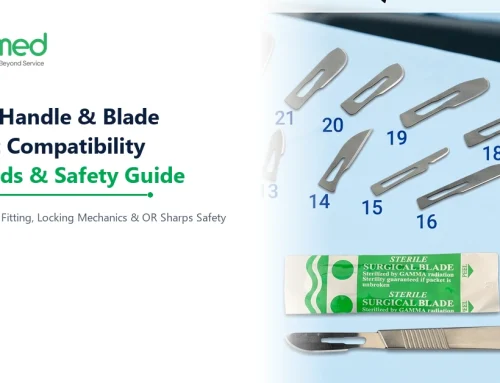
2. Clinical Matching Matrix: #10, #11, #12 and #15 Blade Geometries
Each blade shape was developed to optimize specific tissue planes and surgical specialties across general, thoracic, plastic, and oral surgery:
| Blade Profile | Geometric Design Characteristics | Primary Clinical Indications | Primary Operating Room Risk |
|---|---|---|---|
| Blade No. 10 | Large curved cutting edge extending along the belly; broad flat back. Mates with Handle No. 3. | Long cutaneous laparotomy incisions, thoracotomy access, orthopedic limb incisions, cesarean sections. | Excessive depth if used on thin cosmetic facial tissues; inappropriate for puncturing vessels. |
| Blade No. 11 | Straight triangular profile with acute angled tip and sharpened hypotenuse. Mates with Handle No. 3. | Stab incisions for drainage of abscesses, vascular arteriotomy/venotomy, laparoscopic trocar entry, chest tube placement. | Uncontrolled over-penetration into deep vessels or viscera during forceful plunging; tip bending. |
| Blade No. 12 (and 12D) | Small, pointed crescent-shaped blade with internal curved sharp edge (12D is double-edged). Mates with Handle No. 3. | Tonsillectomy, oral mucogingival flaps, periodontal root planing, cleft palate reconstructive surgery. | Blunt back jamming if angle of pull is misaligned; restricted to shallow pull-cutting techniques. |
| Blade No. 15 (and 15C) | Miniature curved belly with a sharp, delicate tip radius. Mates with Handle No. 3. | Plastic and reconstructive surgery, ophthalmic blepharoplasty, dermatological excision, pediatric surgery. | Rapid dulling if forced through calcified or fibrous fascia; requires frequent intraoperative blade changes. |
For more details on handle selection and ergonomic grip matching, review our clinical guide on how to choose the right scalpel blade for hospital surgical units.
3. Metallurgy: High-Carbon Steel vs Martensitic Stainless Steel Edges
Operating room performance is dictated by metallurgical crystal hardness and edge retention under mechanical shear stress:
- High-Carbon Steel (Grade T10 / SK2 / CS70): Carbon content of 0.95%–1.20% yields exceptional Rockwell hardness (HRC 58–62). High-carbon steel can be honed to an acute, razor-sharp edge angle (14°–16°), generating exceptionally low initial tissue penetration resistance. This keen sharpness is favored in plastic surgery where ragged incision edges compromise scar aesthetics. However, carbon steel is vulnerable to atmospheric oxidation and must be sealed in multi-layer foil pouches containing vapor-phase corrosion inhibitors (VCI).
- Martensitic Stainless Steel (Grade 4Cr13 / AISI 420): Contains 12%–14% chromium, imparting outstanding resistance to moisture, blood corrosion, and pitting (HRC 54–57). While slightly less rigid than carbon steel, stainless steel exhibits greater elastic ductility, significantly reducing the hazard of sudden brittle snapping when lateral bending loads occur during dense orthopedic cartilage incision.
Proper wound coaptation following precise scalpel incision requires matching needle geometry; examine our surgical needle types and curvature selection guide for operating theatre procurement.
4. Sharps Safety, OSHA Compliance & No-Touch Blade Handing
Percutaneous sharps injuries in perioperative environments represent a major occupational transmission route for bloodborne pathogens (Hepatitis B, Hepatitis C, HIV). According to OSHA and AORN perioperative safety standards, over 10% to 15% of all surgical sharps injuries occur during manual scalpel blade loading and unloading using needle holders.
Modern hospital safety protocols mandate two institutional safeguards:
- Universal Hands-Free "Neutral Zone" Transfer: Scalpels must never be handed directly hand-to-hand between surgeon and scrub nurse. A designated magnetic mat or transfer dish (the neutral zone) ensures that only one clinician touches the scalpel at any time.
- Single-Handed Blade Removers & Safety Scalpels: Utilizing puncture-proof mechanical blade removers that detach the blade directly into a sealed sharps receptacle, or transitioning to pre-assembled single-use disposable safety scalpels equipped with retractable protective locking sheaths.
5. Hospital Tender Procurement Criteria & Quality Assurance
Institutional hospital procurement boards and international medical device distributors must require verifiable documentation during bidding:
- ISO 7740 Fitment Gauge Testing: Verified slot dimensions ensuring zero lateral wobble or accidental forward slip off Handle No. 3 under 20 N forward pulling force;
- Sterility Assurance Level (SAL): Validated Gamma irradiation (minimum 25 kGy) or Ethylene Oxide (EO) sterilization certificates compliant with ISO 11137 / ISO 11135;
- Foil Seal Integrity: Automated pinhole and vacuum leak testing ensuring an airtight, hermetic 5-year sterile shelf life under high-humidity tropical warehouse storage.
6. Shevenmed Precision Manufacturing & OEM Export Capabilities
As an established medical consumables manufacturer, Shevenmed's surgical blade and scalpel division operates automated Swiss precision grinding and laser-inspection lines under ISO 13485 quality management systems. With full CE MDR conformity, automated blister packaging, and full-container load (FCL) maritime export logistics, Shevenmed supplies national health authorities and commercial hospital chains with dependable surgical cutting precision at highly competitive factory-direct pricing.