



For dental clinics, prosthetic laboratories, and hospital dental departments, irreversible hydrocolloid alginate impression material represents one of the most frequently consumed clinical supplies. However, dental technicians and procurement managers frequently encounter baffling, intermittent quality discrepancies: alginate paste setting prematurely in the mixing bowl, grainy or watery mixes that slump off the tray, prolonged setting times in the patient's mouth, or stone casts with chalky, friable margins.
In the vast majority of cases, these clinical failures are not caused by chemical defects from the manufacturer; they are the direct consequence of ambient environmental degradation, hygroscopic moisture absorption, and improper storage protocols. As an experienced B2B dental consumables export supply partner managing international freight and warehouse distribution globally, Shevenmed has developed this comprehensive technical guide detailing the degradation chemistry, shelf-life benchmarks, clinic storage SOPs, and packaging standards for medical-grade alginate impression powders.
1. The Degradation Chemistry: Why Alginate Powder Is Environmental Sensitive
To implement effective storage controls, one must understand the delicate chemical equilibrium within dry alginate powder formulated under ISO 21563 / YY 1027-2018 standards. A typical medical alginate powder is an intricate composite of four reactive component classes:
- 1. Soluble Alginate Salt (12%–15%): High-purity sodium or potassium alginate extracted from brown marine algae (Laminaria hyperborea).
- 2. Calcium Reactor (10%–15%): Calcium sulfate dihydrate (gypsum) or anhydrous calcium sulfate, which releases divalent Ca2+ ions to cross-link the polymer chains into an insoluble calcium alginate gel.
- 3. Retarder System (1%–3%): Trisodium phosphate (Na3PO4) or sodium pyrophosphate. The retarder preferentially precipitates Ca2+ ions as insoluble calcium phosphate, establishing a calibrated "working window" before gelation commences.
- 4. Diatomaceous Earth Filler (65%–75%): Micro-porous amorphous silica that provides body, improves tear resistance, and controls paste viscosity.
The Triad of Environmental Degradation: Moisture, Heat & Light
When exposed to ambient warehouse or clinic air, three chemical degradation mechanisms unfold rapidly:
- Hygroscopic Moisture Absorption: Diatomaceous earth and sodium alginate are naturally hygroscopic. Absorbed atmospheric moisture partially dissolves the calcium sulfate and phosphate retarder in the dry state. This initiates micro-reactions within the canister, pre-consuming the chemical retarder and causing the material to develop "false setting" or unpredictable setting acceleration when mixed with water.
- Thermal Depolymerization: Sustained exposure to temperatures above 30°C (86°F)—common in non-climate-controlled shipping containers or clinic attics—breaks the glycosidic bonds linking the D-mannuronic (M) and L-guluronic (G) acid residues in the alginate polymer. This depolymerization results in severe loss of gel elastic recovery (<95%) and catastrophic reduction in tear strength.
- Atmospheric Photo-Oxidation: Ultraviolet (UV) radiation and atmospheric oxygen degrade organic pH indicator dyes (phenolphthalein, thymolphthalein) responsible for three-phase color changes (e.g., purple-to-pink-to-white), leaving technicians unable to visually track working and setting phases.
For a detailed breakdown of chemical reaction kinetics and material selection, review our comprehensive hub on dental alginate impression material chemistry and properties.
2. Shelf Life Benchmarks: Factory Sealed vs. Opened Canisters
Clear distinctions must be maintained between unopened institutional inventory and active chairside containers:
| Packaging Condition | Recommended Storage Temperature | Relative Humidity (RH) | Expected Useful Shelf Life | Key Degradation Risk |
|---|---|---|---|---|
| Factory-Sealed Aluminum Foil Pouch | 15°C – 25°C (59°F – 77°F) | <65% RH | 36 Months (3 Years) | Thermal degradation during maritime cargo transit |
| Factory-Sealed Rigid Plastic Tub / Canister | 15°C – 25°C (59°F – 77°F) | <60% RH | 24 – 36 Months | Vapor permeation through container walls or gasket seals |
| Opened Active Canister (Gasket Sealed) | 18°C – 22°C (64°F – 72°F) | <50% RH | 60 – 90 Days | Gradual humidity intrusion during repeated daily scoops |
| Opened Bag Folded with Clip (Improper) | Ambient Operatory Air | Uncontrolled (>65% RH) | 14 – 21 Days Max | Rapid caking, grainy texture, loss of elastic recovery |
For custom institutional packaging and bulk supply requirements, explore our dedicated procurement guide on OEM alginate impression material private label packaging.
3. Clinic & Laboratory Storage Best Practices (Standard Operating Procedure)
To eliminate model remakes and guarantee consistent setting times, dental practices must enforce these five physical storage rules:
Rule 1: Never Store Near Water Sources or Operatory Autoclaves
The most common mistake in dental clinics is placing alginate canisters on countertops directly adjacent to plaster sinks, ultrasonic scalers, or benchtop autoclaves. Steam exhaust from sterilization cycles elevates local ambient humidity to over 85% RH, drastically accelerating powder clumping. Store alginate in a dry, dedicated supply cabinet at least 3 meters away from plumbing fixtures and steam vents.
Rule 2: Transfer Pouches Immediately into Gasket-Sealed Containers
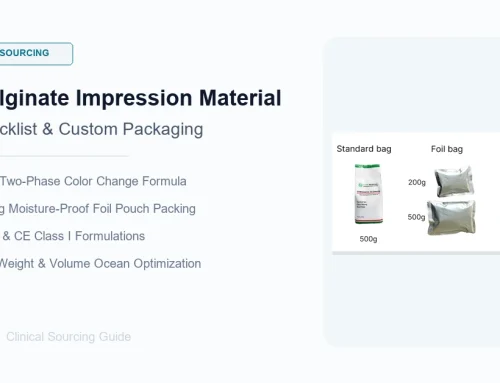
Economic bulk foil pouches (454g or 500g) are the preferred format for busy clinics. However, once snipped open with scissors, simple plastic bag clips or rubber bands fail to prevent vapor migration. Clinic staff should immediately decant the entire foil pouch into an airtight plastic or metal canister equipped with a silicone perimeter gasket and positive latching clamps. Label the canister lid with the date of decanting and the manufacturer's original batch expiration date.
Rule 3: Avoid Powder De-Stratification & Segregation
During transportation and stationary storage, density variations cause heavier components (diatomaceous earth and calcium sulfate) to settle toward the bottom, while lighter sodium alginate polymers migrate to the top. Before opening a fresh canister or after extended weekend storage, gently invert and roll the sealed container 3 to 4 times to re-homogenize the powder blend. Never shake the canister violently, as this aerates the powder and introduces microscopic moisture-laden air pockets.
Rule 4: Prevent "Scoop Contamination"
Technicians must ensure that measuring scoops are bone-dry before plunging them into the canister. Even a single residual droplet of water left on a measuring scoop from a previous wash will seed a cluster of hardened, reacted alginate pellets inside the bulk powder.
Rule 5: Strictly Enforce First-In, First-Out (FIFO) Inventory Control
Ensure medical storage racks are arranged sequentially by manufacturer expiry date. Stock incoming cartons at the back of the shelf and draw active supply from the front. For precise measuring ergonomics and waste prevention, review our technician guide on how to mix alginate molding powder without waste.
4. Diagnostic Troubleshooting: Identifying Storage-Damaged Alginate
When an impression behaves abnormally, use this diagnostic matrix to verify whether environmental degradation is the underlying root cause:
| Observed Defect / Symptom | Underlying Chemical Mechanism | Verification Test | Corrective Action |
|---|---|---|---|
| Powder Forms Hard Lumps / Caking | Moisture absorption causing premature calcium cross-linking | Sift powder through clean dry sieve; presence of unmixable granules | Discard caked batch; replace storage container with hermetic gasket seal |
| Drastic Setting Time Acceleration (<1 min) | Phosphate retarder neutralized by absorbed humidity | Bench-test with 20°C distilled water; sets in bowl before tray loading | Do not use clinically; batch retarder has expired or oxidized |
| Extended / Indefinite Gelation (>5 min) | Polymer chain hydrolysis or severe cold storage (<10°C) | Test mix at 22°C; material remains tacky slurry without snapping | Verify water temperature; if persistent at 22°C, discard degraded lot |
| Grainy Mix with Poor Detail Reproduction | Insoluble calcium phosphate clusters failing to dissolve | Examine mixed paste under magnification; rough sandpaper surface | Powder has suffered thermal degradation; replace clinical canister |
| Chalky Model Surfaces Despite Proper Pour | Alginate depolymerization releasing excess syneresis exudate | Stone surface soft and powdery even after 60-min cure window | Consult our Type 3 & 4 dental stone compatibility guide and replace alginate |
For end-to-end laboratory pouring and cast fabrication protocols, refer to our comprehensive product guide on Type 3 and Type 4 dental stone models.
5. B2B Packaging Standards & Maritime Export Container Protection
For international dental distributors, health ministries, and commercial dental depots importing containerized cargo from China, understanding export packaging integrity is critical for guaranteeing that product arrives in factory-fresh condition.
Multi-Layer Foil Barrier Engineering
Standard clear polyethylene (PE) bags provide zero vapor protection across long trans-oceanic voyages through tropical maritime corridors (Red Sea, Malacca Strait, Panama Canal). Institutional alginate must be sealed within three-layer or four-layer composite barrier laminate packaging:
- Outer Layer (PET / Paper): High mechanical puncture resistance and moisture barrier.
- Barrier Core (Aluminum Foil Al ≥ 7–9 μm): Complete zero-permeability barrier against water vapor, oxygen, and UV radiation (Water Vapor Transmission Rate < 0.05 g/m²/24h).
- Inner Sealant Layer (Linear Low-Density Polyethylene - LLDPE): Premium hot-melt hermetic seal resistant to pressure changes during intermodal air and sea transport.
Ocean Container Desiccant & Temperature Monitoring
During ocean freight transit, internal container temperatures can exceed 55°C (131°F) during "container rain" cycles when humid sea air condenses on the container ceiling. Shevenmed implements strict export cargo protocols:
- Calcium Chloride Super-Desiccant Poles: Placed throughout container walls to maintain ambient container humidity below 45% throughout the 30-to-45-day voyage.
- Pallet Stretch-Hood Shrink Wrapping: Full pallet weather-proofing shielding cartons against warehouse humidity during port staging and customs clearance.
- Non-Dangerous Goods Compliance: Accompanied by certified Air & Sea Non-Dangerous Goods Transport Certificates and comprehensive Material Safety Data Sheets (MSDS), verifying that products are non-hazardous for standard containerized freight.
6. Summary & Institutional Procurement Checklist
When drafting tender specifications or auditing clinical storage bays, enforce these key parameters:
- Demand Multi-Layer Aluminum Foil Pouches: Reject mono-layer PE bags for tropical and humid export destinations.
- Maintain Strict 15°C–25°C Storage: Ensure warehouse staging areas are climate-controlled and shielded from direct sunlight.
- Equip Clinics with Gasket Canisters: Provide dental operatories with secondary airtight storage tubs for opened foil packs.
- Monitor Batch Expiration: Audit clinical stock regularly to ensure no material exceeds its 36-month sealed / 90-day opened lifecycle.
For custom flavor formulations, private label OEM packaging, or consolidated container freight quotations across our dental consumables line, contact our technical supply specialists or request a formal commercial quotation at our B2B inquiry portal.