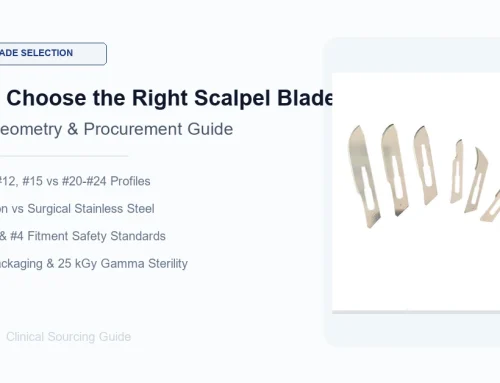




Carbon steel and stainless steel surgical blades can be offered in the same familiar blade shapes, but the material name alone does not tell a buyer which finished blade is better. Procurement teams still need to compare the exact blade geometry, handle fit, edge specification, packaging, sterilization evidence, shelf life, and lot-level quality controls.
This guide focuses on the carbon steel vs stainless steel surgical blade decision. It does not replace the separate selection of blade number, handle compatibility, or intended procedure. Distributors and institutional buyers can use it to compare materials without relying on generic claims such as "always sharper" or "always more durable." Clinical selection remains the responsibility of qualified healthcare professionals and the purchasing facility's approved procedures.
Quick Answer: Which Material Should You Buy?
Buy the finished blade that meets your documented requirements and passes your supplier-qualification process. Carbon steel may be suitable when the approved product specification, packaging, storage controls, and evaluation results meet the project requirements. Stainless steel may be shortlisted when the buyer's specification includes a corrosion-resistance or storage requirement, but approval should still depend on product-specific evidence.
Do not approve a blade only because its material sounds more premium. Two blades made from the same broad material family can perform differently because of steel grade, heat treatment, grinding, edge geometry, surface treatment, coating, cleaning, and packaging.
What the Material Choice Does and Does Not Tell You
| Decision area | Carbon steel blade | Stainless steel blade | What the buyer should verify |
|---|---|---|---|
| Material identity | Carbon steel grade specified by the manufacturer | Stainless steel grade specified by the manufacturer | Declared grade, applicable material specification, and change-control rules |
| Corrosion behavior | Requires product-specific storage and packaging controls | May be considered when corrosion resistance is a defined requirement | Finished-product evidence under the intended storage and distribution conditions |
| Sharpness and cutting consistency | Cannot be concluded from the material name alone | Cannot be concluded from the material name alone | Approved edge specification, representative samples, and lot inspection method |
| Blade shape and handle fit | Available in common shapes depending on the supplier | Available in common shapes depending on the supplier | Blade number, dimensional drawing, compatible handle, and fit verification |
| Sterile barrier and shelf life | Depends on the validated finished product and package | Depends on the validated finished product and package | Sterilization documentation, package integrity evidence, labeling, and expiry basis |
| Commercial decision | Compare approved specification and total landed cost | Compare approved specification and total landed cost | MOQ, price tiers, inspection cost, documentation, lead time, and change control |
Choose the Blade Shape before Comparing Materials
Blade number and geometry usually define the purchasing requirement more precisely than the broad steel family. The same material can be used for multiple blade shapes, and the same blade shape may be available in both carbon and stainless steel.
For example, the official Swann-Morton specifications for Blade No.10 e Blade No.11 list sterile carbon steel and sterile stainless steel versions. This demonstrates why a buyer should define both the blade shape and material instead of treating them as interchangeable requirements.
Shevenmed buyers can review the surgical blade sizes and numbers guide when building an initial shortlist. The final clinical choice should still follow the healthcare facility's approved evaluation and use procedures.
Compare Finished Products, Not Generic Material Claims
A procurement comparison should be tied to the exact supplier, item number, production site, and package configuration. Ask each supplier to submit a controlled specification covering:
- Blade number, dimensions, and compatible handle.
- Declared steel grade and any coating or surface treatment.
- Edge geometry and the supplier's finished-product inspection method.
- Sterile or non-sterile status and the intended market.
- Unit packaging, inner-box quantity, and export-carton configuration.
- Storage conditions, shelf life, and package-integrity evidence.
- Lot identification, traceability, and change-notification process.
Shevenmed maintains separate product pages for carbon steel surgical blades e stainless steel surgical blades. Treat the online pages as an initial product overview. The quotation, approved specification, and current supporting documents should control the actual purchase.
Build a Fair Sample Comparison
Samples are most useful when the comparison method is defined before they arrive. Request representative samples in the intended material, blade number, packaging, and sterile status. Record the supplier, item number, lot, manufacturing date, and package version.
A buyer's evaluation plan may include:
- Identity check: confirm the sample matches the submitted specification and labeling.
- Visual inspection: inspect the blade, edge, surface, package seal, print quality, and visible damage using agreed criteria.
- Dimensional and fit check: verify critical dimensions and compatibility with the approved handle.
- Performance evaluation: use a documented, repeatable method suitable for the buyer's quality system rather than an informal hand test.
- Packaging review: assess opening, presentation, seal condition, traceability, and transport protection.
- Document reconciliation: map test reports and certificates to the exact product, site, model, and market.
Do not compare one carefully selected sample from one supplier with a random production unit from another. Use equivalent configurations and enough samples to support the purchasing decision.
Questions to Include in the RFQ
- Which carbon steel and stainless steel grades are used for this item?
- Which blade numbers are available in each material?
- Which handle standard and specific handles are compatible?
- What edge, coating, and surface-treatment options are available?
- What finished-product inspections are performed for each lot?
- What sterilization, packaging, and shelf-life evidence applies to the quoted configuration?
- Which documents apply to the destination market and exact product model?
- What are the MOQ, mixed-size policy, price tiers, and sample charges?
- Which product, material, process, site, or packaging changes require advance notice?
Common Procurement Mistakes
Assuming Carbon Steel Always Means Sharper
Initial sharpness is a finished-product characteristic. Material is only one input. Require an approved specification and a repeatable evaluation method.
Assuming Stainless Steel Removes Every Storage Risk
Material choice does not replace package-integrity, storage, transport, and shelf-life controls. Verify the complete packaged product.
Comparing Different Blade Numbers
A material comparison is not meaningful if blade geometry, handle fit, coating, sterile status, or package configuration also changes. Hold those variables constant where possible.
Accepting Generic Certificates
Map every document to the exact legal manufacturer, manufacturing site, product, model, scope, and validity period. Do not infer coverage from a similar item.
Carbon Steel or Stainless Steel: Final Buyer Decision
There is no universal winner for every buyer. Start with blade shape and intended procurement specification, then compare supplier-specific carbon steel and stainless steel options under the same evaluation plan. Approve the exact product and packaging configuration that meets the buyer's quality, regulatory, logistics, and commercial requirements.
For a broader category view, see the surgical blade overview. To request samples or a product-specific quotation, contact Shevenmed with the target market, blade numbers, preferred material, sterile status, expected quantity, and required documents.