



Absorbable vs non-absorbable suture — understanding the difference is one of the most fundamental decisions in surgical supply procurement. Choose the wrong suture material for a clinical application and the consequences range from premature wound dehiscence to unnecessary patient discomfort during suture removal. This guide covers everything a medical distributor, hospital procurement manager, or surgical supply importer needs to know: how each type works, which materials fall into each category, absorption timelines, clinical applications, and how to evaluate suppliers for bulk orders.
What Is the Difference Between Absorbable and Non-Absorbable Sutures?
The core distinction is simple: absorbable sutures break down inside the body over time and do not require removal, while non-absorbable sutures remain in tissue permanently or until manually removed.
| Suturas Absorvíveis | Suturas não absorvíveis | |
|---|---|---|
| Breakdown | Degraded by body (hydrolysis or enzymatic) | Remain in tissue indefinitely |
| Removal Required | No — absorbed naturally | Yes (unless used for permanent implant) |
| Tensile Strength | Decreases as absorption progresses | Maintained long-term |
| Typical Use | Internal tissue, deeper layers, mucosa | Skin closure, cardiovascular, permanent fixation |
| Examples | PGA, Polyglactin 910, PDO, Catgut | Silk, Nylon, Polypropylene, Polyester |
Absorbable Sutures — Types, Materials & Absorption Timelines
Absorbable sutures are broken down by the body through one of two mechanisms:
- Hydrolysis — water gradually breaks down the polymer chain. Used by all synthetic absorbable sutures (PGA, Polyglactin 910, PDO, Poliglecaprone 25). Highly predictable absorption rate.
- Enzymatic degradation — body enzymes break down natural protein fibers. Used by catgut sutures. Less predictable — absorption rate varies with patient factors such as infection or inflammation.
1. Polyglycolic Acid (PGA) Suture
PGA is a braided synthetic absorbable suture made from polyglycolic acid polymer. It absorbs through hydrolysis over 60–90 days, with tensile strength maintained at approximately 65% at 2 weeks and 35% at 3 weeks. The braided construction provides excellent knot security. Widely used in general surgery, GI, and OB/GYN. Available in violet and undyed.
→ View PGA Suture (E20007) specifications
2. Polyglactin 910 Suture (Vicryl Equivalent)
Polyglactin 910 is a coated braided absorbable suture composed of glycolide and L-lactide copolymer. Absorption occurs over 56–70 days — slightly faster than PGA. The coating provides smoother tissue passage than standard PGA. The most widely used absorbable suture globally; commonly known by the brand name Vicryl (Ethicon). Suitable for general closure, ophthalmic surgery, and OB/GYN. Available in violet and undyed.
→ View Polyglactin 910 Suture (E20008) specifications
3. Polydioxanone Suture (PDO/PDS Equivalent)
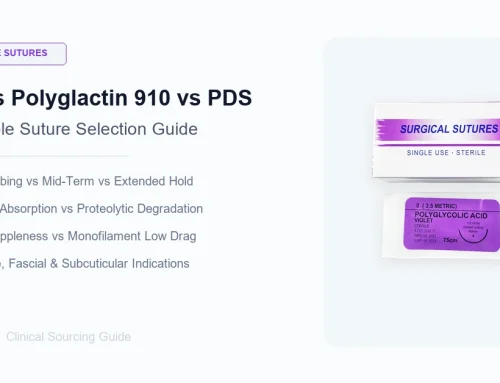
PDO is a monofilament synthetic absorbable suture with the longest absorption timeline of the synthetic group — approximately 180 days. Tensile strength is maintained at 70% at 2 weeks and 25% at 6 weeks, making it the preferred choice when extended wound support is critical. Used in fascial closure, pediatric cardiovascular surgery, and tendon repair. The monofilament structure provides smooth tissue passage and low bacterial adhesion. Commonly known as PDS (Ethicon). For an in-depth analysis of polydioxanone molecular features and handling, explore our dedicated guide to absorbable polydioxanone sutures.
→ View Polydioxanone Suture (E20009) specifications
4. Poliglecaprone 25 Suture (Monocryl Equivalent)
Poliglecaprone 25 is a monofilament absorbable suture made from glycolide and epsilon-caprolactone copolymer. Absorption occurs over 90–120 days, but tensile strength is lost faster than PDO — approximately 50–60% at 1 week and 20–30% at 2 weeks. This rapid early strength loss makes it ideal for subcuticular skin closure where only short-term support is needed and smooth tissue passage is the priority. Commonly known as Monocryl (Ethicon). Available in violet and undyed.
→ View Poliglecaprone 25 Suture (E20010) specifications
5. Chromic Catgut Suture
Chromic catgut is a twisted natural absorbable suture made from purified collagen treated with chromium salts to slow enzymatic absorption to 90–120 days. Unlike synthetic absorbables, its absorption rate varies with patient physiology. Widely used in OB/GYN, oral surgery, and general soft tissue ligation in markets where catgut is the established standard of care. Available in green and tan.
→ View Chromic Catgut Suture (E20005) specifications
6. Plain Catgut Suture
Plain catgut is untreated purified collagen with faster enzymatic absorption at 70–90 days. Softer and more pliable than chromic catgut, preferred for oral surgery and superficial mucosa closure where rapid absorption and minimal patient discomfort are the priority.
→ View Plain Catgut Suture (E20006) specifications
Absorbable Suture Comparison Table
| Suture | Structure | Absorption | Strength at 2 Weeks | Esterilização | Best For |
|---|---|---|---|---|---|
| PGA (E20007) | Braided | 60–90 days | ~65% | Ethylene Oxide | General, GI, OB/GYN |
| Polyglactin 910 (E20008) | Braided | 56–70 days | ~75% | Ethylene Oxide | General, ophthalmic, OB/GYN |
| PDO (E20009) | Monofilament | ~180 days | ~70% | Ethylene Oxide | Fascial, pediatric, tendon |
| Poliglecaprone 25 (E20010) | Monofilament | 90–120 days | ~50–60% | Ethylene Oxide | Subcuticular, cosmetic |
| Chromic Catgut (E20005) | Twisted | 90–120 days | ~40% | Gamma Radiation | OB/GYN, oral |
| Plain Catgut (E20006) | Twisted | 70–90 days | ~20–30% | Gamma Radiation | Oral, mucosa |
Non-Absorbable Sutures — Types & Materials
Non-absorbable sutures are designed to remain in tissue permanently or until removed post-operatively. They maintain tensile strength indefinitely and are used wherever long-term mechanical support is required.
1. Silk Braided Suture
Silk is the most widely used natural non-absorbable suture and has been the reference material in surgery for over a century. Despite being classified as non-absorbable, silk does undergo slow protein degradation over years — it is not truly permanent like synthetic alternatives. Its braided construction provides excellent knot security and soft handling. Available in black and ivory. For clinical nuances, sterilization protocols, and manufacturing details, see our dedicated guide on 20 things you should know about silk sutures.
→ View Silk Braided Suture (E20001) specifications
2. Polyester Braided Suture (Ethibond Equivalent)
Polyester is a truly permanent, non-degrading synthetic braided suture with the highest tensile strength of all braided non-absorbables. Unlike silk, polyester does not degrade in tissue — it retains mechanical integrity indefinitely. The preferred choice for cardiovascular surgery (valve repair, annuloplasty), hernia repair, and orthopedic applications requiring permanent high-tension fixation. Available in green and blue.
→ View Polyester Braided Suture (E20002) specifications
3. Nylon Monofilament Suture (Ethilon Equivalent)
Nylon is a synthetic monofilament non-absorbable suture with low tissue drag and minimal bacterial wicking — the gold standard for skin closure and plastic surgery. While classified as non-absorbable, nylon undergoes slow hydrolysis losing approximately 15–20% tensile strength per year. Available in black and blue.
→ View Nylon Monofilament Suture (E20003) specifications
4. Polypropylene Suture (Prolene Equivalent)
Polypropylene is a completely biologically inert synthetic monofilament suture — the only truly permanent, non-degrading monofilament. It has the lowest tissue drag of any suture material and excellent elasticity that accommodates post-operative tissue swelling without cutting through vessel walls. The material of choice for vascular anastomosis, cardiovascular surgery, and hernia mesh fixation. Available in blue, USP 6/0–3.
→ View Polypropylene Suture (E20004) specifications
Non-Absorbable Suture Comparison Table
| Suture | Structure | Truly Permanent | Tissue Drag | Knot Security | Best For |
|---|---|---|---|---|---|
| Silk (E20001) | Braided | Partial (slow degradation) | Moderado | Excelente | General, cardiovascular, oral |
| Polyester (E20002) | Braided | Sim | Moderado | Excelente | Cardiovascular, hernia, orthopedic |
| Nylon (E20003) | Monofilament | Near-permanent | Baixa | Good | Skin, plastic, ophthalmic |
| Polypropylene (E20004) | Monofilament | Yes — fully inert | Lowest | Moderado | Cardiovascular, hernia, plastic |
How to Choose: Absorbable or Non-Absorbable?
The choice between absorbable and non-absorbable sutures depends on three primary factors:
1. Tissue Type and Healing Rate
Fast-healing tissues such as oral mucosa and superficial skin can use fast-absorbing sutures (plain catgut, poliglecaprone 25). Slow-healing tissues such as fascia and tendon require extended support — either a long-absorbing synthetic (PDO) or a non-absorbable suture. Cardiovascular tissue and hernia repairs require permanent support — non-absorbable only.
2. Need for Suture Removal
Where suture removal is difficult or impractical — pediatric patients, oral cavity, deep internal layers — absorbable sutures eliminate a follow-up procedure. Where sutures are placed on accessible skin and removal is routine, either type may be used depending on clinical preference.
3. Infection Risk
Monofilament sutures (nylon, polypropylene, PDO, poliglecaprone 25) have lower infection risk than braided sutures because their smooth surface does not provide channels for bacterial wicking. In contaminated or infected wounds, monofilament is generally preferred over braided regardless of absorbability.
Quick Selection Reference
| Clinical Scenario | Recommended Suture |
|---|---|
| Skin closure (planned removal) | Nylon (E20003) or Polypropylene (E20004) |
| Subcuticular skin closure (no removal) | Poliglecaprone 25 (E20010) |
| General soft tissue / GI closure | PGA (E20007) or Polyglactin 910 (E20008) |
| Fascial / abdominal wall closure | PDO (E20009) or Polyester (E20002) |
| Cardiovascular / vascular anastomosis | Polypropylene (E20004) or Polyester (E20002) |
| OB/GYN, episiotomy repair | Chromic Catgut (E20005) or Polyglactin 910 (E20008) |
| Oral surgery | Plain Catgut (E20006) or Chromic Catgut (E20005) |
| Pediatric surgery (no removal) | PDO (E20009) or Poliglecaprone 25 (E20010) |
| Hernia mesh fixation | Polypropylene (E20004) or Polyester (E20002) |
| Ophthalmic surgery | Nylon (E20003) or Polyglactin 910 (E20008) |
Branded Sutures vs Generic Equivalents: What Buyers Need to Know
Many buyers are familiar with branded suture names — Vicryl, PDS, Monocryl, Prolene, Ethibond, Ethilon — manufactured primarily by Ethicon (Johnson & Johnson). Generic equivalents manufactured in China offer the same polymer chemistry and performance specifications at significantly lower bulk pricing, with CE and ISO 13485 certification for international regulatory compliance.
| Brand Name | Generic Material | Even Medical Item No |
|---|---|---|
| Vicryl (Ethicon) | Polyglactin 910 | E20008 |
| PDS II (Ethicon) | Polydioxanone (PDO) | E20009 |
| Monocryl (Ethicon) | Poliglecaprone 25 | E20010 |
| Prolene (Ethicon) | Polipropileno | E20004 |
| Ethibond (Ethicon) | Polyester Braided | E20002 |
| Ethilon (Ethicon) | Nylon Monofilament | E20003 |
| Dexon (Covidien) | Ácido poliglicólico (PGA) | E20007 |
Procurement Considerations for Medical Distributors
For actionable purchasing checklists, minimum order quantities (MOQ), and packaging configurations, see our practical guide on how to buy surgical sutures in bulk.
Sterilization Documentation
Confirm whether the suture requires gamma radiation or ethylene oxide (EO) sterilization. Synthetic absorbable sutures (PGA, Polyglactin, PDO, Poliglecaprone) require EO sterilization to avoid thermal degradation. Natural and non-absorbable sutures typically use gamma radiation. Require batch sterility certificates for each shipment.
Regulatory Compliance
For EU import: confirm CE marking under EU MDR. For Middle East and Gulf markets: confirm ISO 13485 certification and country-specific registration requirements. For US market: FDA registration. Even Medical supplies CE and ISO 13485 certified sutures across all 10 materials with documentation available for regulatory submissions.
USP Size Range
Confirm the full USP size range available from your supplier. Even Medical supplies all suture types in USP 6/0 through 2 (polypropylene up to 3), covering the full clinical range from fine ophthalmic to heavy general closure sutures.
OEM and Private Label
For distributors building their own brand, confirm OEM capabilities including custom box design, needle specification, thread length, and multi-language labeling. Even Medical supports full OEM programs for all suture types.
Frequently Asked Questions
Can absorbable sutures be used for skin closure?
Yes, in specific scenarios. Subcuticular running sutures using poliglecaprone 25 or polyglactin 910 are common in plastic surgery to eliminate suture marks from transcutaneous stitches. For accessible skin where suture removal is routine, non-absorbable nylon or polypropylene is more commonly used.
How long does it take for absorbable sutures to dissolve?
It depends on the material. Plain catgut absorbs in 70–90 days; PGA and polyglactin 910 in 56–90 days; poliglecaprone 25 in 90–120 days; chromic catgut in 90–120 days; and polydioxanone (PDO) in approximately 180 days. Note that tensile strength is lost much earlier than complete absorption — PDO loses 75% of its strength by 6 weeks even though full absorption takes 6 months.
Which suture is strongest?
Among non-absorbables, polyester braided (E20002) has the highest absolute tensile strength. Among absorbables, PDO (E20009) retains strength the longest. Polypropylene (E20004) has the highest strength-to-diameter ratio of any monofilament non-absorbable.
What is the difference between braided and monofilament sutures?
Braided sutures consist of multiple filaments twisted or woven together — providing better knot security and handling but higher bacterial adhesion risk. Monofilament sutures are a single strand — providing smoother tissue passage, lower infection risk, and better performance in contaminated wounds, but requiring more careful knot technique.
Are Chinese-made sutures as good as branded ones?
CE-certified and ISO 13485-certified sutures from Chinese suppliers use the same polymer chemistry as branded equivalents and are subject to the same international quality standards. The certification process validates sterilization, sterility, tensile strength, and absorption performance. Even Medical sutures carry CE marking and ISO 13485 certification with full batch documentation available for import submissions.
View All Surgical Sutures from Even Medical
Even Medical supplies all 10 suture types — absorbable and non-absorbable — with CE and ISO 13485 certification, USP 6/0–2 full range, and OEM options:
- PGA Suture (E20007) — Dexon equivalent
- Polyglactin 910 Suture (E20008) — Vicryl equivalent
- Polydioxanone Suture (E20009) — PDS equivalent
- Poliglecaprone 25 Suture (E20010) — Monocryl equivalent
- Chromic Catgut Suture (E20005)
- Plain Catgut Suture (E20006)
- Silk Braided Suture (E20001)
- Polyester Braided Suture (E20002) — Ethibond equivalent
- Nylon Monofilament Suture (E20003) — Ethilon equivalent
- Polypropylene Suture (E20004) — Prolene equivalent