



Phlebotomy and venous blood sampling are among the most frequently performed invasive medical procedures worldwide. Every blood draw carries clinical and operational considerations: maintaining specimen integrity to prevent pre-analytical diagnostic errors, and safeguarding healthcare personnel against accidental needlestick injuries (NSIs) and bloodborne pathogen transmission. Under modern occupational safety regulations—including OSHA in the United States and the European Sharps Directive (2010/32/EU)—conventional non-safety needles have been phased out in favor of safety-engineered devices.
For laboratory directors, nursing supervisors, and healthcare procurement committees, selecting between pen-type multi-sample safety needles 그리고 winged safety blood collection sets (butterfly needles) requires evaluating vein caliber, clinical patient demographics, hemolysis rates, and unit acquisition cost. In this clinical guide, we analyze needle mechanics, examine pre-analytical hemolysis dynamics, review OSHA safety locking mechanisms, and provide a procurement decision framework (blood collection tubes color coding guide).
목차
- 1. Mechanical Architectures: Pen-Type vs. Winged Butterfly Sets
- 2. Vein Accessibility & Clinical Patient Demographics
- 3. Hemolysis Risk & Fluid Shear Stress Dynamics
- 4. OSHA-Compliant Safety Shielding & Single-Handed Activation
- 5. Technical & Clinical Comparison Matrix
- 6. Hospital Procurement Economics & Phlebotomy Kit Consolidation
- 7. Frequently Asked Questions (FAQ)
1. Mechanical Architectures: Pen-Type vs. Winged Butterfly Sets
The functional divergence between pen-type and butterfly devices stems from their physical design:
- Pen-Type Multi-Sample Needles: Feature a rigid, straight cannula with needles at both ends. The anterior beveled needle enters the patient's vein, while the posterior needle penetrates the vacuum tube stopper within a plastic tube holder. A flexible rubber sleeve covers the posterior needle, automatically re-sealing between tubes to allow seamless multi-tube draws without blood leakage.
- Winged Blood Collection Sets (Butterfly Needles): Feature a short needle attached to flexible plastic wings and connected to 15 to 30 cm of clear, flexible tubing. The tubing absorbs patient hand movement, preventing needle displacement during tube changes.
2. Vein Accessibility & Clinical Patient Demographics
Clinical indication dictates device choice:
- Pen-Type Needles (Routine Adult Venipuncture): Best suited for prominent, resilient veins in the antecubital fossa (median cubital, cephalic, basilic veins). The rigid design provides direct tactile feedback, allowing rapid blood flow into vacuum tubes.
- Butterfly Needles (Difficult Access & Fragile Veins): Indispensable for geriatric patients with fragile veins, oncology patients undergoing chemotherapy, pediatric patients, and small veins on the dorsal hand or wrist. The shallow insertion angle (10° to 15°) prevents vein wall transfixion. In addition, the clear tubing provides immediate visual blood flashback confirmation.
3. Hemolysis Risk & Fluid Shear Stress Dynamics
Pre-analytical specimen rejection is frequently caused by in vitro hemolysis (rupture of erythrocytes releasing intracellular potassium and hemoglobin). Red blood cells rupture when subjected to high fluid shear stress through narrow bores:
- Gauge Selection: Using a 21G or 22G needle minimizes shear stress. Overly narrow needles (25G) cause mechanical RBC rupture during high-vacuum tube filling.
- Tubing Length Impact: In butterfly needles, blood traveling through 30 cm of tubing experiences friction drag. For sensitive coagulation tests (PT/INR), clinicians must discard the initial tube if tubing air volume displaces the proper 9:1 blood-to-citrate ratio.
4. OSHA-Compliant Safety Shielding & Single-Handed Activation
Preventing needlestick injuries requires intuitive, single-handed safety mechanisms:
- Hinged Flip-Shield Mechanisms: A protective plastic sheath hinges over the needle immediately upon withdrawal from the vein, locking with an audible click using the thumb or a hard surface.
- In-Vein Push-Button Retraction: Advanced butterfly sets feature a push-button that retracts the needle directly out of the vein into the protective housing, eliminating exposure during withdrawal.
5. Technical & Clinical Comparison Matrix
| 기능 | Pen-Type Safety Needle | Winged Safety Butterfly Set |
|---|---|---|
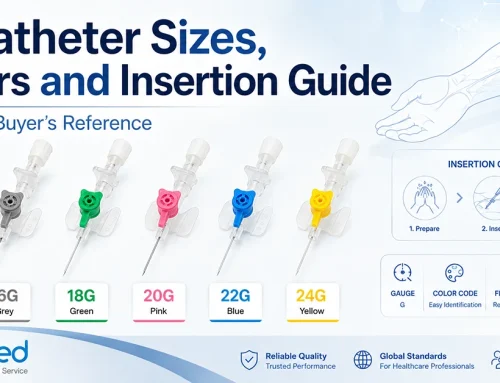
| Standard Needle Gauges | 20G (Yellow), 21G (Green), 22G (Black) | 21G (Green), 23G (Light Blue), 25G (Royal Blue) |
| Flashback Chamber | Typically absent (Standard models) | Instant visual flashback confirmation |
| Insertion Angle | 15° – 30° (Standard antecubital) | 10° – 15° (Shallow dorsal hand) |
| Patient Movement Tolerance | Low (Rigid connection transfers tremors) | High (Flexible tubing absorbs movement) |
| Unit Cost Ratio | 1x (Baseline economic efficiency) | 3.0x – 4.5x (Premium assembly cost) |
6. Hospital Procurement Economics & Phlebotomy Kit Consolidation
Because butterfly needles cost 3 to 4.5 times more than standard pen-type needles, hospital procurement guidelines typically restrict butterfly sets to dedicated clinical pathways (pediatrics, oncology, ICU, and documented difficult venipuncture). Consolidating blood collection needles alongside vacuum tubes, holder adapters, and 70% alcohol swabs streamlines hospital supply chain operations.
7. Frequently Asked Questions (FAQ)
Q1: Why does using a 25G butterfly needle increase hemolysis risk?
A 25G needle has a very narrow internal lumen. When paired with high-vacuum collection tubes (e.g., 6 ml to 10 ml draw volumes), the high negative pressure forces blood through the micro-orifice at extreme velocities, producing fluid shear stress that lyses red blood cells. When using 23G or 25G needles, small-volume pediatric vacuum tubes (2 ml to 3 ml) should be utilized.
Q2: What is the purpose of the discard tube when using a butterfly needle?
The flexible tubing of a butterfly needle contains approximately 0.5 ml of air. When drawing into a light-blue citrate coagulation tube first, this air is pulled into the tube, displacing volume and altering the precise 9:1 blood-to-anticoagulant ratio required for valid PT/INR assays. Drawing a non-additive or red discard tube first purges the line of air.
Source Safety Blood Collection Needles in Wholesale Volume
Shevenmed supplies clinical laboratory networks and healthcare distributors with CE-certified pen-type safety needles and winged blood collection sets. Benefit from competitive container freight and full phlebotomy kit consolidation.