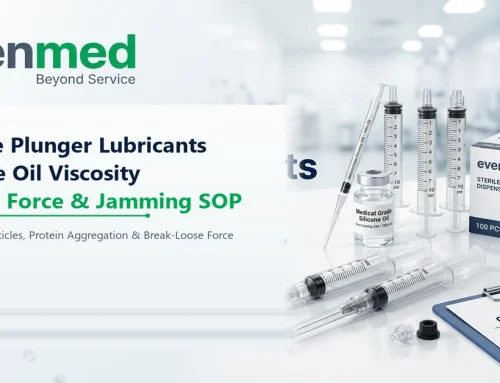




Across worldwide healthcare delivery systems, specialized oncology infusion centers, pediatric immunization campaigns, and high-volume surgical operating theaters, single-use disposable hypodermic syringes constitute the ultimate high-frequency clinical consumable. Annually consumed in billions of units globally, a syringe is deceptively simple in appearance yet demanding in engineering precision. In commercial hospital tenders and high-volume distributor importing, purchasing generic or substandard syringes triggers immediate clinical disruptions: severe plunger "stick-slip" hesitation that jerks intravenous lines during critical drug titration, silicone oil droplet contamination that precipitates high-value monoclonal antibodies, unacceptable dead space volume that wastes up to 15% of expensive vaccines, and barrel ink dissolution under antiseptic wipe down. Sourcing sterile medical 주사기 at master container scale requires an analytical procurement framework grounded in ISO 7886-1 (Sterile hypodermic syringes for single use), ISO 80369-7 (Luer connectors), tribological lubrication dynamics, and rigorous warehouse arrival lot-inspection standards.
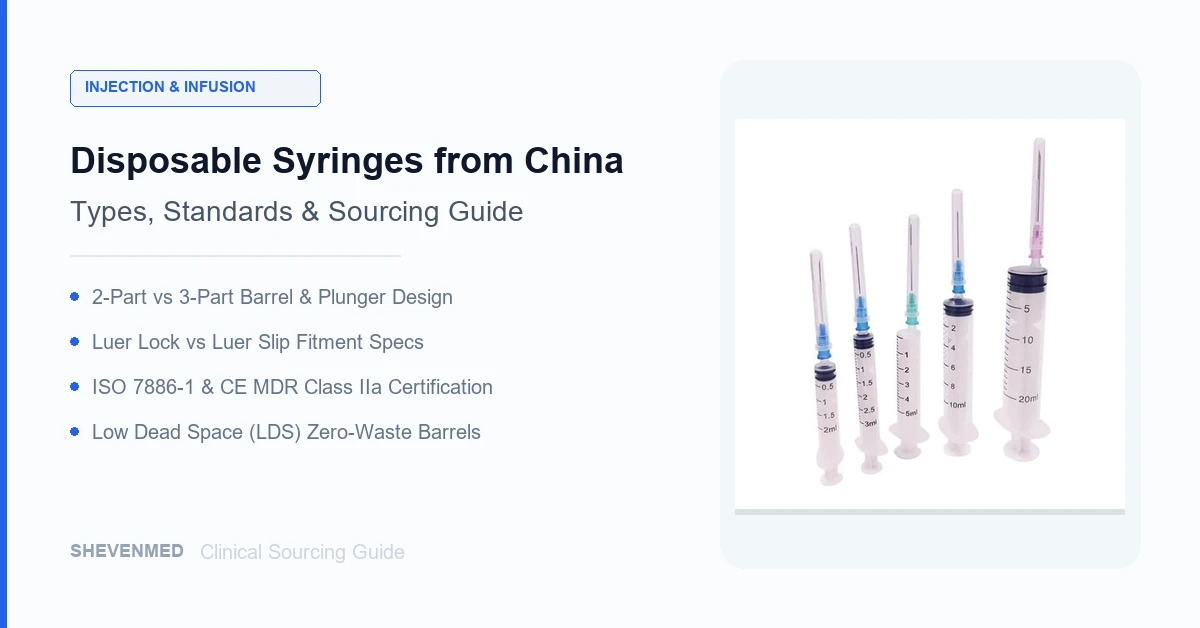
1. Structural Architecture: 2-Part vs. 3-Part Syringe Mechanics
The foundational engineering classification in medical syringe manufacturing divides products into two distinct structural architectures: Two-Piece (2-Part) 그리고 Three-Piece (3-Part) syringes. Understanding their mechanical differences is essential for clinical procurement committees matching products to clinical specialties:
| Mechanical & Chemical Attribute | 2-Part Syringes (Two-Piece Architecture) | 3-Part Syringes (Three-Piece Architecture) | Clinical & Supply Chain Procurement Impact |
|---|---|---|---|
| Plunger / Piston Composition | One-piece injection-molded High-Density Polyethylene (HDPE) plunger with an expanded interference collar | Molded Polypropylene (PP) plunger rod fitted with an elastomeric synthetic rubber or polyisoprene gasket | 2-Part eliminates elastomeric extractables; 3-Part provides maximum air-tight vacuum seal |
| Plunger Lubricant (Silicone Oil) | 100% Silicone-Free: utilizes natural lubricity between medical-grade PP barrel and HDPE plunger | Requires medical-grade Polydimethylsiloxane (PDMS) silicone oil spray (≤ 0.25 mg/barrel) | 2-Part prevents silicone droplet interaction with sensitive biologicals, IVF fluids, and ophthalmic drugs |
| Latex & Chemical Allergen Risk | Zero rubber, zero latex, zero vulcanizing agents or phthalate plasticizers | Synthetic polyisoprene or halogenated butyl rubber (modern formulations are 100% latex-free) | Both meet latex-free mandates, but 2-Part guarantees zero polymer leaching into lipophilic drugs |
| Plunger Gliding Smoothness | Firm initial breakaway; slightly stiffer mechanical feel during rapid injection | Silky, effortless glide with minimal breakaway force (Fbreak ≤ 5 N) | 3-Part is heavily preferred by anesthesiologists and ICU nurses for delicate manual syringe-driver titrations |
| Pressure & Vacuum Seal Integrity | Adequate for standard gravity and manual intramuscular (IM) injections | Superior hydraulic seal under high positive pressure (300 kPa) and vacuum (88 kPa) | 3-Part is mandatory for automated infusion syringe pumps and power contrast injectors |
| Manufacturing Cost & Price Point | Lower production cost: 2 components, no rubber molding, automated high-speed single assembly | Standard global benchmark; approximately 10% to 18% higher unit manufacturing cost | 2-Part offers unmatched tender economics for massive public health and mass-vaccination programs |
💡 Clinical Procurement Guideline: 2-Part vs. 3-Part
Mandate 2-Part syringes when procuring for reproductive medicine (IVF), ophthalmic intravitreal injections, blood gas analysis, and monoclonal antibody delivery where silicone oil droplets or rubber extractables risk drug neutralization or aseptic endophthalmitis. For general inpatient nursing, syringe-pump driven continuous infusions, and blood aspiration, mandate certified 3-Part syringes.
2. Tribology: Silicone Oil Ultrasonic Titration & Plunger Glide Force Dynamics
In 3-part syringes, the interface between the elastomeric rubber piston and the polypropylene barrel wall requires chemical lubrication. An improperly lubricated syringe causes "stick-slip" phenomenon—the plunger sticks, the nurse applies higher thumb pressure, and the plunger suddenly jumps forward, risking accidental drug bolus overdosing:
- Ultrasonic Micro-Atomization Coating: Top-tier manufacturers apply medical-grade Polydimethylsiloxane (PDMS, viscosity 1,000 to 12,500 cSt) via high-frequency ultrasonic atomizing nozzles. This creates a uniform molecular monolayer rather than uneven liquid droplets.
- Silicone Titration Ceiling (≤ 0.25 mg/barrel): Excessive silicone oil migrates into the pharmaceutical solution, appearing as sub-visible particles (USP <788> violation) and clouding clear biologics. B2B tender specifications must mandate gravimetric or infrared extraction verification confirming silicone limits below 0.25 mg per barrel.
- ISO 7886-1 Plunger Glide Force Mechanics: When tested on an automated tensile/compression tester at 100 mm/min crosshead speed:
- Breakaway Force ($F_{break}$): Initial force required to overcome static friction must not exceed 10.0 N (ideal ≤ 5.0 N).
- Sustained Gliding Force ($F_{glide}$): Dynamic continuous resistance throughout the graduated stroke must remain smooth and below 5.0 N without jerky oscillations.
3. Dead Space Volume Economics: Standard vs. Low Dead Space (LDS) Syringes
Dead space represents the residual fluid volume trapped within the syringe tip nozzle and needle hub after the plunger is fully depressed. In high-cost oncology chemotherapy, pediatric biologics, and pandemic vaccine rollouts, dead space volume directly governs hospital pharmacoeconomics:
$$\text{Total Financial Loss} = N_{\text{doses}} \times V_{\text{dead}} \times C_{\text{drug}}$$
| Syringe Tip Architecture | Trapped Dead Space Volume (ISO 7886-1 Limit) | Clinical & Supply Chain Significance |
|---|---|---|
| Standard Luer Lock Syringe | 0.070 mL – 0.100 mL (70 – 100 μL) | Acceptable for routine saline flushes and cheap broad-spectrum antibiotics |
| Standard Luer Slip Syringe | 0.050 mL – 0.075 mL (50 – 75 μL) | Standard medical ward medication administration |
| Low Dead Space (LDS) Syringe with Plunger Piston Extension | ≤ 0.020 mL (< 20 μL) | The extended rubber piston tip penetrates into the luer cone, evacuating nearly all residual liquid; yields an extra 6th dose from standard 5-dose vaccine vials |
| Fixed-Needle Integrated Syringe (Insulin / Tuberculin) | ≤ 0.005 mL (< 5 μL) | Zero hub interface; maximum extraction efficiency for micro-dosing and insulin management |
4. Clinical Buyer's Arrival Quality Inspection SOP & Rejection Triggers
To prevent distributing defective syringe cartons to hospital wards, receiving quality engineers should enforce the following 5-Stage ISO 7886-1 Lot Acceptance Protocol on incoming shipments (AQL 1.0 General Inspection Level II):
| Inspection Dimension | Rigorous Laboratory Test Method | Acceptance Tolerance Threshold | Critical Defect Rejection Trigger |
|---|---|---|---|
| Piston Liquid Seal Under Hydraulic Pressure | Draw water to nominal capacity, occlude nozzle, apply axial mechanical pressure generating 300 kPa (43.5 psi) for 30 seconds (ISO 7886-1 Annex B). | Zero leakage of water past the piston seal rings or through the barrel wall. | Any visible droplet formation passing the primary or secondary rubber seal rings. |
| Piston Air Seal Under Negative Pressure (Vacuum) | Aspirate water to 25% volume, occlude nozzle, pull plunger to maximum line, generate 88 kPa vacuum for 15 seconds (ISO 7886-1 Annex C). | Zero air bubble leakage passing the piston into the evacuated chamber. | Plunger collapse, air ingestion, or catastrophic loss of internal vacuum. |
| Luer Connector Conical Taper (ISO 80369-7) | Measure 6% luer taper angle and dimensions using calibrated Go/No-Go plug and ring gauges; verify luer lock collar thread pitch. | Strict compliance with ISO 80369-7 dimensions; torque engagement between 0.12 N·m and 0.18 N·m. | Loose fitting allowing needle hub slippage, or overtight jamming preventing needle disengagement. |
| Graduation Scale Print Indelibility | Vigorously rub barrel graduation markings with cotton gauze saturated in 95% medical ethanol for 15 cycles under 5 N downward force. | Zero graduation ink smearing, blurring, or line dissolution; contrast remains 100% crisp. | Any flaking or rub-off of graduation numbers, presenting severe medication dosing hazard. |
| Residual EO Sterilization Limits (ISO 10993-7) | Gas chromatography headspace analysis of aerated syringe lots. | Ethylene Oxide (EO) ≤ 4.0 mg/day; Ethylene Chlorohydrin (ECH) ≤ 9.0 mg/day. | EO residual exceeding regulatory toxicological thresholds. |
5. 40HQ Ocean Logistics & Volumetric Container Economics
Because medical syringes contain hollow plastic barrels, master shipping cartons possess low bulk density (high cubic volume relative to weight). Sourcing profitability relies on volumetric optimization and palletized ocean transit protection:
| Syringe Size & Specification | Individual Unit Packaging | Inner Box Count | Master Carton Quantity | 40HQ Container Total Capacity (68 CBM) |
|---|---|---|---|---|
| 1 mL / Insulin Syringes | Ribbon blister or polybag | 100 pcs / box | 3,200 pcs / carton (0.072 CBM) | approx. 2,800,000 units |
| 2 mL / 3 mL Syringes | Peelable blister pack | 100 pcs / box | 2,400 pcs / carton (0.076 CBM) | approx. 2,000,000 units |
| 5 mL Syringes | Peelable blister pack | 100 pcs / box | 1,600 pcs / carton (0.078 CBM) | approx. 1,350,000 units |
| 10 mL Syringes | Peelable blister pack | 100 pcs / box | 1,000 pcs / carton (0.081 CBM) | approx. 800,000 units |
| 20 mL Syringes | Peelable blister pack | 50 pcs / box | 600 pcs / carton (0.082 CBM) | approx. 480,000 units |
| 50 mL / 60 mL Syringes | Peelable blister pack | 25 pcs / box | 300 pcs / carton (0.084 CBM) | approx. 240,000 units |
6. Standard Technical RFQ Checklist for Syringe Importers
When drafting Requests for Quotation (RFQs) for international syringe tenders or hospital supply contracts, distributors should mandate these exact technical declarations:
- Architectural Specification: Explicitly state 2-Part (HDPE/PP, silicone-free) or 3-Part (PP/rubber gasket/silicone coated).
- Tip Connection Type: Luer Lock (ISO 80369-7 threaded) or Luer Slip (central vs. eccentric tip for ≥ 20 mL).
- Needle Configuration: Mounted needle, side-packed unmounted needle, or without needle (bare syringe).
- Plunger Color & Customization: Standard white, highly visible amber/black for light-sensitive chemotherapy, or custom OEM corporate plunger colors.
- Quality Certification: ISO 13485:2016, CE Certificate under EU MDR 2017/745 (Class IIa), US FDA 510(k), and national Certificate of Free Sale (CFS).
7. Frequently Asked Questions (FAQ)
Why do large-volume syringes (20mL, 50mL) feature an eccentric luer nozzle?
Eccentric (off-center) tips align the fluid outlet flush with the bottom edge of the barrel. This permits low-angle surface aspiration from medical vials and facilitates closer skin alignment during vascular drainage or thoracentesis, minimizing dead space and operator wrist strain.
What is an Auto-Disable (AD) immunization syringe?
Auto-Disable syringes (ISO 7886-3) incorporate an internal plastic locking ring or frangible plunger notch. After a single full depression, any attempt to withdraw the plunger backwards fractures the plunger rod or locks the piston permanently inside the barrel, preventing syringe reuse and cross-contamination in mass immunization programs.
How does sterilization method affect syringe clarity?
Standard polypropylene barrels undergo Ethylene Oxide (EO) sterilization, maintaining high optical transparency. When Gamma radiation sterilization is requested, standard PP yellows and embrittles; manufacturers must utilize specialized radiation-stabilized clarifying polypropylene resins.
Direct Factory Disposable Syringes & Injection Consumables Wholesale
Shevenmed manufactures certified single-use hypodermic syringes (2-Part, 3-Part, LDS, Auto-Disable), sterile IV cannulas, and safety blood collection systems in state-of-the-art cleanroom facilities.
Request Free Syringe Evaluation Samples & Master Tender Price Schedules