



Dental irreversible hydrocolloid (alginate) remains the global benchmark for preliminary impressions, diagnostic study casts, and orthodontic aligner manufacturing due to its cost-efficiency, rapid setting kinetics, and patient tolerance. However, dental laboratories and clinic purchasing departments frequently face unexplained material deterioration—characterized by shortened working times, lumpy consistency, reduced tear strength, and chalky stone model surfaces. This comprehensive engineering guide examines the hygroscopic chemistry of sodium alginate degradation, evaluates multi-layer barrier packaging against ambient humidity, establishes clinical storage protocols, and models bulk procurement inventory turnover economics under ISO 21563 standards.
1. The Chemistry of Alginate Degradation: Atmospheric Moisture & Sol-to-Gel Premature Crosslinking
Dental alginate powder is an intricate formulation consisting of soluble potassium or sodium alginate (12–15%), calcium sulfate dihydrate as the reactor (8–12%), trisodium phosphate as the retarder (1–2%), and diatomaceous earth filler (70–75%). When stored in ideal dry environments, the retarder maintains an alkaline pH buffer that prevents calcium ions from cross-linking the sodium alginate polymer chains prematurely.
When atmospheric water vapor penetrates defective packaging:
- Retarder Consumption: Trisodium phosphate dissolves in micro-droplets of ambient moisture, triggering early precipitation of calcium phosphate inside the unmixed powder.
- Polymer Chain Hydrolysis: Moisture initiates partial depolymerization of anhydro-β-D-mannuronic acid (M) and α-L-guluronic acid (G) blocks, slashing the ultimate tensile and tear strength by up to 45%.
- Inhomogeneous Gelling: Micro-clumping of diatomaceous earth filler leads to gritty pastes that fail to capture 50 µm fine margins on prepared abutments.
2. Barrier Packaging Engineering: Aluminum Foil vs Metalized PET vs Polyethylene Bags
The shelf life of alginate is overwhelmingly governed by the Water Vapor Transmission Rate (WVTR) of its primary packaging. Below is an engineering comparison of standard commercial packaging formats:
| Packaging Substrate Structure | WVTR (g/m²/24h @ 38°C, 90% RH) | Oxygen Transmission Rate (cc/m²/24h) | Effective Shelf Life in Tropical / Coastal Climates | Puncture Resistance (N) |
|---|---|---|---|---|
| Multi-Layer Foil (PET / Al Foil 9µm / LLDPE) | < 0.05 (True Hermetic Barrier) | < 0.1 | 36 to 48 Months | > 65 N |
| Metalized Polyester (VMPET / PE) | 0.8 – 1.5 (Prone to Flex Cracks) | 1.5 – 3.0 | 12 to 18 Months | 42 N |
| Standard Polyethylene (LDPE / HDPE Blend) | 4.5 – 8.0 (Porous to Water Vapor) | > 250 | 3 to 6 Months (Rapid Failure) | 28 N |
| Rigid HDPE Canister with Gasketed Seal | 0.15 – 0.35 (Depends on Cap Torque) | 0.5 – 1.2 | 24 to 36 Months | Rigid Wall |
3. Clinic and Laboratory Storage Protocols: Temperature & Humidity Kinetics
Alginate powder behaves according to the Arrhenius reaction rate: for every 10°C elevation in ambient storage temperature above 23°C, the rate of internal retarder depletion doubles. To maintain reproducible setting kinetics (Type 1 Fast Set: 1.5–2.0 min; Type 2 Regular Set: 3.0–4.5 min):
- Controlled Ambient Environment: Maintain central inventory rooms between 15°C and 23°C (59°F–73°F) and relative humidity (RH) below 50%. Never store adjacent to autoclave sterilization suites where ambient steam saturates the air.
- Canister Decanting Best Practices: Once an aluminum pouch is opened, transfer powder into an airtight gasketed canister immediately. Press the lid tightly between dispensations to prevent hygroscopic absorption.
- Shaking / Aeration Protocol: Diatomaceous earth fillers naturally settle during ocean freight consolidation. Gently invert the sealed canister 2–3 times prior to measuring to re-establish standardized bulk density (0.32–0.36 g/cm³).
4. Laboratory Inventory Economics: Minimum Order Quantities (MOQ) vs Ocean Freight Freshness
For international dental distributors and hospital chains, balancing containerload shipping economies with stock freshness is critical. A standard 20-foot GP container accommodates approximately 10,800 kg of dental alginate (21,600 units of 500g pouches packed in 24-unit export cartons).
To minimize dead inventory and avoid clinical expiration disputes, procurement managers must adopt a rolling 90-day FIFO (First-In, First-Out) inventory replenishment model, backed by manufacturer batch certificates verifying initial moisture content below 1.8% by weight (Karl Fischer titration).
5. Frequently Asked Questions (FAQ)
Can expired alginate still be used if the powder looks dry?
No. Even if visible caking has not occurred, microscopic consumption of sodium phosphate retarders leads to uncontrollable flash setting or chalky cast surfaces that compromise prosthetic crown margins.
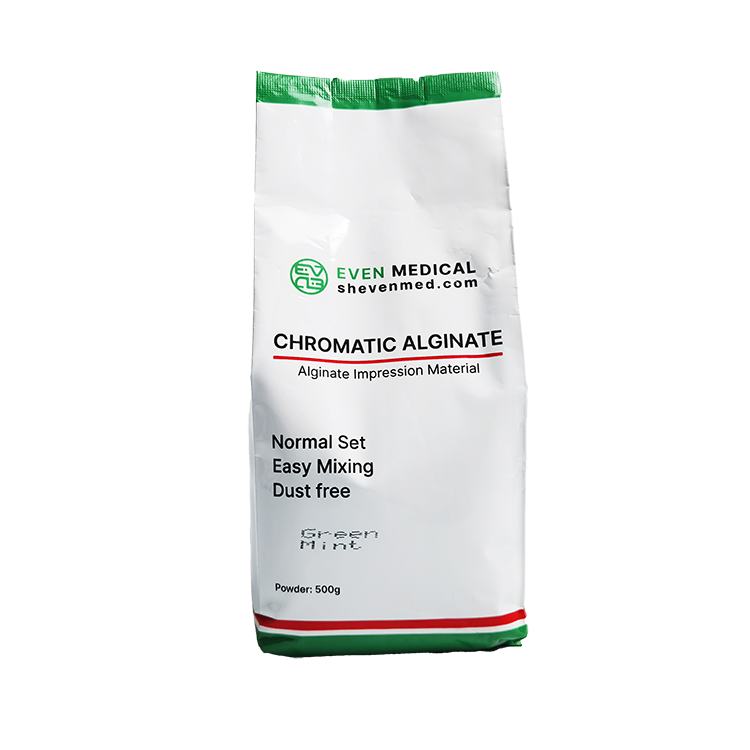
Why does Evenmed supply alginate in 500g vacuum-sealed aluminum foil pouches?
Evenmed uses triple-laminated PET/Al/PE high-barrier foil pouches to guarantee zero moisture ingress during maritime container shipping through equatorial shipping lanes, ensuring guaranteed 36-month shelf life stability.