



Surgical sutures represent one of the highest-volume operating theater consumables globally. For decades, multinational conglomerates have established strong brand recognition around proprietary trade names such as Prolene, Vicryl, Monocryl, and PDS II. However, under the United States Pharmacopeia (USP) and European Pharmacopoeia (EP), surgical sutures are standardized not by commercial trademarks, but by generic chemical polymer composition, tensile strength retention, absorption kinetics, and needle-to-thread attachment integrity.
For international hospital procurement committees, ministry of health tender boards, and medical device distributors, transitioning to high-grade generic equivalent surgical sutures from China delivers significant cost reductions (typically 40% to 60%) without compromising surgical safety or patient outcomes. In this buyer's guide, we detail the generic equivalents of major brand-name sutures, examine the metallurgical and polymer specifications of Chinese manufacturing lines, review CE MDR Class IIb and ISO 13485 regulatory verification, and outline quality assurance benchmarks (surgical suture types complete guide).
Índice
- 1. Brand vs. Generic Chemical Cross-Reference Matrix
- 2. Polymer Chemistry, Tensile Retention & Absorption Kinetics
- 3. Surgical Needle Metallurgy & USP Pull-Off Standards
- 4. Regulatory Auditing: CE MDR Class IIb & ISO 13485
- 5. Sterilization Technologies & Primary Foil Packaging
- 6. Hospital Tender Sourcing & Container Consolidation
- 7. Frequently Asked Questions (FAQ)
1. Brand vs. Generic Chemical Cross-Reference Matrix
Procurement teams must evaluate sutures based on their standardized polymer classifications. The table below maps prominent brand names to their generic clinical equivalents:
| Brand Name (Trademark) | Generic Polymer Composition | Structure & Coating | USP Classification | China Generic Equivalent Product |
|---|---|---|---|---|
| Prolene® | Polypropylene (Isotactic stereoisomer) | Monofilament (Uncoated) | Non-Absorbable | Polypropylene Suture |
| Vicryl® (Polyglactin 910) | 90% Glycolide + 10% L-Lactide | Braided (Coated w/ Polycaprolactone + Ca-Stearate) | Absorbable (Mid-Term) | Polyglactin 910 Suture |
| Monocryl® (Poliglecaprone 25) | 75% Glycolide + 25% ε-Caprolactone | Monofilament (Uncoated) | Absorbable (Short/Mid-Term) | Poliglecaprone 25 Suture |
| PDS® II (Polydioxanone) | Poly (p-dioxanone) | Monofilament (Uncoated) | Absorbable (Extended Long-Term) | Polydioxanone (PDO) Suture |
| Dexon® / Safil® | 100% Polyglycolic Acid (PGA) | Braided (Coated with Polycaprolactone) | Absorbable (Mid-Term) | Polyglycolic Acid (PGA) Suture |
2. Polymer Chemistry, Tensile Retention & Absorption Kinetics
Top-tier Chinese suture manufacturing centers utilize medical-grade synthetic polymers identical in chemical formulation to Western counterparts, complying strictly with USP and ISO 11070/ISO 13485 standards:
- Polypropylene Monofilament (Prolene Equivalent): Formed from high-purity isotactic polypropylene. The extrusion process ensures uniform diameter calibration and zero capillarity. It maintains 100% tensile strength indefinitely in cardiovascular anastomoses, hernia mesh repair, and skin closure.
- Polyglactin 910 Braided (Vicryl Equivalent): A 90/10 copolymer of glycolide and L-lactide. The braided structure is coated with polycaprolactone and calcium stearate, providing smooth knot rundown without premature locking. Retains ~75% tensile strength at 14 days, ~50% at 21 days, and completes absorption via hydrolysis within 56 to 70 days.
- Poliglecaprone 25 Monofilament (Monocryl Equivalent): Monofilament extrusion eliminates wicking in subcuticular cosmetic closures. High initial tensile strength drops to ~50%–60% at 7 days and ~20%–30% at 14 days, with full absorption in 90 to 120 days.
- Polydioxanone Monofilament (PDS II Equivalent): Engineered for slow-healing tissues like abdominal fascial closure and orthopedic tendon repair. Retains ~70% tensile strength at 14 days, ~50% at 28 days, and ~25% at 42 days, with total absorption occurring between 180 and 210 days.
3. Surgical Needle Metallurgy & USP Pull-Off Standards
The clinical efficacy of a suture depends as much on the surgical needle as the thread. Advanced Chinese manufacturing lines employ high-grade stainless steels:
- AISI 300 & 420 Series Stainless Steel: Needle shanks are forged from martensitic AISI 420 or high-yield AISI 302/304 stainless alloys, providing exceptional resistance to bending deflection (ductility) and needle snapping under heavy fascial loads.
- Micro-Honed Needle Geometries: Reverse cutting, taper point, and blunt needles undergo electrochemical polishing and triple-bevel grinding to minimize penetration force. A micro-silicone coating ensures atraumatic passage through multiple tissue layers.
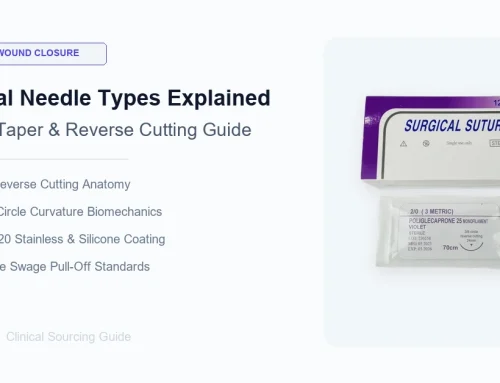
- USP Swage Pull-Off Testing: The attachment point where the suture thread is crimped into the needle shank is rigorously inspected. Production lots are sampled to verify that swage tensile pull-off force exceeds USP standards across all gauges (e.g., > 1.10 N for USP 6-0; > 14.2 N for USP 0).
4. Regulatory Auditing: CE MDR Class IIb & ISO 13485
Surgical sutures are classified as Class IIb medical devices under European Medical Device Regulation (EU MDR 2017/745) and Class II under US FDA regulations. When auditing Chinese manufacturers, international buyers must verify:
- Valid ISO 13485:2016 Certification: Issued by accredited registrars covering suture spinning, braiding, needle assembly, and cleanroom packaging.
- EU MDR CE Certificates: Issued by recognized Notified Bodies (such as TÜV SÜD, BSI, or DNV). Under the EU MDR extension regulations (Regulation 2023/607), verify whether legacy MDD certificates are properly supported by formal MDR applications and written Notified Body agreements.
- Biocompatibility Dossiers: Full compliance with ISO 10993 (cytotoxicity, systemic toxicity, intracutaneous reactivity, sensitization, and implantation testing).
5. Sterilization Technologies & Primary Foil Packaging
Suture packaging must maintain a 5-year sterile barrier while protecting moisture-sensitive absorbable polymers:
- Hermetic Aluminum Foil Blisters: For absorbable sutures (PGA, Polyglactin 910, PDS, Poliglecaprone 25), moisture triggers premature hydrolysis. These filaments are sealed in ultra-high-barrier medical aluminum foil pouches containing desiccants with zero water vapor transmission (WVTR < 0.01 g/m²/24h).
- Sterilization Methods:
- Ethylene Oxide (EO) Gas: Standard for silk, nylon, and absorbable braided sutures, followed by multi-day vacuum desorption to reduce residual EO below 10 ppm.
- Cobalt-60 Gamma Radiation (25 kGy): Applied for polypropylene and nylon monofilament, achieving a Sterility Assurance Level (SAL) of 10-6.
6. Hospital Tender Sourcing & Container Consolidation
Partnering with an experienced medical export consolidation partner like Shevenmed streamlines procurement. Rather than managing separate suppliers for sutures, surgical consumables from China, and wound dressings, buyers benefit from unified containerized shipments. For comprehensive procurement guidance, review our overview on how to buy surgical sutures in bulk.
7. Frequently Asked Questions (FAQ)
Q1: Are generic sutures from China clinically identical to Ethicon or Covidien brand sutures?
Yes, chemically and mechanically. Generic sutures are manufactured from identical synthetic homopolymers and copolymers (such as 90/10 Polyglactin 910 or isotactic polypropylene) meeting the exact same USP and European Pharmacopoeia (EP) specifications for tensile strength, elongation, wire diameter, and absorption profiles.
Q2: What is the shelf life of absorbable generic sutures?
Properly sealed in original, undamaged medical-grade aluminum foil primary packaging and stored under controlled conditions (below 25°C and relative humidity < 60%), absorbable surgical sutures maintain a certified sterile shelf life of 3 to 5 years.
Q3: What are the minimum order quantities (MOQ) for OEM suture packaging?
For standard generic hospital packaging (12 or 24 foils per box), MOQ is typically 500 to 1,000 dozen per specification. For custom OEM private branding with specialized hospital artwork, MOQs generally start at 2,000 to 5,000 dozen across an assorted gauge matrix.
Request Generic Suture Cross-Reference & Pricing
Upgrade your hospital supply chain with CE-marked Prolene, Vicryl, Monocryl, and PDS equivalent sutures from China. Shevenmed provides complete technical cross-reference files, free evaluation samples, and reliable container freight.