

(function(c,l,a,r,i,t,y){ c[a]=c[a]||function(){(c[a].q=c[a].q||[]).push(arguments)}; t=l.createElement(r);t.async=1;t.data-privacy-src="https://www.clarity.ms/tag/"+i; y=l.getElementsByTagName(r)[0];y.parentNode.insertBefore(t,y); })(window, document, "clarity", "script", "gn944t9uep");

Surgical Consumables & Wound Closure

Professional guides and procurement standards for surgical sutures, scalpel blades, handles, and wound closure consumables.

Surgical Scalpel Blade Shapes and Incision Geometry: Clinical Matching for #10, #11, #12 and #15

In operating room precision surgery, tissue incision geometry dictates not only the initial entry dynamics and visibility of the operative field, but directly governs postoperative tensile wound healing, epidermal edge approximation, and cosmetic scar formation. While all surgical blades comply with the fitment standards of ISO 7740, their curved bellies, angled tips, and specialized cutting radii create vastly divergent biomechanical [...]
Por |2026-10-26T13:38:16+08:00November 11, 2026|Categorías: Surgical Consumables & Wound Closure|Comentarios desactivados en Surgical Scalpel Blade Shapes and Incision Geometry: Clinical Matching for #10, #11, #12 and #15

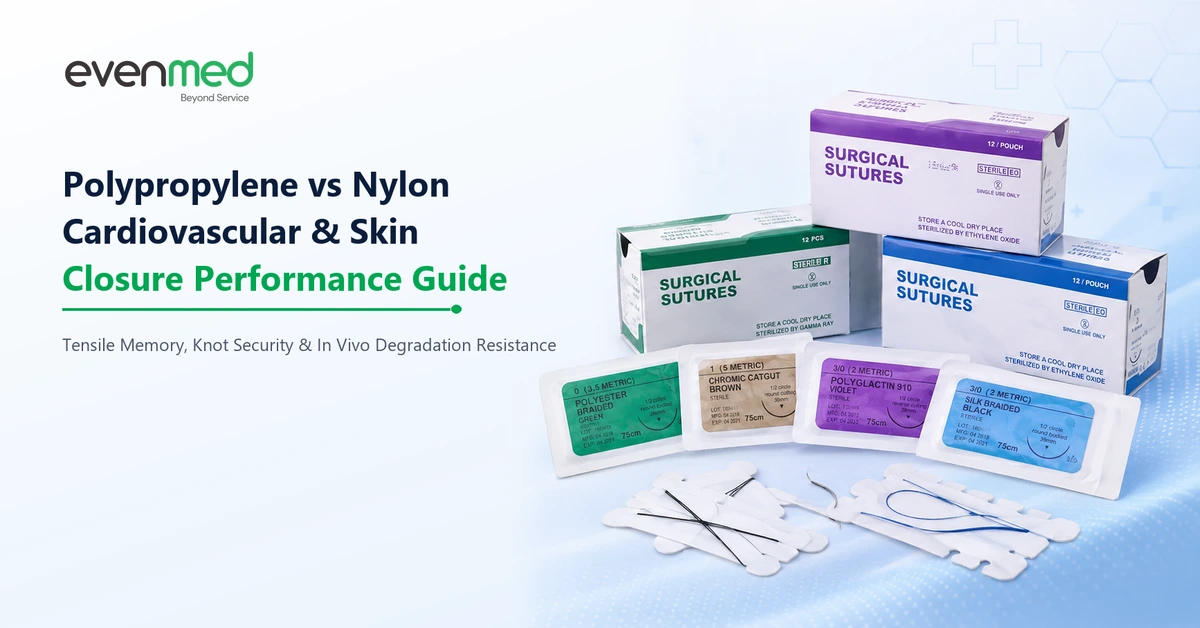
Polypropylene vs Nylon Sutures in Cardiovascular and Cuticular Closure: Tensile Memory, Knot Security & In Vivo Stability

In soft tissue surgery, selecting the ideal non-absorbable monofilament suture is a fundamental balance between handling ergonomics and permanent mechanical stability. While both Polypropylene (e.g., Prolene equivalent) and Nylon / Polyamide (e.g., Ethilon equivalent) provide smooth monofilament tissue glide and low biological reactivity, their molecular structure, knot security, tensile retention in vivo, and handling memory diverge substantially. For operating theatre [...]

Por |2026-10-26T13:42:03+08:00November 9, 2026|Categorías: Surgical Consumables & Wound Closure|Comentarios desactivados en Polypropylene vs Nylon Sutures in Cardiovascular and Cuticular Closure: Tensile Memory, Knot Security & In Vivo Stability

Surgical Scalpel Handle and Blade Compatibility: Fitment Standards, Ergonomics & Operating Room Safety

In modern operating theatres, the surgical scalpel remains the ultimate instrument of precision tissue dissection. Yet despite its fundamental role in surgical craft, incompatibilities between scalpel handles and interchangeable surgical blades continue to cause operative delays, compromised tactile feedback, and perilous sharps injuries during intraoperative assembly and disassembly. Understanding the dimensional fitment standards set forth in ISO 7740, metallurgical behavior, [...]

Por |2026-10-26T13:38:10+08:00November 6, 2026|Categorías: Surgical Consumables & Wound Closure|Comentarios desactivados en Surgical Scalpel Handle and Blade Compatibility: Fitment Standards, Ergonomics & Operating Room Safety

Absorbable vs Non-Absorbable Sutures in General Surgery: A Hospital Procurement Comparison

In general surgical practice, anatomical coaptation requires matching suture degradation kinetics with the biological healing rate of specific tissue layers. Selecting a suture that loses tensile strength prematurely risks catastrophic wound dehiscence or incisional herniation. Conversely, deploying permanent non-absorbable materials in infected or contaminated fields creates chronic niduses for foreign-body granulomas, suture sinus tracts, and persistent surgical site infections. For [...]

Por |2026-10-26T13:40:23+08:00November 3, 2026|Categorías: Surgical Consumables & Wound Closure|Comentarios desactivados en Absorbable vs Non-Absorbable Sutures in General Surgery: A Hospital Procurement Comparison

Surgical Suture Needles: 300 Series vs 400 Series Alloy Ductility & Honing Guide

In surgical procedures ranging from microvascular anastomosis to heavy orthopedic fascial closure, a surgical needle is subjected to severe mechanical bending forces. A needle that bends prematurely under hand torque forces the surgeon to pause, discard the suture, and re-clamp a new strand. Far more dangerous is a needle that undergoes brittle catastrophic fracture inside deep pelvic or thoracic cavities, [...]

Por |2026-10-26T13:41:56+08:00October 30, 2026|Categorías: Surgical Consumables & Wound Closure|Comentarios desactivados en Surgical Suture Needles: 300 Series vs 400 Series Alloy Ductility & Honing Guide

Surgical Scalpel Blades: Carbon Steel vs Stainless Steel ISO 7740 Metallurgy Guide

In operating theaters and minor procedure rooms worldwide, the surgical scalpel remains the ultimate instrument of initial anatomical access. While modern surgical energy devices and lasers offer advanced coagulation capabilities, nothing replaces the mechanical precision, tissue tactile feedback, and minimal lateral thermal damage of a micro-honed steel surgical blade. Under international standard ISO 7740 (Instruments for surgery — Scalpels with [...]

Por |2026-10-26T13:38:04+08:00October 24, 2026|Categorías: Surgical Consumables & Wound Closure|Comentarios desactivados en Surgical Scalpel Blades: Carbon Steel vs Stainless Steel ISO 7740 Metallurgy Guide

Sutures in Plastic & Dermatological Surgery: Minimizing Scars & Material Selection

In plastic, aesthetic, and reconstructive surgery, wound closure is judged not merely by structural coaptation, but by final aesthetic outcome. A conspicuous "railroad track" cross-hatch scar or hypertrophic suture line represents a clinical failure regardless of deep healing success. Achieving fine, imperceptible scar lines requires selecting suture materials with minimal biological reactivity, exceptional knot security, and precise tissue gliding dynamics. [...]

Por |2026-10-26T13:41:48+08:00October 21, 2026|Categorías: Surgical Consumables & Wound Closure|Comentarios desactivados en Sutures in Plastic & Dermatological Surgery: Minimizing Scars & Material Selection

5 Things Every Hospital Buyer Should Know About Chinese Suture Suppliers

Surgical sutures are among the most critical clinical consumables in any hospital operating room. A minor defect—such as an insecure needle swage attachment, inconsistent thread tensile strength, or compromised sterile foil barrier—can lead to catastrophic intraoperative needle snapping or severe surgical site infections. In recent years, China has emerged as the premier manufacturing engine for sterile surgical consumables, producing billions [...]

Por |2026-10-26T13:41:39+08:00October 15, 2026|Categorías: Surgical Consumables & Wound Closure|Comentarios desactivados en 5 Things Every Hospital Buyer Should Know About Chinese Suture Suppliers

How to Choose the Right Scalpel Blade: A Guide for Surgeons & Buyers

In surgical procedures, the scalpel is the definitive instrument of precision. A surgeon's control over tissue incising, dissection depth, and wound edge trauma begins with selecting the correct scalpel blade geometry and metallurgical composition. For healthcare institutions, operating theater managers, and medical device distributors, standardizing scalpel inventory requires balancing clinical performance across surgical subspecialties with supply chain reliability, packaging integrity, [...]

Por |2026-10-26T13:28:31+08:00October 14, 2026|Categorías: Surgical Consumables & Wound Closure|Comentarios desactivados en How to Choose the Right Scalpel Blade: A Guide for Surgeons & Buyers

Top Surgical Suture Manufacturers in China: How to Evaluate & Choose in 2026

China has established itself as the global manufacturing hub for sterile medical disposables and surgical consumables. Across wound closure technologies, Chinese manufacturing facilities produce billions of needle-attached suture foils annually, serving public healthcare tenders, multinational OEM brand partnerships, and private hospital networks across Europe, Latin America, the Middle East, and Southeast Asia. However, navigating the Chinese suture manufacturing landscape requires [...]

Por |2026-10-26T13:41:31+08:00October 13, 2026|Categorías: Surgical Consumables & Wound Closure|Comentarios desactivados en Top Surgical Suture Manufacturers in China: How to Evaluate & Choose in 2026
Ir arriba