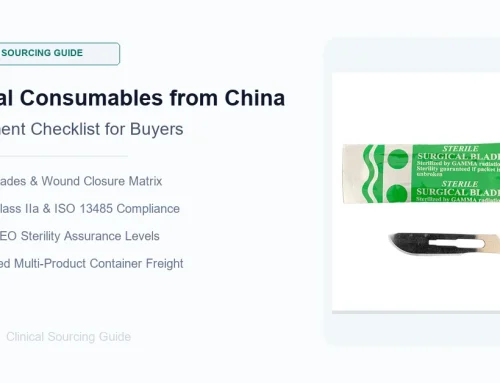




China has established itself as the global manufacturing hub for sterile medical disposables and surgical consumables. Across wound closure technologies, Chinese manufacturing facilities produce billions of needle-attached suture foils annually, serving public healthcare tenders, multinational OEM brand partnerships, and private hospital networks across Europe, Latin America, the Middle East, and Southeast Asia. However, navigating the Chinese suture manufacturing landscape requires discerning between raw component assemblers, localized domestic producers, and world-class certified export leaders.
For international medical distributors, procurement directors, and hospital tender evaluators, selecting a Chinese suture manufacturing partner requires a structured auditing methodology. Critical criteria extend far beyond initial quotation pricing: cleanroom classifications, Cobalt-60 radiation versus Ethylene Oxide (EO) sterilization validation, USP needle attachment pull-off force consistency, and compliance with the stringent European Medical Device Regulation (EU MDR 2017/745). In this definitive 2026 guide, we outline the geographical manufacturing clusters, evaluation benchmarks, quality control audits, and container consolidation strategies (surgical consumables from China guide).
Inhaltsübersicht
- 1. Geographical Clusters of Suture Manufacturing in China
- 2. The 5-Pillar Factory Evaluation Framework for Importers
- 3. Cleanroom Standards & Sterility Assurance Validation
- 4. Needle Metallurgy & In-House Attachment Pull-Off Testing
- 5. EU MDR & ISO 13485:2016 Regulatory Due Diligence
- 6. B2B Multi-Category Container Consolidation Logistics
- 7. Frequently Asked Questions (FAQ)
1. Geographical Clusters of Suture Manufacturing in China
China's medical suture industry is geographically clustered, with specific provinces specializing in distinct tiers of the supply chain:
- Jiangsu Province (Taizhou Medical City, Changzhou & Suzhou): The premier epicenter for advanced medical devices in China. Facilities in Jiangsu feature high levels of automation, computerized cleanroom climate controls, and extensive experience with EU MDR Notified Body audits and US FDA 510(k) submissions. Specializes in advanced synthetic absorbables (PGA, Polyglactin 910und PDO).
- Shandong Province (Heze & Weihai): A major historical manufacturing hub for natural non-absorbable (silk braided) and catgut sutures, as well as high-volume hospital disposables. Offers massive production capacity and competitive economies of scale for large national tenders.
- Shanghai & Zhejiang (Hangzhou & Ningbo): Focuses on high-end specialized microsurgical needles, ophthalmic sutures, and precision contract manufacturing for international private label brands.
2. The 5-Pillar Factory Evaluation Framework for Importers
When assessing prospective suture suppliers in China, procurement teams should implement a rigorous 5-pillar qualification protocol:
| Audit Pillar | Key Verification Checkpoints | High-Risk Red Flags to Avoid |
|---|---|---|
| 1. Cleanroom Environment | ISO Class 8 (100,000) or Class 7 certified; differential pressure logs; continuous particulate monitoring. | Manual assembly in uncontrolled ambient air; absence of positive pressure airlocks. |
| 2. Sterilization Assurance | ISO 11135 (EO) or ISO 11137 (Gamma) validated; physical dosimeter records; biological indicators (SAL 10-6). | Unvalidated third-party sterilization; lack of residual EO degassing test records (> 10 ppm). |
| 3. Mechanical Testing | Calibrated electronic tensile pull testers; USP swage attachment force data; needle penetration curve records. | Failure to log batch-specific pull-off test results; needle bending during clinical use. |
| 4. Regulatory Certification | ISO 13485:2016 scope specific to sutures; CE Class IIb certificate from recognized EU Notified Body; FDA 510(k). | Expired MDD certificates without MDR extension agreements; forged or trading-company-only certificates. |
| 5. Barrier Packaging | Automated heat sealing; vacuum bubble emission testing (ASTM D3078); tri-laminate medical aluminum foil. | Single-layer plastic pouches for absorbable sutures; channel leaks along pouch heat seals. |
3. Cleanroom Standards & Sterility Assurance Validation
Surgical sutures are invasive Class IIb medical devices placed directly into vascular, visceral, and cutaneous tissues. Legitimate Chinese export manufacturers operate fully validated ISO Class 8 (100,000 grade) cleanrooms with dedicated HEPA filtration, automated gowning airlocks, and continuous bioburden monitoring.
Sterilization is validated to achieve a Sterility Assurance Level (SAL) of 10-6:
- Cobalt-60 Gamma Irradiation (ISO 11137): Validated minimum absorption dose of 25 kGy. Radiation is preferred for polypropylene, nylon, and stainless steel wire sutures due to zero chemical residues.
- Ethylene Oxide Gas (ISO 11135): Used for moisture-sensitive synthetic polymers (PGA, PDS, Polyglactin) and natural silk. Validated facilities incorporate multi-stage vacuum aerators to ensure residual EO and ethylene chlorohydrin levels remain well below 4 mg/device per ISO 10993-7.
4. Needle Metallurgy & In-House Attachment Pull-Off Testing
A frequent complaint among surgeons using substandard generic sutures is needle detachment or excessive bending during deep fascia approximation. Premier Chinese manufacturers enforce strict needle metallurgy controls:
- Raw Material Traceability: Medical-grade AISI 420 or AISI 302 stainless steel wire sourced with mill test chemical certificates (Carbon 0.15%–0.30%, Chromium 12.0%–14.0%).
- Micro-Honed Needle Tips: Multi-axis CNC grinding machines hone reverse cutting, tapercut, and round-bodied geometries, followed by electro-polishing to remove microscopic edge burrs.
- USP Pull-Off Attachment Verification: Automated swaging machines crimp threads into laser-drilled needle ends. In-house quality control conducts continuous destructive pull-off testing against USP tables, ensuring zero needle pull-out under physiological tissue tension.
5. EU MDR & ISO 13485:2016 Regulatory Due Diligence
Under the European Medical Device Regulation (EU MDR 2017/745), regulatory scrutiny has intensified. When evaluating Chinese suture suppliers in 2026, importers must conduct comprehensive document audits:
- Notified Body Verification: Confirm that the manufacturer's CE certificate is issued by an active Notified Body designated under MDR (e.g., TÜV SÜD NB 0123, BSI NB 2797). Ensure the certificate explicitly covers "Sterile Absorbable and Non-Absorbable Surgical Sutures with/without Needles."
- Regulation (EU) 2023/607 Transition Compliance: For manufacturers operating under extended MDD validity, confirm they possess a valid MDR formal application submitted before May 2024 and a signed written agreement with a designated Notified Body.
- Post-Market Clinical Follow-up (PMCF): Review the manufacturer's Clinical Evaluation Report (CER) and active PMCF registry documenting in-vivo safety and performance data.
6. B2B Multi-Category Container Consolidation Logistics
Procuring surgical sutures directly from isolated single-product factories often leads to logistical inefficiencies, including multiple LCL handling charges, customs clearance duplication, and container under-utilization. Shevenmed acts as an integrated B2B supply chain partner, consolidating surgical sutures alongside complementary operating theater consumables (bulk suture purchasing guide):
- Consolidated 20ft & 40ft Ocean Shipments: Combine suture cartons with surgical blades, medical skin preparation pads, and disposable drapes under a single unified Bill of Lading, Certificate of Origin, and commercial invoice.
- Custom OEM Packaging & Labeling: Provide private label dispenser boxes, primary foil printing, and multilingual IFUs (Instructions for Use) tailored to international hospital tender specifications.
7. Frequently Asked Questions (FAQ)
Q1: How can an international buyer verify that a Chinese manufacturer's CE certificate is genuine?
Always request the official CE certificate and verify the certificate number directly with the issuing Notified Body (via their online certificate verification portal or formal email inquiry). Furthermore, verify that the legal manufacturer's address on the certificate matches the actual cleanroom manufacturing site audited in China.
Q2: What is the typical lead time for full container loads of surgical sutures from China?
Standard production lead time for full container loads (FCL) of assorted surgical sutures is typically 30 to 45 days from purchase order confirmation and artwork approval, including primary foil printing, automated swaging, cleanroom packaging, and EO/Gamma sterilization cycles.
Q3: What quality testing documentation should be requested with each suture shipment?
Each commercial production batch must be accompanied by an official Certificate of Analysis (CoA) documenting: needle attachment pull-off force (USP compliant), thread diameter and tensile breaking load, package seal integrity testing (dye penetration / vacuum bubble), and a validated Sterilization Release Certificate.
Evaluate Chinese Suture Manufacturing Lines with Shevenmed
Streamline your wound closure sourcing with audited, CE MDR-compliant Chinese manufacturing lines. Shevenmed delivers comprehensive factory audits, pre-shipment quality inspections, and multi-category ocean container consolidation.