



A medical tourniquet is one of the most basic, low-cost devices in any hospital, clinic, or first-aid kit, yet the wrong choice can cause nerve damage, hemolysis, or failed venipuncture. This practical guide walks healthcare buyers through every major type of medical tourniquet, their clinical uses, and how to source them in bulk from qualified China manufacturers.
Medical Tourniquet Guide: Selection, Specs, and Sourcing for Healthcare Buyers
Medical tourniquets are essential devices used in both clinical and emergency settings. From venipuncture tourniquets for blood draws to tactical tourniquets for hemorrhage control, understanding the different types and their applications is critical for healthcare procurement. A poor choice can lead to failed IV sticks, patient injury, or non-compliance with safety standards.
This guide covers every major tourniquet category with real specs, clinical limitations, and buying criteria. We focus on what matters to procurement managers, surgeons, and EMS directors making bulk purchasing decisions.
Why Tourniquet Material Matters More Than You Think
The material directly affects patient comfort, allergy risk, and reusability. Latex allergies affect 1-6% of the general population and up to 17% of healthcare workers. Using a latex tourniquet on a sensitized patient can trigger contact dermatitis or anaphylaxis.
TPE (thermoplastic elastomer) and silicone alternatives eliminate this risk entirely. TPE bands also resist cracking better than latex when exposed to alcohol-based disinfectants commonly used in clinics.
For operating rooms, reusable Penrose drains made of latex rubber can be autoclaved repeatedly. But for single-use phlebotomy, thin latex or TPE bands at 0.5-0.8 mm thickness provide sufficient elasticity at lower cost.
Disposable Venipuncture Tourniquets: The Clinical Workhorse
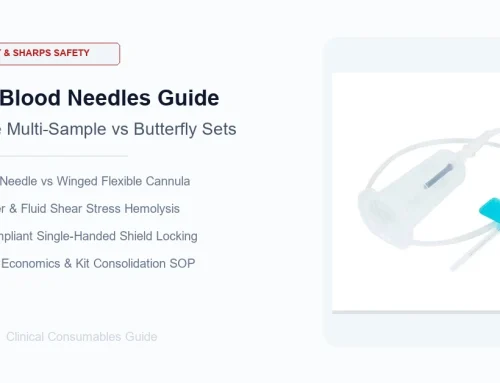
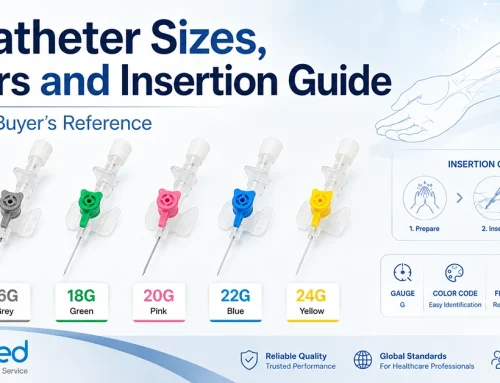
These are the most common tourniquets in hospitals and labs. They are elastic bands applied around the upper arm to distend veins for blood collection with contact-activated safety blood lancets, standard twist blood lancets, traditional stainless steel lancets, or IV catheter insertion (review our comprehensive IV catheter sizes, colors, and insertion guide for gauge selection). For aspirating blood or administering IV medications once venous access is secured, phlebotomists deploy compatible medizinische Spritzen. In phlebotomy and admission workflows, staff cross-verify patient identity using secure patient identification bracelets before applying tourniquets.
Standard dimensions are 2.5 cm × 40 cm for adult arms and 1.9 cm × 30 cm for pediatric use. The width distributes pressure evenly — too narrow (<1.5 cm) causes pain and bruising, too wide (>5 cm) may not occlude effectively.
Maximum application time is 60 seconds. Beyond that, hemoconcentration and hemolysis occur, skewing lab results for potassium, lactate, and hematocrit. Many phlebotomy guidelines recommend releasing the tourniquet within 30 seconds of needle entry.
Color Coding and Allergy Alerts
Color-coded tourniquets serve a practical safety function. Blue or purple bands commonly indicate latex-free material. Red may signal high-risk allergy patients. Green and yellow are general-purpose latex options.
Hospitals with color-coding protocols reduce adverse events by flagging allergies visually. Even Medical supplies disposable venipuncture tourniquets in multiple colors for this exact purpose.
Specs Comparison: Latex vs. Latex-Free Disposable Tourniquets
| Merkmal | Latex (Natural Rubber) | TPE (Latex-Free) | Silikon |
|---|---|---|---|
| Elastic recovery | Excellent (>95%) | Good (85-90%) | Excellent (>95%) |
| Tensile strength | 20-30 MPa | 10-15 MPa | 8-12 MPa |
| Allergy risk | Hoch | None | None |
| Cost per piece (bulk) | $0.02 - $0.05 | $0.04 - $0.08 | $0.10 - $0.20 |
| Shelf life | 3-5 years | 5-7 years | 5-10 years |
| Alcohol resistance | Poor (cracks) | Good | Ausgezeichnet |
Latex-free TPE is now the standard in many European and North American hospitals. The slightly higher cost is offset by reduced litigation risk and fewer allergic reactions.
Reusable Penrose Drain Tourniquets
Penrose drains are soft latex rubber tubes used in surgery. When used as a tourniquet, they are wrapped around a limb and clamped with a hemostat to control bleeding during procedures.
Typical sizes range from 0.6 cm to 2.5 cm in diameter and 30 cm to 90 cm in length. They can be steam sterilized at 134°C for up to 20 cycles before degradation.
These are not suitable for emergency hemorrhage control — they lack a mechanical advantage for tightening. Their primary use is in hand surgery, podiatry, and minor orthopedic procedures.
One red flag: reused Penrose drains can harbor biofilm if not properly cleaned. Inspect for discoloration or tackiness before each use.
Emergency and Tactical Tourniquets
These are life-saving devices designed for severe limb hemorrhage. The Committee on Tactical Combat Casualty Care (CoTCCC) currently recommends the CAT Gen7, SOF-T Wide, and SAM XT as top-tier options.
Key performance metrics include occlusion success rate (target >95% within 3 minutes) and windlass durability. Cheap knock-offs often fail under the 150-200 lbs of force required to occlude a femoral artery.
Application is 5-8 cm above the wound, directly over clothing if necessary. Never place over a joint. Time of application must be recorded — irreversible nerve damage begins after 2 hours.
Red Flags When Buying Tactical Tourniquets
- No FDA 510(k) clearance or CE mark — avoid unbranded imports
- Windlass that bends or snaps during testing
- Nylon webbing less than 3.8 cm wide (increases pressure necrosis risk)
- No one-handed application capability
- Missing or unclear time-stamp label
Bulk buyers should request third-party test reports showing occlusion pressure data. A reputable manufacturer will provide these without hesitation.
Pneumatic Surgical Tourniquets
These are used in orthopedic and trauma surgery to create a bloodless field. The system consists of an inflatable cuff, a pressure regulator, and a gas source (usually compressed air or nitrogen).
Cuff widths range from 10 cm to 45 cm. Wider cuffs require lower pressure — a 45 cm thigh cuff may need only 200 mmHg versus 300 mmHg for a 10 cm cuff. This reduces nerve compression risk.
Standard inflation pressure is 50-100 mmHg above the patient's systolic blood pressure for upper limbs and 100-150 mmHg above for lower limbs. Maximum safe inflation time is 2 hours for upper limbs and 1.5 hours for lower limbs.
Modern systems include automatic pressure monitoring and audible alarms for pressure loss. Manual bulb-inflated cuffs are still used in low-resource settings but lack precision.
Sourcing Disposable Tourniquets from China
China produces an estimated 60% of the world's disposable medical tourniquets. The supply chain is mature, but quality varies dramatically between factories.
Key specifications to verify before ordering:
- Material composition (virgin TPE vs. recycled blends — recycled causes inconsistent elasticity)
- Thickness tolerance (±0.1 mm acceptable)
- Elongation at break (>600% for latex, >400% for TPE)
- Packaging (individually wrapped vs. bulk rolls)
Typical Order Parameters
| Parameter | Standard Range | Notes |
|---|---|---|
| Material | Latex, TPE, silicone | Latex-free preferred in Western markets |
| Width | 2.5 cm, 4 cm, 5 cm | Wider for bariatric patients |
| Länge | 40 cm, 60 cm, 90 cm | 90 cm for thigh application |
| Colors | Blue, red, green, purple, yellow | Color-code for allergy alerts |
| MOQ | 10,000 - 50,000 pcs | Lower MOQ for custom colors |
| Lead time | 10 - 20 days | Depends on color changeover |
| Certifications | ISO 13485, CE, FDA registered | Verify certificate validity |
Pricing factors include material grade, packaging type, and quantity. A typical 2.5 cm × 40 cm TPE tourniquet in bulk costs $0.04-$0.08 FOB Shanghai. Custom printing adds $0.01-$0.02 per piece.
For guidance on verifying certifications, read our CE/ISO Guide. If you are new to importing, our article on how to source medical consumables from China covers factory audits and payment terms.
Sterilization and Packaging Considerations
Disposable tourniquets are typically non-sterile — they are used on intact skin. However, some surgical applications require sterile units.
Sterile tourniquets are individually packaged in peel-pouches and gamma-irradiated at 25-40 kGy. This adds $0.10-$0.20 per unit cost. Most phlebotomy tourniquets are sold in bulk rolls of 100-500 pieces.
For operating room use, consider sterile, single-use pneumatic cuff liners to prevent cross-contamination between patients.
Cross-Linking with Other Medical Consumables
Tourniquets are rarely purchased in isolation. They are part of a broader vascular access and wound management kit.
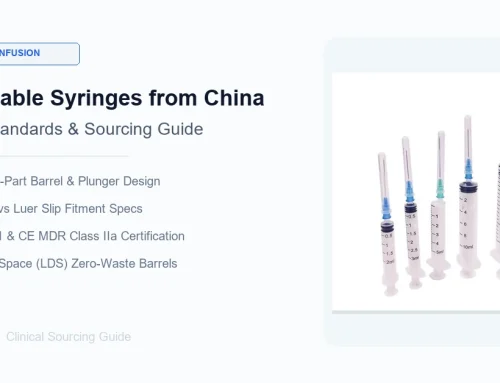
For blood draws, pair tourniquets with vacuum blood collection tubes, winged butterfly blood collection needles, or single-use safety blood collection needles with holders. For IV insertion, use with winged scalp vein sets, IV catheters, and disposable Spritzen.
Skin antisepsis before venipuncture requires 70% IPA swabs or CHG alcohol swabs. For detailed usage, see our Alkoholkissen buyer guide and CHG swab guide.
In surgical settings, tourniquets are used alongside surgical blades and sutures. The choice between absorbable and non-absorbable materials depends on wound type. Our suture types guide covers this in detail.
Bulk Buying and OEM Options
Hospitals and group purchasing organizations (GPOs) typically buy tourniquets in quantities of 50,000-500,000 units per year. Direct factory sourcing cuts out distributor margins of 30-50%.
OEM options include custom color, custom packaging with your logo, and custom width/length combinations. Minimum order quantities for OEM are typically 50,000-100,000 pieces.
For a complete overview of working with Chinese factories, see our OEM guide for medical consumables and list of surgical suture manufacturers (many also produce tourniquets).
For bulk suture purchasing, our bulk buy guide outlines volume discount tiers. The same principles apply to tourniquets.
Even Medical Tourniquets
Even Medical supplies disposable venipuncture tourniquets in latex and latex-free options, available in multiple colors for allergy identification. All products are manufactured in ISO 13485-certified facilities with full CE and FDA registration.
Contact us for OEM pricing and samples. We can match any specification sheet within 48 hours.
Frequently Asked Questions
How long can a tourniquet be left on for a blood draw?
Maximum 60 seconds. Leaving it on longer causes hemoconcentration and false lab results. Release the tourniquet within 30 seconds of needle entry for best accuracy.
What is the difference between a latex and TPE tourniquet?
Latex offers higher elasticity but carries allergy risk. TPE is hypoallergenic, more resistant to alcohol disinfectants, and has a longer shelf life. TPE costs slightly more per unit but eliminates latex-related adverse events.
Can disposable tourniquets be reused?
No. Disposable tourniquets are for single patient use only. Reuse risks cross-contamination from bloodborne pathogens. Reusable Penrose drains are autoclavable but must be inspected for degradation.
What certifications should I look for when sourcing from China?
ISO 13485 for quality management system, CE marking for European markets, and FDA 510(k) clearance for the US. Always request copies of valid certificates and verify with the issuing body.
What is the MOQ for custom color tourniquets?
Standard MOQ is 10,000-50,000 pieces per color. Custom Pantone matching may require 50,000+ pieces. Lead time is typically 15-20 working days after sample approval.
In emergency trauma care and field surgery, rapid hemorrhage control is paired with sterile wound management; explore cutting-edge wound debridement in our surgical blade sizes and reference guide, prep peripheral skin with clinical alcohol pad aseptic protocols, and review post-hemostasis laceration repair in our guide on surgical sutures and wound healing timelines.
For technical specifications, CE/ISO documentation, and bulk procurement inquiries, explore our military spinning tourniquets, trauma-ready emergency Israeli bandages, and hypothermia-prevention emergency blankets. For comprehensive vital signs assessment and rapid intake screening, explore non-invasive temperature monitoring in our guide to infrared forehead thermometers.