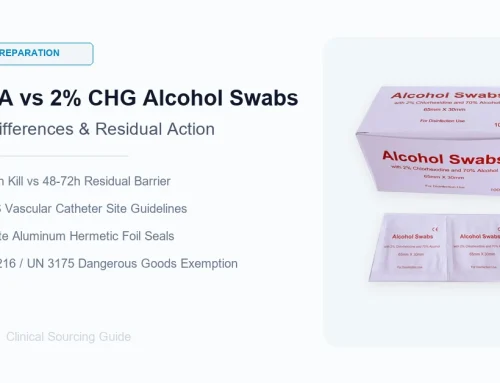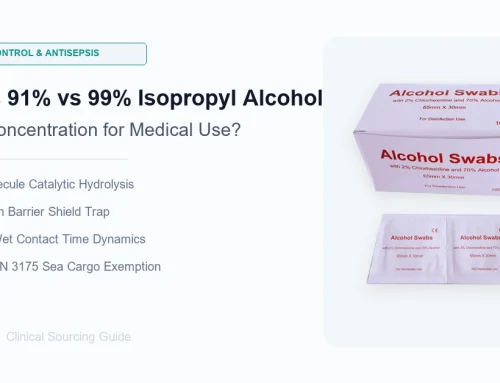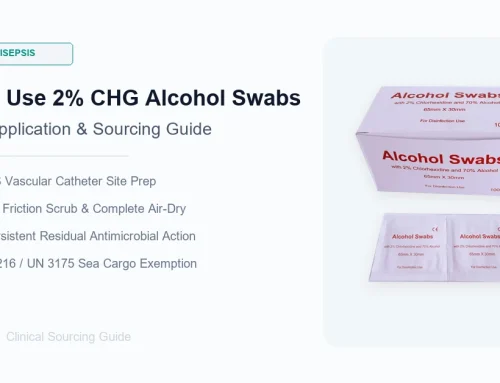




Not all alcohol swabs are created equal. When sourcing from China or any overseas supplier, quality verification is critical — especially for products used in clinical settings. This checklist helps procurement teams evaluate alcohol swab quality before placing orders.
A single batch of substandard swabs can lead to surgical site infections, compliance failures, and reputational damage. Hospitals and clinics rely on these simple products for skin antisepsis before injections, blood draws, and minor procedures.
Procurement teams must know exactly what to test, what documentation to request, and which red flags signal trouble. Below is a detailed breakdown of every quality parameter that matters. For clinical pharmacology benchmarks, review our guide on 70% isopropyl alcohol swabs as the infection control gold standard.
IPA Concentration Verification
The active ingredient in most clinical swabs is 70% isopropyl alcohol (IPA). This concentration is not arbitrary — 70% IPA penetrates bacterial cell walls more effectively than higher concentrations because it evaporates slower, allowing longer contact time.
You must verify that the IPA concentration falls within 70% ± 5%. Anything outside this range compromises disinfection efficacy. Higher concentrations (90%+) actually coagulate proteins too quickly, preventing deep penetration.
Testing Methods
Gas chromatography is the gold standard for IPA concentration testing. Request a Certificate of Analysis (COA) per lot from your supplier, and test random samples from received shipments using an independent lab if possible.
Some suppliers provide hydrometer-based readings, but these are less accurate. Always insist on gas chromatography results for critical orders. A reliable supplier like Sogar medizinisch provides COAs with every shipment.
Documentation Checklist
- COA per production lot
- Gas chromatography test results
- Expiration date and stability data
- Certificate of analysis matching batch numbers
Saturation Volume and Consistency
Each alcohol swab pad must contain a specific volume of solution. For standard 3cm x 3cm swabs, the typical range is 0.5–1.5 ml. Larger 5cm x 7cm swabs may hold 2.0–3.0 ml.
Insufficient saturation means the pad dries before adequate contact time is achieved. Excessive saturation causes leaking packaging, which compromises sterility and creates mess during use.
How to Test Saturation
Weigh ten individual swabs from different packages. Record the wet weight, then dry them in an oven at 70°C for 4 hours. Weigh again. The difference is the solution volume. Compare against the specification.
Acceptable variation is typically ±10% from the stated volume. Anything beyond this indicates poor manufacturing control. Request your supplier's saturation uniformity data per lot.
Packaging Integrity
Alcohol swabs are typically packaged in individual foil sachets. These must be hermetically sealed to maintain sterility and prevent alcohol evaporation. A compromised seal means the product is useless before it reaches the patient.
Visual Inspection Criteria
Check for visible leaks, punctures, or incomplete seals. The peel-open packaging should tear cleanly without shredding or delaminating. If the foil tears unevenly, it creates frustration for clinical staff and potential contamination risks.
Seal Strength Testing
Request seal strength data per ASTM F88. Minimum peel strength for foil sachets is typically 1.5 N/15mm. Values below this indicate weak seals that may open during shipping or storage.
Perform a dye penetration test on random samples. Apply methylene blue solution to the seal area and check for capillary wicking. Any blue trace inside the package means the seal is compromised.
Sterility Assurance
Alcohol swabs used in clinical settings must be terminally sterilized. The two common methods are ethylene oxide (EO) sterilization and gamma irradiation. Both are acceptable, but EO is more common for alcohol swabs because gamma can degrade certain packaging materials.
Sterility Validation Documents
Request the sterility validation report per ISO 11135 (for EO) or ISO 11137 (for gamma). The Sterility Assurance Level (SAL) must be 10⁻⁶, meaning a one-in-a-million chance of a non-sterile unit.
Do not accept "sterile" claims without supporting documentation. A supplier without sterility validation is likely producing non-sterile swabs and labeling them as sterile. This is a major patient safety risk.
Bioburden Testing
Before sterilization, manufacturers should perform bioburden testing per ISO 11737-1. This establishes the initial microbial load and confirms the sterilization cycle is adequate. Request this data for each production lot.
Substrate Material Quality
The pad material affects absorbency, lint generation, and user experience. Three common materials are used for alcohol swabs, each with distinct properties.
| Material | Absorbency | Lint Generation | Skin Feel | Cost Factor |
|---|---|---|---|---|
| Non-woven (spunlace) | Good | Low to none | Soft | Mittel |
| Cotton | Hoch | Moderate to high | Natural | Low to medium |
| Rayon | Mäßig | Very low | Smooth | Medium to high |
Non-woven spunlace is the most common choice for clinical swabs. It offers good absorbency without leaving fibers on the skin. Cotton is traditional but can shed fibers that contaminate injection sites or wound areas.
Rayon provides a smooth texture ideal for sensitive skin, but it costs more. For general procurement, non-woven material with a weight of 40–60 gsm is a reliable standard.
Biocompatibility and Safety Testing
Alcohol swabs contact skin directly. They must not cause irritation, allergic reactions, or cytotoxicity. Three ISO tests are standard for medical device biocompatibility.
Cytotoxicity Testing (ISO 10993-5)
This test evaluates whether materials leach toxic substances. Cells are exposed to extracts from the swab material. If cell viability drops below 70%, the material fails. Request this data for both the pad and the packaging.
Skin Irritation (ISO 10993-10)
A patch test on rabbit skin determines irritation potential. The swab material is applied for 24 hours, and skin reactions are scored. Primary Irritation Index (PII) should be 0.0–0.4 (negligible).
Sensitization (ISO 10993-10)
This test checks for allergic reactions. A modified Buehler test or Guinea Pig Maximization Test is standard. The material should show no evidence of delayed hypersensitivity.
Request all three reports from your supplier. Many low-cost manufacturers skip biocompatibility testing entirely. Read our comprehensive encyclopedia on medical-grade alcohol pads manufacturing and quality control.
Red Flags When Sourcing Alcohol Swabs
Certain warning signs indicate a supplier may be cutting corners. Watch for these red flags during evaluation.
No ISO 13485 Certification
ISO 13485 is the quality management standard for medical devices. A supplier without this certification cannot demonstrate consistent quality control. Check our CE/ISO Guide for details on required certifications.
Cannot Provide COA Per Lot
If a supplier refuses or cannot provide a Certificate of Analysis for each production lot, walk away. This document is the minimum proof of quality control. Without it, you have no way to verify what you received.
No Sterility Validation Documentation
Sterility claims without validation reports are meaningless. A supplier who cannot provide ISO 11135 or ISO 11137 documentation is likely selling non-sterile products. This is the most dangerous red flag.
Suspiciously Low Pricing
If pricing is significantly below market average, something is wrong. Non-sterile production costs less. Using cheaper materials costs less. Skipping testing costs less. You get what you pay for.
Generic "Medical Grade" Claims Without Data
"Medical grade" is a marketing term, not a regulated classification. Any supplier can print it on packaging. Without test data and certifications, the claim is worthless.
Packaging Without IPA Concentration
The packaging must clearly state the IPA concentration. If it only says "alcohol swabs" without specifying 70% IPA, the product may not meet clinical requirements.
Pricing Factors and What to Expect
Alcohol swab pricing varies based on several factors. Understanding these helps you evaluate whether a quote is reasonable.
| Factor | Impact on Price | Notes |
|---|---|---|
| Material type | ±15% | Rayon costs more than non-woven |
| Sterilization method | ±10% | EO is cheaper than gamma |
| Packaging quality | ±20% | Foil vs. paper, seal strength |
| Saturation volume | ±10% | More solution = higher cost |
| Certification costs | ±15% | ISO 13485, CE, FDA add cost |
| Order quantity | ±30% | Bulk orders reduce per-unit cost |
For bulk orders of 100,000+ units, expect pricing between $0.02 and $0.06 per swab for standard quality. Premium products with rayon material and higher saturation may reach $0.08–$0.12 per unit.
If a quote comes in below $0.015 per swab, question the quality. Read our guide on sourcing medical consumables from China for more pricing benchmarks.
How to Verify Supplier Claims
Don't rely solely on documents. Perform physical verification whenever possible.
Request Pre-Shipment Samples
Ask for 100–200 samples from the actual production lot. Test them in your facility or send to an independent lab. Check saturation, seal integrity, and IPA concentration.
Factory Audit
Visit the factory or hire a third-party inspection company. Verify the cleanroom classification (ISO Class 8 minimum for sterile manufacturing). Check EO sterilization records and bioburden test logs.
Our article on surgical suture manufacturers in China provides audit tips that apply equally to alcohol swab production.
Third-Party Testing
For critical orders, pay for independent lab testing. SGS, TÜV, and Bureau Veritas all offer medical device testing services. Test for IPA concentration, sterility, and biocompatibility.
Documentation Requirements for Procurement
Build a documentation checklist into your procurement process. Require these documents before approving any supplier.
- ISO 13485 certificate (current, not expired)
- CE marking certificate (if selling in EU)
- FDA establishment registration (if selling in US)
- Certificate of Analysis per lot
- Sterility validation report (ISO 11135 or 11137)
- Biocompatibility test reports (ISO 10993-5, -10)
- Packaging integrity test data
- Stability study data (shelf life claim)
Our OEM Guide for Medical Consumables explains how to structure these requirements into supplier contracts.
Even Medical Quality Assurance
All Even Medical alcohol swabs are manufactured in our ISO 13485-certified cleanroom. We use 70% IPA verified by gas chromatography for every production lot.
Our IPA swabs are terminally sterilized by EO and tested per USP/EP standards. We provide full documentation with every shipment, including COAs, sterility certificates, and biocompatibility reports.
For chlorhexidine-alcohol combinations, we offer sterile CHG swabs with 2% chlorhexidine gluconate in 70% IPA. Read our CHG swab usage guide for clinical application details.
Contact Shevenmed for quality documentation, batch testing certificates, and factory samples. We ship worldwide and support bulk orders with full traceability.
Frequently Asked Questions
What is the difference between IPA swabs and CHG swabs?
IPA swabs contain 70% isopropyl alcohol only. CHG swabs combine 2% chlorhexidine gluconate with 70% IPA. CHG provides residual antimicrobial activity after the alcohol evaporates, making it preferred for central line insertion and surgical site preparation. IPA swabs are sufficient for routine injections and blood draws.
How long do alcohol swabs remain effective after manufacturing?
Most alcohol swabs have a shelf life of 2–3 years when stored properly (cool, dry place away from direct sunlight). The alcohol can evaporate through the packaging over time, reducing efficacy. Always check the expiration date and verify IPA concentration on aged stock.
Can I use alcohol swabs on open wounds?
No. Alcohol swabs are for intact skin only. Using them on open wounds causes tissue damage, delays healing, and increases pain. For wound cleaning, use sterile saline or wound-specific antiseptics. For skin antisepsis around wounds, CHG swabs are preferred.
What certifications should a Chinese supplier have?
Minimum requirements are ISO 13485 certification and CE marking (for EU markets). For US markets, FDA establishment registration and 510(k) clearance may be needed. Read our CE/ISO/FDA certification guide for a complete breakdown.
How many swabs should I order for a minimum viable bulk purchase?
Most Chinese manufacturers set minimum order quantities (MOQs) at 50,000–100,000 units for standard swabs. Custom packaging or private labeling may require 200,000+ units. Our bulk buying guide explains how to negotiate MOQs and pricing tiers.