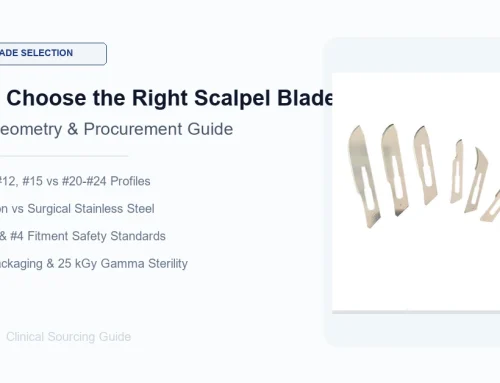




In operating theaters and minor procedure rooms worldwide, the surgical scalpel remains the ultimate instrument of initial anatomical access. While modern surgical energy devices and lasers offer advanced coagulation capabilities, nothing replaces the mechanical precision, tissue tactile feedback, and minimal lateral thermal damage of a micro-honed steel surgical blade. Under international standard ISO 7740 (Instruments for surgery — Scalpels with detachable blades — Fitting dimensions), blade manufacturing relies on strict metallurgical controls and precision edge-geometry specifications.
For operating room procurement committees, chief surgeons, and medical supply distributors, the fundamental metallurgical decision is choosing between high-carbon surgical steel und martensitic stainless steel. Each alloy exhibits distinct hardness ratings, initial sharpness profiles, edge-retention dynamics during dense tissue transection, and corrosion resistance under tropical logistics conditions. In this clinical procurement guide, we analyze the metallurgy of surgical cutting edges, compare blade performance across orthopedic and plastic surgery procedures, and detail packaging integrity standards (surgical scalpel handle types and sizes guide).
Inhaltsübersicht
- 1. Metallurgical Composition: Carbon Steel vs. Martensitic Stainless Steel
- 2. Rockwell Hardness (HRC) & Cutting Edge Micro-Geometry
- 3. Clinical Application: Soft Tissue Glide vs. Dense Fascial Resistance
- 4. Corrosion Resistance & Tropical Supply Chain Stability
- 5. ISO 7740 Blade-to-Handle Interlock Security & Accidental Decoupling
- 6. Vapor Corrosion Inhibitor (VCI) Foils & Gamma Sterilization
- 7. Frequently Asked Questions (FAQ)
1. Metallurgical Composition: Carbon Steel vs. Martensitic Stainless Steel
The cutting performance of a surgical blade is governed by its underlying chemical alloy matrix:
- High-Carbon Surgical Steel (e.g., Grade T10A / 1095): Contains approximately 1.0% to 1.2% carbon with minimal chromium. High carbon content allows heat treatment to achieve extreme hardness, resulting in an acutely fine, razor-sharp edge with minimal initial cutting resistance. Review our carbon steel surgical blades technical specifications.
- Martensitic Stainless Steel (e.g., AISI 420C / DIN 1.4034): Contains approximately 0.45% to 0.55% carbon and 12.5% to 14.5% chromium. Chromium forms a passive chromium oxide surface layer that prevents oxidation. While marginally less hard than pure carbon steel, stainless steel offers total corrosion resistance against moisture and saline exposure. Explore our stainless steel surgical blades portfolio.
2. Rockwell Hardness (HRC) & Cutting Edge Micro-Geometry
Hardness directly determines how finely a blade's edge can be ground and how long that edge withstands tissue friction:
| Metallurgical Property | High-Carbon Steel Blades | Martensitic Stainless Steel Blades |
|---|---|---|
| Rockwell Hardness (HRC) | 60 to 64 HRC | 54 to 58 HRC |
| Initial Edge Keenness | Superior (Ultra-fine micro-bevel) | Excellent (Electro-chemically deburred) |
| Edge Longevity in Bone/Cartilage | High (Resists edge rolling; micro-chipping risk) | Moderate (Prone to slight edge folding under heavy load) |
| Corrosion Vulnerability | Vulnerable (Requires VCI protective packaging) | Inert (Highly resistant to blood, saline & humidity) |
3. Clinical Application: Soft Tissue Glide vs. Dense Fascial Resistance
Surgical specialty requirements dictate the preferred metal:
- Plastic, Ophthalmic & Dermatologic Surgery: High-carbon steel blades (e.g., #11 and #15) are favored. Surgeons require absolute initial sharpness to execute feather-light incisions with zero tissue drag, preventing ragged dermal margins and secondary scar formation.
- Orthopedic, Trauma & General Surgery: Stainless steel blades (e.g., #10, #20, #22) are preferred. When cutting through dense aponeurosis, periosteum, and fibrous ligaments in fluid-heavy surgical fields, stainless steel's fracture toughness and corrosion resistance provide clinical reliability.
4. Corrosion Resistance & Tropical Supply Chain Stability
For international medical distributors operating in Latin America, Southeast Asia, or the Middle East, port storage conditions pose a severe challenge. High ambient humidity and maritime saline air can penetrate substandard packaging. Unprotected carbon steel blades can develop microscopic rust pits along the cutting edge within months, dulling the edge before clinical use. Stainless steel blades remain chemically unaffected by humid equatorial climates.
5. ISO 7740 Blade-to-Handle Interlock Security & Accidental Decoupling
Under ISO 7740, blade heel slots must correspond exactly to scalpel handle fittings:
- Small Fitment Handles (#3, #7, #9): Pair with blade sizes #10 through #15. The heel tang slot must engage with less than 0.05 mm mechanical play to prevent lateral blade wobble during delicate dissection.
- Large Fitment Handles (#4): Pair with blade sizes #20 through #25. Designed for abdominal incisions requiring higher downward force. Precision stamped heel slots ensure blades cannot inadvertently detach during deep retraction.
6. Vapor Corrosion Inhibitor (VCI) Foils & Gamma Sterilization
To overcome carbon steel's susceptibility to oxidation, tier-1 manufacturers utilize Vapor Corrosion Inhibitor (VCI) peelable aluminum foil packets. The inner foil laminate releases a volatile microscopic protective compound that passivates the steel surface against oxidation inside the sterile pouch. Both carbon and stainless blades undergo Cobalt-60 Gamma radiation sterilization (25 kGy), ensuring a guaranteed SAL 10⁻⁶ sterility level across a 5-year shelf life. Pair your surgical procurement with our surgical consumables from China sourcing overview.
7. Frequently Asked Questions (FAQ)
Q1: Can carbon steel blades break or shatter inside the patient?
Because carbon steel is hardened to 60+ HRC, it exhibits lower ductility than stainless steel. If a surgeon uses a carbon blade as a lever against hard bone, micro-fracture can occur. Proper surgical technique dictates using blades strictly for linear cutting, never twisting or prying against rigid structures.
Q2: What is the primary advantage of stainless steel blades in military and emergency settings?
Stainless steel blades withstand field trauma kits, maritime storage, and temperature cycling without requiring airtight VCI protection. Even if outer cartons are exposed to rain or humidity, the blade cutting edge remains pristine and rust-free.
Source ISO 7740 Surgical Scalpel Blades in Wholesale Volume
Shevenmed exports premium carbon steel and stainless steel surgical blades (#10 to #25) packaged in medical-grade VCI foils with individual gamma sterility verification. Contact our surgical team for bulk container pricing.