



Surgical Blade Sizes & Numbers: Complete Reference Guide (#6 to #36)
Surgical blade sizes and numbers are not arbitrary — each blade number corresponds to a specific shape, cutting geometry, and clinical application. Selecting the wrong blade size can compromise surgical precision, increase operating time, and cause unnecessary tissue trauma. This complete reference guide covers all standard blade numbers from #6 to #36, their shapes, handle compatibility, primary clinical uses, and what to look for when procuring surgical blades in bulk.
How Surgical Blade Numbering Works
Surgical blades follow an international numbering system standardized across manufacturers. The number designates the blade's shape and size profile — not its sharpness or material. The same blade number from any ISO-certified manufacturer should have the same geometry and fit the same handle.
Blade numbers are divided into two groups by handle compatibility:
- Blades #6–#16 — fit Handle #3 (shorter, lighter handle — standard for fine and medium work)
- Blades #18–#36 — fit Handle #4 (longer, heavier handle — standard for general and large-incision surgery)
Note: Blade #9 fits #3 handle. Blades #12, #12B, #15C are specialized variants within the #3 range.
Complete Surgical Blade Size Chart — #6 to #36
| Blade No | Shape Description | Handle | Primary Clinical Use | Specialty |
|---|---|---|---|---|
| #6 | Small curved, fine point | #3 | Ophthalmic surgery, microsurgery, fine dissection | Ophthalmic, Micro |
| #9 | Small pointed, narrow belly | #3 | Fine incisions, plastic surgery, small wound excision | Plastic, Dermatology |
| #10 | Large curved belly, broad arc | #3 | General surgery skin incisions, large tissue cutting, opening body cavities | General Surgery |
| #11 | Pointed triangular, straight back | #3 | Stab incisions, abscess drainage, vascular access, puncture wounds, tenotomy | General, Vascular, ED |
| #12 | Curved hook shape, tip curves back | #3 | Oral surgery, ENT procedures, curved incisions in body cavities | Oral, ENT |
| #12B | Modified hook, shorter curve | #3 | Oral surgery, specialized curved cuts in confined spaces | Oral Surgery |
| #13 | Small pointed, narrow | #3 | Ophthalmic surgery, fine tissue work, small cyst excision | Ophthalmic |
| #14 | Small curved, concave back | #3 | Plastic surgery, delicate dissection, small curved incisions | Plastic Surgery |
| #15 | Small curved belly, rounded tip | #3 | Plastic surgery, pediatric surgery, curved skin incisions, excision of small lesions | Plastic, Pediatric, Dermatology |
| #15C | Extra small curved belly | #3 | Ophthalmic surgery, microsurgery — smallest curved blade in standard range | Ophthalmic, Micro |
| #16 | Curved, medium size | #3 | General and plastic surgery, moderate incisions | General, Plastic |
| #18 | Large curved, broad | #4 | Orthopedic surgery, large incisions, tissue dissection | Orthopedic |
| #19 | Large curved belly | #4 | General surgery, large tissue cutting | General Surgery |
| #20 | Large curved belly, broad arc | #4 | General surgery, abdominal incisions — similar to #10 but for #4 handle | General Surgery |
| #21 | Large curved belly, deeper arc | #4 | General surgery, deep tissue dissection, large abdominal procedures | General Surgery |
| #22 | Large curved belly, widest arc | #4 | General surgery — the most widely used large blade globally; abdominal, thoracic, and general incisions | General Surgery |
| #23 | Large pointed belly | #4 | General surgery, abdominal and thoracic procedures, deep penetrating incisions | General, Thoracic |
| #24 | Large curved, elongated | #4 | General surgery, large incisions in thick tissue | General Surgery |
| #25 | Large curved, broad | #4 | General surgery, orthopedic procedures | General, Orthopedic |
| #26 | Large curved | #4 | General surgery, large tissue cutting, trauma surgery | General Surgery |
| #34 | Large elongated, narrow | #4 | Orthopedic surgery, deep cavity access, bone exposure | Orthopedic |
| #36 | Extra large, broad | #4 | Orthopedic and general surgery, large tissue dissection, amputation procedures | Orthopedic, General |
Most Commonly Used Blade Numbers — By Specialty
General Surgery
The most frequently ordered blades in general surgery are #10 (skin incision, opening cavities), #11 (stab incisions, drainage), #15 (curved skin incisions, lesion excision), #22 (large incisions), and #23 (abdominal and thoracic). For high-volume general surgery procurement, these five blade numbers account for the majority of usage.
Plastic & Reconstructive Surgery
#15 is the workhorse of plastic surgery — its small curved belly allows precise curved incisions with minimal trauma. #11 is used for puncture incisions and drainage. #9 و #14 for fine dissection work. Stainless steel is often preferred in plastic surgery for more consistent edge quality.
Orthopedic Surgery
#22 و #23 for initial skin and fascial incisions; #10 أو #15 for soft tissue work around joints; #18, #34و #36 for deep tissue access and bone exposure in major orthopedic procedures.
Ophthalmic Surgery
#6, #13و #15C are the standard ophthalmic blades. These very fine blades are used for corneal incisions, conjunctival dissection, and lid surgery. Precision and consistency are critical — stainless steel is the standard choice for ophthalmic applications.
Oral & Maxillofacial Surgery
#12 و #12B are specifically designed for oral surgery — their curved hook profile allows incisions along the gingival margin and in confined intraoral spaces. #15 is also widely used for flap incisions.
Emergency Medicine & Bedside Procedures
#11 is the standard blade for emergency procedures — abscess incision and drainage, central line skin incision, chest tube insertion incision, and other bedside stab procedures. Its pointed triangular shape allows controlled depth penetration.
Blade #10 vs #22 — What Is the Difference?
This is one of the most common questions in surgical blade procurement. Both have a large curved belly, but they are not interchangeable:
| Blade #10 | Blade #22 | |
|---|---|---|
| Handle | #3 (shorter, lighter) | #4 (longer, heavier) |
| مقاس | Smaller overall | Larger overall — wider belly, longer cutting edge |
| Best For | Moderate incisions, accessible sites, single-handed use | Large incisions, abdominal surgery, two-handed scalpel technique |
| Typical User | General surgeons, dermatologists, plastic surgeons | General surgeons, abdominal and thoracic surgeons |
Blade #11 vs #15 — When to Use Each
| Blade #11 | Blade #15 | |
|---|---|---|
| Shape | Pointed triangular — tip is the cutting edge | Small curved belly — entire arc is the cutting edge |
| Incision Type | Stab / puncture incisions (point-first entry) | Curved sweep incisions (blade-first entry) |
| Best For | Abscess drainage, vascular access, tenotomy, biopsy punch | Curved skin incisions, lesion excision, plastic surgery, pediatric procedures |
| Depth Control | High precision depth control via point | Controlled sweep with curved belly |
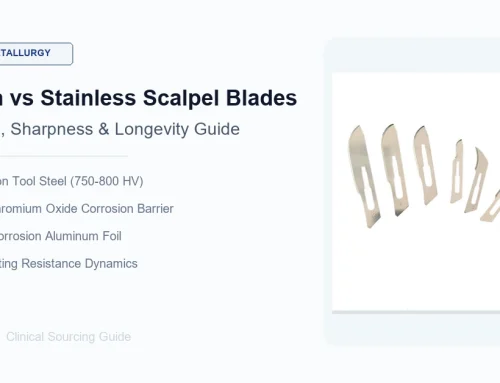
Carbon Steel vs Stainless Steel Blades
Both carbon steel and stainless steel surgical blades are available in all standard sizes (#6–#36). The choice depends on clinical requirements and procurement priorities:
| Carbon Steel (E20011C) | Stainless Steel (E20011S) | |
|---|---|---|
| Initial Sharpness | Excellent — sharper edge out of pack | Very good — slightly less sharp initially |
| Edge Retention | Good for single-use | Better long-term consistency |
| Corrosion Resistance | Standard — use promptly after opening | High — better in humid storage environments |
| التكلفة | Lower | Slightly higher |
| Best For | High-volume general surgery, cost-sensitive markets | Humid climates, ophthalmic and plastic surgery, longer shelf storage |
For bulk procurement in Africa, Southeast Asia, and tropical climates, stainless steel is often recommended due to superior humidity resistance during shipping and storage. For high-volume general surgery procurement where turnover is fast, carbon steel offers the best cost efficiency.
Handle Compatibility — #3 vs #4
| Handle #3 | Handle #4 | |
|---|---|---|
| Compatible Blades | #6, #9, #10, #11, #12, #12B, #13, #14, #15, #15C, #16 | #18, #19, #20, #21, #22, #23, #24, #25, #26, #34, #36 |
| Handle Length | Shorter, lighter | Longer, heavier |
| Grip | Pen grip — precision work | Palm grip — power cutting |
| Most Common Blades Used | #10, #11, #15 | #20, #22, #23 |
Reusable stainless steel handles (#3 and #4) are available from Even Medical (E20012S3 / E20012S4) for use with blade-only packs. Alternatively, pre-assembled disposable scalpels with plastic handle are available for single-use applications.
Disposable Scalpel vs Blade-Only — Procurement Considerations
| Blade Only (E20011C/S) | Disposable Scalpel with Handle (E20012C/S) | |
|---|---|---|
| التعبئة | 100pcs/box, 50 boxes/carton | 10pcs/box, 50 boxes/carton |
| Cost per Unit | Lower | Higher (handle included) |
| Sharps Safety | Blade change required — injury risk | Pre-attached — no assembly injury risk |
| Best For | OR departments with reusable handle sterilization | Outpatient, emergency, field, infection control-focused settings |
Bulk Procurement Reference — Even Medical Surgical Blades
| Product | Item No | Sizes Available | التعقيم | التعبئة |
|---|---|---|---|---|
| Carbon Steel Surgical Blade | E20011C | #6–#36 (all standard) | Gamma Radiation 25kGy | 100pcs/box, 50boxes/ctn |
| Stainless Steel Surgical Blade | E20011S | #6–#36 (all standard) | Gamma Radiation 25kGy | 100pcs/box, 50boxes/ctn |
| Disposable Scalpel (Carbon) | E20012C | #6–#36 | Gamma Radiation 25kGy | 10pcs/box, 50boxes/ctn |
| Disposable Scalpel (Stainless) | E20012S | #6–#36 | Gamma Radiation 25kGy | 10pcs/box, 50boxes/ctn |
| Scalpel Handle #3 | E20012S3 | Fits blades #6–#16 | Gamma Radiation | 500pcs/carton |
| Scalpel Handle #4 | E20012S4 | Fits blades #18–#36 | Gamma Radiation | 500pcs/carton |
Frequently Asked Questions
What is the most commonly used surgical blade number?
Blade #22 is the most widely used large blade globally for general surgery. Blade #10 is the most widely used medium blade for general and plastic surgery. Blade #15 is the most widely used small blade for plastic, pediatric, and dermatological surgery. Blade #11 is the standard for stab incisions and emergency procedures. For most procurement teams, stocking #10, #11, #15, #22, and #23 covers the majority of clinical needs.
What is the difference between blade #22 and #23?
Both are large blades fitting a #4 handle. Blade #22 has a broad curved belly — the cutting arc is convex and wide, suited for sweeping incisions across large tissue surfaces. Blade #23 has a more pointed belly — it narrows toward the tip, providing better control for penetrating incisions into deeper tissue layers. In abdominal surgery, #22 is used for the skin incision and #23 for deeper dissection layers.
Can blade #10 and #22 be used interchangeably?
No. Blade #10 fits a #3 handle and blade #22 fits a #4 handle — they are not interchangeable. While both have a curved belly profile, #22 is significantly larger and designed for the heavier #4 handle used in major surgery. Using the wrong blade-handle combination compromises surgical control and risks blade detachment.
What blade is used for skin graft harvesting?
Blade #22 or #23 on a #4 handle is commonly used for split-thickness skin graft donor site incisions in standard scalpel technique. Dedicated dermatome devices are used for larger grafts.
What is the smallest surgical blade available?
Blade #15C is the smallest standard curved blade — designed for ophthalmic and microsurgery. Blade #6 is also very fine and used for microsurgery and ophthalmic procedures.
How should surgical blades be stored?
Store in original sealed sterile packaging in a cool, dry environment away from moisture and direct sunlight. Do not use blades with damaged or compromised packaging. Carbon steel blades should be used promptly after opening individual packs to avoid oxidation. Stainless steel blades are more resistant to humidity during storage.
Related Products
- Carbon Steel Surgical Blade (E20011C) — #6 to #36, all sizes
- Stainless Steel Surgical Blade (E20011S) — #6 to #36, all sizes
- Disposable Scalpel with Plastic Handle (E20012C/S)
- Stainless Steel Scalpel Handle #3 & #4 (E20012S3/S4)
- Hemostatic Gelatin Sponge for Surgical Bleeding Control
To understand the clinical significance of blade geometries in specialized operations, read our guide on the importance of surgical blades in medical procedures. Prior to surgical incision or wound debridement, clinicians enforce strict antisepsis following our clinical alcohol pad aseptic preparation guide, while active arterial bleeding requires rapid occlusion via medical and tactical tourniquets. Following precise sharp dissection, closing fascial and subcutaneous layers requires dependable wound closure; explore needle curvature and resorption profiles in our PGA 4/0 suture technical review, compare tensile strength in absorbable vs non-absorbable suture materials, and review material choices in our comprehensive guide to surgical sutures. For foundational scalpel metallurgy, edge geometry, and stainless steel specifications, review our clinical introduction in surgical blade overview. When transitioning from sharp tissue incising to wound closure, examine suture tensile strength parameters in surgical suture overview and review bulk procurement guidelines in generic surgical sutures from China.