



China dominates global medical consumable production, accounting for over 40% of the world's supply. For buyers, this means access to competitive pricing and massive production capacity. But the real challenge isn't finding a supplier—it's finding a reliable one.
Most buyers start with price comparisons, but experienced procurement managers focus on certification verification and quality control. A single bad batch of sutures or 주사기 can cost thousands in rejected shipments and damaged reputation.
This guide walks through the complete process—from identifying product categories to managing logistics. We focus on practical steps that reduce risk and improve outcomes for first-time and experienced buyers alike.
The cost advantage remains the primary driver. Manufacturing costs in China are typically 30–60% lower than in Western countries, even after factoring in shipping and import duties. A box of 36 surgical blades that costs $18 from a US distributor might cost $6–8 directly from a Chinese factory.
Product variety is unmatched. Chinese factories produce thousands of SKUs across every category—from nylon sutures to blood collection tubes to IV catheters. You can consolidate orders from one manufacturer rather than juggling multiple suppliers.
Production scale is enormous. Top factories run 24-hour cycles, producing millions of units monthly. This means shorter lead times and better price breaks at higher volumes. Many manufacturers now hold ISO 13485, CE, and FDA registrations.
For a broader overview of the product categories and supply landscape, explore our comprehensive medical consumables portfolio.
Step 1: Identify Your Product Category
Medical consumables from China fall into several well-defined categories. Each has different certification requirements and quality benchmarks. Knowing your exact product type helps you target the right factories and avoid suppliers that claim to make everything.
외과 봉합사
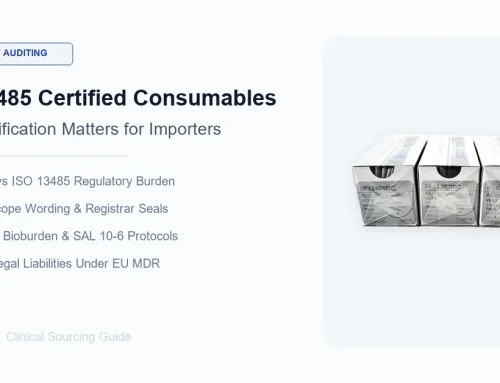
This category includes both absorbable and non-absorbable options. Absorbable sutures like PGA, polyglactin 910, and PDS require strict tensile strength testing. Non-absorbable options include silk and nylon, which have different handling characteristics.
For a detailed breakdown of suture types, read our complete guide to surgical suture types. If you're comparing absorbable options, our comparison of absorbable vs non-absorbable sutures covers tensile strength retention and absorption timelines.
Most suture factories offer USP sizes from 6-0 (fine) to 2 (heavy). Needle types include reverse cutting, conventional cutting, and taper point. Standard packaging is 12 or 36 sutures per box, with sterile double-pouches. Bulk orders of 5,000+ boxes typically reduce per-unit costs by 15–25%.
Surgical Blades & Scalpels
Blades come in carbon steel and stainless steel varieties. Carbon steel blades are sharper but rust if not properly coated. Stainless steel blades last longer but require more force during cutting. Standard sizes range from #10 to #25, with specialty sizes for specific procedures.
Our surgical blade sizes and numbers guide explains which blade fits which handle and typical surgical applications. Most factories offer blades packaged 100 or 150 per box, with bulk discounts at 10,000+ units.
Blade thickness varies by size. A #10 blade is typically 0.38mm thick, while a #22 blade is 0.56mm. Carbon steel blades cost $0.06–0.12 per unit at volume, while stainless steel runs $0.15–0.30. Always request a sharpness test report—ASTM F2328 is the standard for cutting edge performance.
Injection & Infusion Products
This category covers disposable syringes, hypodermic needles, IV catheters, and IV administration sets. Syringes come in 2-part and 3-part designs. Three-part syringes have a separate plunger gasket, providing smoother operation and better seal integrity.
Needle gauges range from 14G (large bore) to 30G (fine). Standard sizes for IV catheters are 18G, 20G, and 22G. Blood collection tubes come in 2ml, 3ml, 5ml, and 10ml volumes with various additives—EDTA, heparin, citrate, and serum separators.
IV catheter wings must meet ISO 10555-1 standards for flexibility and grip. The needle bevel angle should be 12–15 degrees for optimal insertion. Ask for the needle penetration force test data—a good catheter needle punctures through a silicone membrane with less than 1.5 Newtons of force.
Disinfection Products
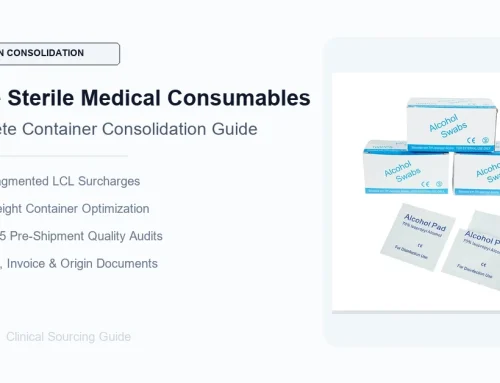
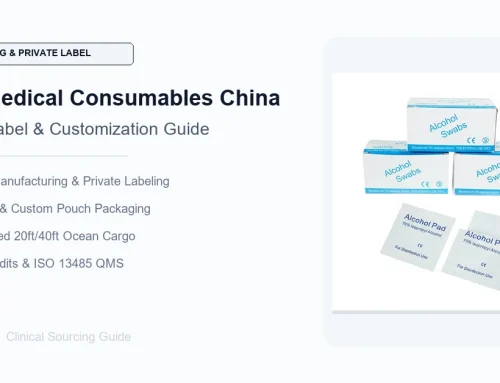
IPA swabs (70% isopropyl alcohol) and CHG alcohol swabs (2% chlorhexidine gluconate + 70% IPA) are the most common. The alcohol content must be verified independently—some factories under-fill to save costs. Our medical-grade alcohol pad buyer guide covers testing methods. For CHG-specific guidance, see our CHG alcohol swab usage guide.
Standard pack sizes are 100, 200, or 500 swabs per box. Individually wrapped swabs cost more but meet sterile field requirements. Swab material is typically non-woven polyester or polypropylene, with a weight of 40–60 gsm. The alcohol saturation rate should be at least 0.5ml per 3x3cm swab. Test this by weighing a swab before and after saturation—the liquid weight should be 60–70% of total weight.
Step 2: Verify Certifications
Certifications are the single most important verification step. Do not accept photocopies or PDFs without verifying the certificate numbers with the issuing body.
| 인증 | What It Means | Required For |
|---|---|---|
| ISO 13485 | Medical device quality management system | All medical devices globally |
| CE Mark (EU MDR) | Meets EU safety requirements | European market |
| FDA Registration | Registered with US FDA | US market |
| 510(k) Clearance | FDA premarket notification | Higher-risk devices in US |
| Anvisa | Brazil health authority registration | Brazilian market |
| MDSAP | Medical Device Single Audit Program | Multiple markets (Canada, Brazil, Japan, Australia, US) |
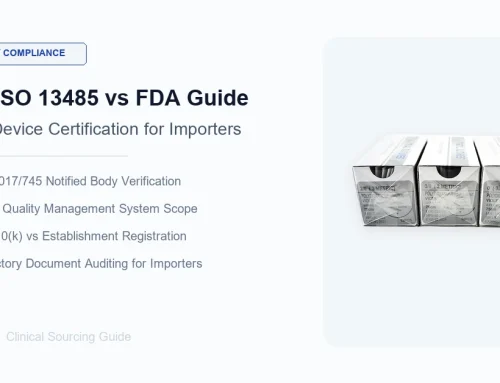
For a deeper dive into what each certification requires, read our CE, ISO 13485, and FDA certification guide. Some factories claim "FDA registered" but only have a facility registration, not device-specific 510(k) clearance. Always ask for the specific listing number.
Red flags include certificates that list a different factory address, expired dates, or issuing bodies you cannot verify. A legitimate ISO 13485 certificate costs $10,000–$20,000 to obtain—factories charging less often cut corners.
For EU MDR compliance, check that the CE certificate references the new regulation (EU 2017/745) rather than the old MDD (93/42/EEC). Under Regulation (EU) 2023/607, the transition period for valid MDD certificates has been extended to December 2027 or December 2028 depending on device risk class, provided the manufacturer meets defined QMS conditions. Products placed on the market must strictly adhere to these transition timelines.
Step 3: Evaluate Suppliers
Supplier evaluation separates successful sourcing from costly mistakes. Start with a simple checklist and follow each step rigorously.
Request Samples First
Never place a production order without physically testing samples. For sutures, test tensile strength, needle attachment force, and packaging integrity. For alcohol swabs, verify alcohol content with a hydrometer or refractometer.
Request at least 10–20 units per SKU for destructive testing. Expect to pay for samples and shipping—legitimate factories charge $30–$100 for sample sets. Free samples from unknown suppliers are often substandard.
Set up a simple testing protocol. For sutures, the USP standard requires a minimum tensile strength of 2.0 kg for 4-0 gauge, 4.0 kg for 2-0 gauge. Use a tensiometer to confirm. For needles, the attachment force should exceed the suture tensile strength—a needle that separates during surgery is a critical failure.
Verify Certificates Directly
ISO 13485 certificates have a unique number and issuing body. Contact the registrar (SGS, TÜV, BSI, DNV) to confirm the certificate is valid and covers the products you're buying. Some factories use expired or forged certificates.
The European Commission's NANDO database lists all Notified Bodies. Cross-reference the four-digit Notified Body number on the CE certificate. If the number isn't in the database, the certificate is invalid.
Ask for the certificate's scope of registration. A factory certified for "medical devices" may not be certified for sterile sutures specifically. The scope should list your exact product category. Also request the latest surveillance audit report—this shows whether the factory passed its annual inspection.
Arrange a Factory Audit
Visit in person or hire a third-party auditor like SGS, Bureau Veritas, or TÜV. A proper audit checks production lines, quality control procedures, raw material storage, and employee training records. Photos and videos can be staged—nothing replaces an on-site visit.
Audit costs range from $1,500–$4,000 depending on scope and location. This is money well spent. A single rejected container can cost $10,000–$50,000 in lost product and shipping fees.
During the audit, check the QC lab. A proper lab should have a tensiometer, pH meter, moisture analyzer, and sterility testing equipment. Ask to see their non-conformance reports for the last six months. Factories that track and correct defects are more reliable than those that hide them.
Check Export History
Ask for shipping documents from previous exports to your target market. A factory that regularly exports to Europe likely understands EU MDR requirements. Ask for references from buyers in similar markets.
Request at least three buyer references. Contact them directly and ask about product quality, lead time reliability, and after-sales support. Most legitimate factories provide references willingly.
Check the factory's export license. In China, medical device manufacturers need a special export registration from the NMPA (National Medical Products Administration). Ask for the registration number and verify it online through the NMPA portal.
Start with a Trial Order
Begin with 10–20% of your target volume. This tests production quality, lead time accuracy, and communication responsiveness before committing to large volumes. A trial order also reveals hidden costs like packaging minimums or sterilization fees.
Set clear acceptance criteria in your purchase contract. Define acceptable defect rates (typically <1% for visual defects, <0.1% for functional defects). Specify the AQL (Acceptable Quality Level) sampling standard—most medical devices use AQL 1.0 or 0.65 per ISO 2859.
Step 4: Understand MOQ & Pricing
Minimum order quantities vary significantly by product type. Factories set MOQs based on production efficiency—they need to cover setup time and material minimums.
| Product | Typical MOQ | 리드 타임 | Price Range (per unit) |
|---|---|---|---|
| Surgical sutures (box of 36) | 1,000–5,000 pcs | 20–30 days | $5–15 |
| Surgical blades (box of 100) | 10,000–50,000 pcs | 15–25 days | $0.08–0.25 |
| Alcohol swabs (box of 100) | 10,000–100,000 pcs | 15–20 days | $0.02–0.06 |
| Disposable syringes (3-part, 5ml) | 50,000–100,000 pcs | 20–30 days | $0.08–0.18 |
| IV catheters (20G) | 10,000–50,000 pcs | 25–35 days | $0.30–0.80 |
| Blood collection tubes (5ml) | 50,000–200,000 pcs | 20–30 days | $0.10–0.25 |
Pricing factors include raw material costs (medical-grade resin costs more than industrial-grade), packaging type (blister pack vs. bulk), sterilization method (EO gas vs. gamma radiation), and certification scope. A factory with full CE technical files will charge more than one selling only domestically.
For bulk purchasing strategies, see our guide to buying surgical sutures in bulk. If you need custom specifications, our OEM medical consumables guide covers private labeling, MOQ evaluation, and custom packaging requirements.
Negotiate MOQs by offering to pay a setup fee. Some factories will reduce MOQs by 30–50% if you cover the initial production line changeover cost ($200–$500 per SKU). Also ask about mixed containers—you can combine different products to reach the total MOQ.
Step 5: Shipping & Logistics
Most Chinese medical consumable factories ship FOB (Free on Board) from Shanghai, Ningbo, or Shenzhen. This means the factory covers costs until the goods are loaded onto the vessel.
Sea freight is the most economical option for bulk orders. Transit time is 25–40 days to US West Coast, 30–45 days to Europe, and 35–50 days to South America. A 20-foot container holds roughly 10–15 pallets of sutures or 20–30 pallets of swabs.
Air freight costs 4–6 times more but delivers in 5–7 days. Use air freight for urgent orders, sample shipments, or high-value products where inventory carrying costs are higher than shipping costs.
Required documentation: Your supplier must provide a Certificate of Analysis (COA), packing list, commercial invoice, and certificate of origin. For CE-marked products, you also need the Declaration of Conformity and technical file summary. Without these, customs clearance will be delayed and your shipment may be rejected at the port of entry.