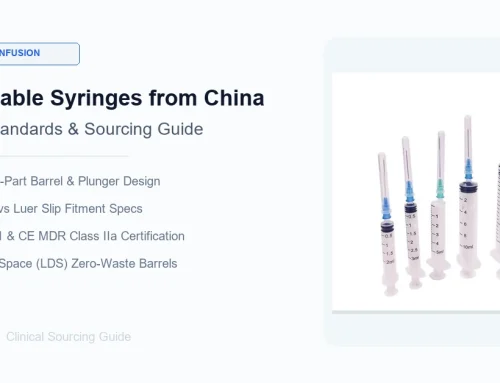




Disposable hypodermic syringes are among the highest-volume sterile consumables across the healthcare continuum. From mass immunization campaigns and intravenous bolus administration to arterial blood sampling and compounding pharmacy prep, syringes operate as precision fluid-dispensing instruments. Under international standard ISO 7886-1 (Sterile hypodermic syringes for single use), syringe design is engineered to ensure leak-free sealing, low gliding force, clear volumetric graduations, and zero chemical contamination.
For hospital tender committees, clinical nurse managers, and pharmaceutical packaging engineers, a major technical distinction is choosing between 2-part (latex-free, rubber-free) 그리고 3-part (elastomeric plunger seal) syringe designs. Furthermore, the chemical composition of medical-grade silicone oil lubricants and their potential interaction with sensitive biologic medications represent a critical clinical safety topic. In this procurement guide, we analyze syringe barrel physics, compare friction mechanics, review ISO 7886-1 dead-space tolerances, and examine bulk sourcing economics (disposable syringes from China quality standards guide).
목차
- 1. Structural Architectures: 2-Part vs. 3-Part Design Mechanics
- 2. Medical-Grade Silicone Oil Lubrication & Biologic Aggregation Risks
- 3. Low Dead Space (LDS) Engineering: Preventing Expensive Drug Waste
- 4. Barrel Clarity & Medical-Grade Polypropylene Purity
- 5. ISO 80369-7 Luer Connections: Slip vs. Threaded Lock Security
- 6. Procurement Matrix: Immunization, Anesthesia & Oncology Applications
- 7. Frequently Asked Questions (FAQ)
1. Structural Architectures: 2-Part vs. 3-Part Design Mechanics
The core distinction between the two architectures lies in how the fluid seal is achieved:
- 2-Part 주사기 (Plunger + Barrel): Feature a precision-molded polypropylene or polyethylene plunger head that seals directly against the internal barrel wall via interference fit. They contain zero rubber gaskets and zero added silicone oil lubricants, eliminating potential extractables and leachables.
- 3-Part Syringes (Barrel + Plunger Stem + Elastomeric Stopper): Feature a natural rubber or synthetic isoprene elastomeric stopper mounted at the plunger tip. The flexible dual-rib gasket provides exceptional hermetic sealing and smooth gliding force when lubricated with medical silicone oil.
2. Medical-Grade Silicone Oil Lubrication & Biologic Aggregation Risks
While 3-part syringes offer effortless gliding dynamics, the silicone oil lubricant introduces specific biochemical considerations:
| Design Feature | 2-Part Syringe Design | 3-Part Syringe Design |
|---|---|---|
| Plunger Components | Single molded polymer plunger | Polymer stem + Synthetic rubber stopper |
| Lubricant Requirement | Zero silicone oil added | Medical silicone oil (Dow Corning 360 equivalent) |
| Biologic Compatibility | Superior (No silicone-induced protein aggregation) | Standard (Verify silicone limits for mAb compounding) |
| Gliding Tactile Feel | Slightly higher initial breakaway force | Ultra-smooth, uniform gliding resistance |
| Latex Allergy Risk | Zero (100% polymer construction) | Zero when using synthetic polyisoprene stoppers |
3. Low Dead Space (LDS) Engineering: Preventing Expensive Drug Waste
Standard syringes retain residual medication inside the nozzle hub after plunger depression. In mass vaccination programs or oncology compounding where single-dose vials are expensive, deploying Low Dead Space (LDS) syringes with protruding plunger tips reduces residual dead volume from 0.07 ml to less than 0.01 ml, yielding 10% to 20% additional doses per vial.
4. Barrel Clarity & Medical-Grade Polypropylene Purity
Syringe barrels must use high-clarity, radiation-stable medical polypropylene (PP) compliant with USP Class VI. High optical transparency allows immediate visual detection of air bubbles and particulate matter prior to injection, while solvent-resistant black graduations resist wipe-off during alcohol decontamination.
5. ISO 80369-7 Luer Connections: Slip vs. Threaded Lock Security
Connecting syringes to needles or IV lines is governed by ISO 80369-7 small-bore connector standards:
- Luer Slip (Central / Eccentric): Push-fit friction seal ideal for standard intramuscular injections and phlebotomy. Eccentric tips allow horizontal alignment close to the skin for smooth venipuncture.
- Luer Lock (Threaded Collar): A mechanical threaded collar that prevents accidental disconnection under high infusion pressures, mandatory for chemotherapy, arterial lines, and CT contrast power injectors.
6. Procurement Matrix: Immunization, Anesthesia & Oncology Applications
Hospitals optimize cost and clinical efficacy by categorizing syringe procurements: 2-part syringes for IV compounding pharmacy cleanrooms and mass vaccination; 3-part Luer Lock syringes for intensive care infusion pumps, anesthesia manifolds, and oncology chemotherapy delivery. Consolidate your supply chain with our medical consumables from China procurement guide.
7. Frequently Asked Questions (FAQ)
Q1: Why are 2-part syringes preferred for ophthalmic intraocular injections?
In intravitreal anti-VEGF injections, microscopic silicone oil droplets shed from conventional 3-part syringes can float in the patient's vitreous humor, causing symptomatic floaters and optical disturbances. Silicone-free 2-part syringes completely eliminate this complication.
Q2: What sterilization methods are standard for disposable syringes?
Ethylene Oxide (EO) gas is the primary method for 3-part syringes to preserve rubber elasticity. Cobalt-60 Gamma radiation or E-beam is frequently utilized for 2-part polymer syringes containing radiation-stabilized polypropylene.
Source ISO 7886-1 Sterile Syringes in Bulk Container Volume
Shevenmed supplies healthcare distribution networks with certified 2-part and 3-part Luer slip and Luer lock syringes (1ml to 60ml) in sterile blister packaging. Request wholesale pricing today.