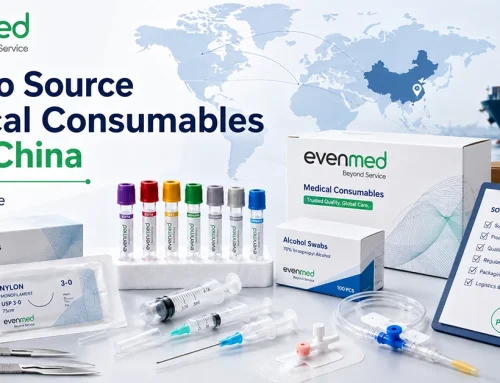




Skin antisepsis represents the primary physical and biochemical barrier preventing Healthcare-Associated Infections (HAIs), Catheter-Related Bloodstream Infections (CRBSIs), and Surgical Site Infections (SSIs). Among modern topical skin antiseptic formulations, 2% Chlorhexidine Gluconate (CHG) combined with 70% Isopropyl Alcohol (IPA) is recognized by international clinical authorities—including the Centers for Disease Control and Prevention (CDC), the World Health Organization (WHO), and the Infusion Nurses Society (INS)—as the frontline standard of care for pre-operative skin preparation and vascular access site disinfections.
However, the antimicrobial efficacy of CHG swabs is not automatic. Improper application technique, neglecting mechanical friction scrubbing, or failing to allow full evaporation can degrade bacterial kill rates by over 50%. For international healthcare distributors, hospital infection control committees, and medical consumables importers, understanding correct clinical protocols and sourcing compliant 2% CHG + 70% IPA chlorhexidine alcohol swabs alongside complementary procedural disposables—such as peripheral IV catheters, 3-part sterile disposable syringes및 safety butterfly blood collection needles—is essential to build robust, cost-effective clinical supply chains.
Dual-Action Antimicrobial Mechanism: 2% CHG + 70% IPA Synergism
The combination of 2% Chlorhexidine Gluconate and 70% Isopropyl Alcohol functions through two distinct, complementary biochemical pathways:
| Antiseptic Component | Biochemical Mechanism | Speed of Kill | Persistence & Residual Effect |
|---|---|---|---|
| 70% Isopropyl Alcohol (IPA) | Rapidly dissolves microbial lipid cell membranes and denatures cellular proteins | Immediate bactericidal action within 15–30 seconds of physical application | Zero residual activity; evaporates completely, leaving dry stratum corneum |
| 2% Chlorhexidine Gluconate (CHG) | Cationic molecule binds electrostatically to negatively charged bacterial cell walls, causing cytoplasmic leakage and coagulation | Intermediate onset; enhanced by alcohol pre-treatment | Persistent antimicrobial activity extending up to 48 hours; binds tenaciously to skin keratin even in the presence of blood and organic fluid |
Compared to traditional aqueous povidone-iodine (which is readily inactivated by blood, requires prolonged drying, and offers minimal residual protection), CHG/IPA exhibits broad-spectrum activity against Gram-positive pathogens (including Methicillin-Resistant Staphylococcus aureus [MRSA] and Staphylococcus epidermidis), Gram-negative bacilli (such as E. coli 그리고 Pseudomonas aeruginosa), pathogenic yeasts, and enveloped viruses.
Clinical Protocol 1: Peripheral Intravenous (PIV) Cannulation Prep
Peripheral venous access is among the most common invasive procedures in acute care. Correct skin antisepsis prevents thrombophlebitis and bacteremia:
- Perform Hand Hygiene & Don Gloves: Wash hands thoroughly and don clean clinical examination gloves.
- Select & Inspect Site: Palpate the target vein before antiseptic application. If site hair must be removed, use a surgical clipper; never use razors that cause microscopic skin abrasions.
- Open Swab Sachet: Tear the sterile peelable pouch at the notch. Remove the saturated swab stick or prep pad without touching the foam applicator tip to non-sterile surfaces.
- Mechanical Friction Scrub (30 Seconds Minimum): Apply the swab to the venipuncture site using a vigorous, back-and-forth friction scrub for at least 30초 covering a target area of at least $5\,\text{cm} \times 5\,\text{cm}$ ($2" \times 2"$). Friction is clinically vital: the mechanical shearing force dislodges superficial desquamating epithelial cells and drives the antiseptic deep into the subcutaneous hair follicles and sebaceous crevices where 80% of resident skin flora reside.
- Mandatory Complete Air Drying (30 to 60 Seconds): Allow the prepped area to air dry completely. Do not blot with dry gauze, fan with hands, or blow on the skin. Wet alcohol causes acute burning pain upon needle puncture, increases the risk of chemical dermatitis beneath occlusive dressings, and can hemolyze diagnostic blood specimens.
- Aseptic Cannulation: Insert the catheter smoothly without re-palpating the prepped skin. If palpation is unavoidable, the clinician must wear sterile gloves. Consult our comprehensive peripheral IV catheter insertion guide for gauge selection.
Clinical Protocol 2: Central Venous Catheter (CVC) & PICC Site Preparation
Central vascular access devices (including internal jugular, subclavian, and femoral lines) demand maximal sterile barrier precautions and rigorous skin antisepsis:
| Procedure Parameter | Standard Clinical Requirement | Rationale & Infection Control Basis |
|---|---|---|
| Minimum Prep Area | $15\,\text{cm} \times 15\,\text{cm}$ ($6" \times 6"$) or larger | Encompasses the entire planned insertion field and potential suture/dressing securement zone |
| Scrubbing Technique | Concentric circles outward or cross-hatch friction (per facility protocol) | Vigorous application ensuring complete coverage of skin folds and hair follicles |
| Contact Scrub Time | Dry site (jugular/subclavian): $\ge 2\,\text{minutes}$; Moist site (femoral/groin): $\ge 3\,\text{minutes}$ | Extended contact ensures high-density colonization in moist intertriginous skin folds is eradicated |
| Complete Drying Time | Minimum 2 full minutes (air dry) | Residual wet alcohol enclosed under large transparent dressings can cause severe erythema and chemical blistering |
| Sterile Barrier | Full-body sterile patient drape + surgical gown, cap, and mask | Eliminates airborne microbial deposition onto the antiseptic-prepped access zone |
Clinical Protocol 3: Blood Culture Venipuncture Technique
Diagnostic blood cultures are notoriously susceptible to false-positive contamination caused by resident coagulase-negative staphylococci. A contaminated blood culture leads to unnecessary antibiotic administration, extended hospitalization, and increased hospital costs:
- Two-Step Antiseptic Technique: Utilize two separate sterile swabs. Use the first swab to vigorously scrub the rubber septa of both aerobic and anaerobic blood culture bottles for 15 seconds, allowing them to air dry.
- Patient Skin Scrub: Use the second swab to scrub the patient's puncture site for 30 seconds using vigorous multi-directional friction.
- Zero Palpation Rule: Never touch the vein after the final prep has dried. Collect blood smoothly using sterile collection sets or transfer devices. For routine skin hygiene, review our clinical alcohol pad usage and aseptic skin preparation guide.
Critical Clinical Contraindications & Precautions
While 2% CHG + 70% IPA is exceptionally safe for intact adult skin, healthcare staff must observe vital safety boundaries:
- Known Chlorhexidine Hypersensitivity: If the patient has a documented CHG allergy, substitute with sterile sterile 70% isopropyl alcohol swabs or 10% povidone-iodine.
- Premature & Low-Birth-Weight Neonates: Because premature infants under 2 months of age possess an immature, highly permeable epidermal barrier, CHG absorption can cause systemic toxicity and severe chemical burns. Use sterile saline or gentle non-alcoholic antiseptics per neonatal ICU guidelines.
- Neurological & Ophthalmic Contraindications: Never apply CHG swabs near the eye (corneal toxicity / keratitis risk), inner ear (ototoxicity / permanent sensorineural deafness if entering through a perforated tympanic membrane), or directly onto brain tissue or meninges during neurosurgical procedures.
- Intact Skin Only: CHG/IPA swabs are designed exclusively for intact, unbroken skin. Never apply directly into deep open wounds, third-degree burns, or mucous membranes.
Product Formats: Swab Sticks, Prep Pads, and Applicators
Selecting the optimal product format enhances clinical ergonomics while minimizing consumable waste:
| Swab Format | Solution Fill Volume | Applicator Head Construction | Primary Sourcing / Use Scenario |
|---|---|---|---|
| Medical Swab Stick | $1.5\,\text{ml}$ to $3.0\,\text{ml}$ | Surgical-grade medical polyurethane foam tip ultrasonically bonded to a hollow rigid polypropylene wand | Venipuncture, peripheral IV cannulation, dialysis fistula access, blood gas sampling |
| Sachet Prep Pad | $1.0\,\text{ml}$ to $2.0\,\text{ml}$ | Folded multi-layer non-woven fabric pad (viscose/polyester blend) | Vial stopper disinfection, suture removal cleansing, quick injection site prep |
| Large Surgical Applicator | $10.5\,\text{ml}$ to $26\,\text{ml}$ | Crushable internal glass ampoule with sponge applicator handle | Major operating room surgical site draping, cardiac catheterization, CVC/PICC placement |
For operating room teams preparing sterile surgical scrub stations, explore our complementary surgical hand scrub brushes with chlorhexidine.
Manufacturing Standards, Packaging Integrity & Regulatory Reality
Because topical antiseptics contain active pharmacological reagents and volatile alcohols, international procurement requires strict attention to chemical stability, packaging barriers, and localized regulatory compliance:
Packaging Barrier Technology (Zero Alcohol Evaporation)
Standard low-cost polybags cannot contain volatile isopropyl alcohol vapors over extended shelf lives. High-grade CHG swabs are sealed in multi-layer composite foil pouches (Polyester Film + Aluminum Foil + Polyethylene Film / PET+AL+PE). The internal aluminum barrier ensures zero solvent permeation, guaranteeing full 70% IPA saturation throughout a validated 24 to 36-month shelf life.
Regulatory & Quality System Guidance
- ISO 13485:2016 & GMP: Manufacturing must take place under strict Good Manufacturing Practice (GMP) cleanroom conditions with automated liquid metering, visual particulate inspection, and microbiological bioburden monitoring.
- European Union (EU MDR / BPR): In European jurisdictions, skin antiseptics may fall under the Medical Device Regulation (MDR) as procedural accessories or under the Biocidal Products Regulation (BPR). Importers should confirm technical files and CE conformity declarations with qualified EU representatives.
- United States FDA Classification: In the US market, topical patient preoperative skin preps and vascular access antiseptics are regulated under the FDA Over-the-Counter (OTC) Drug Monograph or require active New Drug Applications (NDA / 510k combination reviews). Only a selective tier of Chinese specialized pharmaceutical/antiseptic facilities hold active US FDA Drug Establishment Registrations and National Drug Codes (NDC). Overseas buyers must verify exact listing codes for US-bound shipments rather than accepting generalized regulatory assurances.
Supply Chain Sourcing Advantage: Complete Vascular Access Consolidation
Procuring topical antiseptic swabs as a standalone product from overseas manufacturers frequently leads to high logistics costs and customs friction. Because alcohol-saturated swabs contain flammable liquid, shipments require specialized dangerous goods (DG) packaging, Class 4.1 / Class 3 transport classifications, or validated non-hazardous maritime transport certificates (Special Provision A46 / UN 3175 exemptions for individually wrapped small sealed sachets containing less than $10\,\text{ml}$ of liquid completely absorbed in non-woven pads).
As an agile medical supply chain and export partner, 심지어 의료 solves this complexity through multi-category supply chain consolidation:
- Comprehensive Vascular Access Kits: Consolidate 2% CHG swabs alongside matching peripheral IV catheters, sterile transparent IV dressings, 3-part sterile disposable syringes및 safety butterfly blood collection needles into unified container shipments.
- Harmonized Dangerous Goods & Sea Freight Documentation: We provide full chemical regulatory support, including compliant Safety Data Sheets (SDS / MSDS per GHS standards), Certificate of Analysis (COA) confirming active 2% CHG and 70% IPA percentages, and official Safe Transport Declarations for ocean container shipping.
- Private OEM Packaging: Custom sachet foil printing, customer-branded inner dispenser boxes (50, 100, or 200 units per box), multi-language warning text, and GS1-compliant DataMatrix barcodes.
Frequently Asked Questions (FAQ)
1. Why is 70% Isopropyl Alcohol preferred over 99% alcohol in CHG swab formulations?
Pure 99% alcohol evaporates too rapidly and causes instant coagulation of superficial bacterial surface proteins without penetrating inside the microbial cell. Water in the 70% solution slows evaporation, maintaining crucial moisture that allows the alcohol to cross bacterial cell membranes, dissolve lipid envelopes, and denature essential intracellular enzymes effectively.
2. Can 2% CHG swabs be used to disinfect catheter hubs and needleless connectors?
Yes. 2% CHG in 70% IPA is recognized as the most effective antiseptic for "scrubbing the hub" on needleless IV connectors and dialysis catheter ports. Clinicians should scrub the connector septum vigorously with friction for 15 seconds and allow it to dry completely before accessing the line.
3. How do I know if an individual CHG swab package has degraded?
Before opening, inspect the foil sachet. If the sachet feels flat, brittle, or displays puncture pinholes or leakage, discard it immediately. Upon opening, the foam or non-woven pad must be thoroughly saturated with liquid. If the swab feels dry, alcohol evaporation has occurred, compromising antimicrobial potency.
4. What is the standard shelf life of Even Medical 2% CHG + 70% IPA swabs?
Our CHG/IPA swabs have a validated shelf life of 24 to 36 months from the manufacturing date when stored in intact multi-layer aluminum foil sachets at room temperature ($15^\circ\text{C}$ to $30^\circ\text{C}$ / $59^\circ\text{F}$ to $86^\circ\text{F}$) away from direct sunlight and excessive heat.
5. Are CHG swabs classified as dangerous goods during international ocean shipping?
Standard individually wrapped sealed sachets containing small volumes of alcohol completely absorbed within foam or non-woven substrates generally qualify for maritime transport exemptions under IMDG Code Special Provision 216 / UN 3175 (solids containing flammable liquid). We supply verified Non-Hazardous Cargo Inspection Certificates and GHS SDS documentation to ensure smooth maritime transit and customs clearance.
Ready to upgrade your hospital skin antisepsis consumables with certified batch quality and consolidated ocean freight? Contact our medical skin antisepsis export team today to review technical specifications, receive free clinical evaluation samples, and discuss custom OEM volume orders.