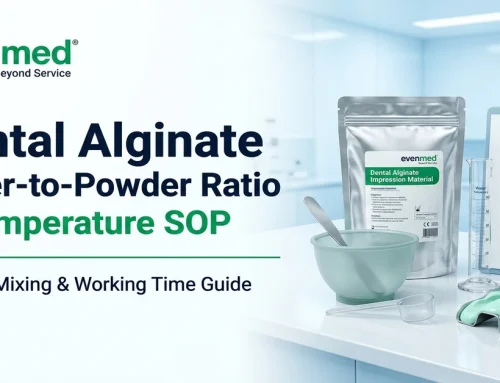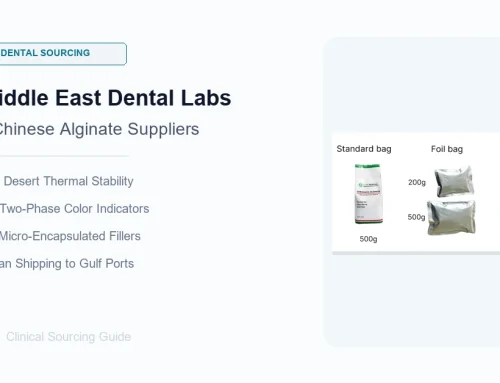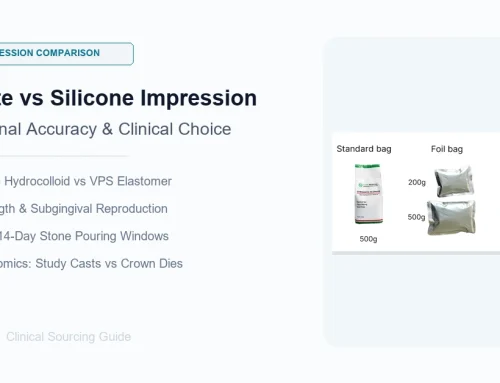




Dental alginate impression material is an irreversible hydrocolloid supplied as a powder and mixed with water before use. The mixture changes into an elastic gel that records the shape of teeth and surrounding oral structures. Depending on the product's intended use and the dental professional's procedure, alginate may be selected for preliminary impressions, study models, opposing-arch records, orthodontic models, or other applications stated in the manufacturer's instructions for use (IFU).
This guide explains the material categories, properties, handling variables, limitations, and procurement checks that matter when comparing dental alginate. It does not replace a product-specific IFU, safety data sheet (SDS), technical data sheet (TDS), local infection-control procedure, or professional judgment.
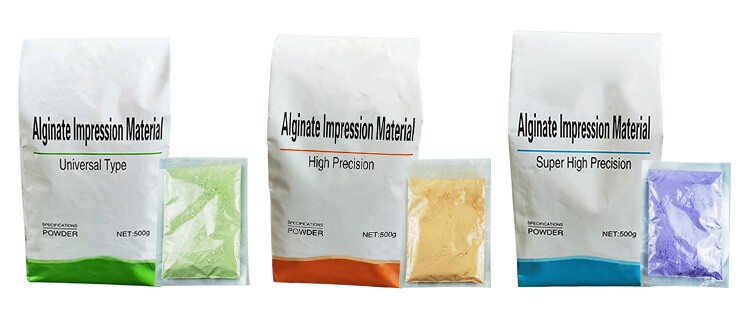
What is dental alginate impression material?
Alginate is a water-based impression material in the irreversible hydrocolloid family. "Irreversible" means that after the material sets through a chemical reaction, it cannot be returned to its original mixed state. This distinguishes it from reversible hydrocolloids and from elastomeric impression materials such as addition silicone.
A typical formulation contains a soluble alginate, a calcium source that supports gel formation, fillers, and reaction-control ingredients. Exact ingredients and concentrations vary by manufacturer and product. Buyers should therefore use the current SDS and TDS for composition, hazards, storage, and handling information instead of assuming that one formula represents every alginate product.
Common types of dental alginate
Alginate products can be grouped by how they are formulated and presented. The descriptions below are comparison categories, not universal specifications.
| Product characteristic | What it changes | What to verify |
|---|---|---|
| Regular-set or fast-set profile | The time available for mixing, loading, positioning, and setting | Working and setting times at the temperature stated in the IFU |
| Chromatic formulation | Color stages may indicate parts of the mixing or setting sequence | What each color means and whether timing still depends on temperature |
| Dust-controlled powder | Designed to reduce loose airborne powder during dispensing and mixing | Handling instructions and any claims supported by supplier documentation |
| Extended-pour formulation | May allow a longer validated interval before a model is poured | The permitted storage method and maximum delay stated for that exact product |
| Flavor or color options | Changes sensory or visual characteristics | Available variants, ingredient disclosure, and local purchasing requirements |
Terms such as "high precision" or "extended pour" should be supported by test data for the exact formulation. They should not be treated as interchangeable grades across suppliers.
Properties that influence performance
Working and setting behavior
Working time starts when powder and water are combined. Water temperature, powder-to-water ratio, mixing method, room conditions, and product formulation can all affect the usable time. A generic ratio or timing value should not be transferred from one brand to another. Use the measuring devices, water temperature range, ratio, and timing specified in the current IFU.
Detail reproduction and elastic recovery
The material must record the detail required for its intended application and recover after removal. Results depend on the formulation as well as mixing quality, tray selection, material thickness, setting, removal, and model-pouring procedure. Procurement samples should be evaluated under the buyer's actual workflow rather than selected from a single marketing adjective.
Tear strength and removal
Thin sections are more vulnerable to tearing. Product selection and technique should account for the intended anatomy, tray design, and removal path. A damaged or visibly distorted impression should be assessed under the dental facility's quality procedure before it is used to produce a model.
Dimensional stability
Water-based hydrocolloids can change dimension during storage. Water loss and water uptake are both relevant, so placing an impression in water is not a general preservation method. Unless the exact product documents a validated delayed-pour procedure, prompt model pouring is the conservative approach. Research on immediate and delayed pouring also shows that stability is material-dependent, which is why results from one formulation cannot be applied to every alginate.
Mixing and handling controls
Alginate should be handled by trained personnel according to the product IFU and the dental facility's procedures. A controlled workflow normally includes the following checks:
- Confirm the product, lot, expiry date, storage history, and intended use before opening the package.
- Use the manufacturer's powder and water measures. Level and measure consistently instead of estimating the ratio.
- Use water within the IFU temperature range and mix for the stated duration using compatible equipment.
- Select a suitable tray and follow the documented loading, positioning, setting, and removal procedure.
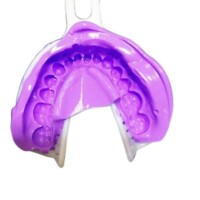
- Inspect the completed impression for tears, voids, tray exposure, separation, or distortion according to the facility's acceptance criteria.
- Rinse, disinfect, communicate, package, and transfer the impression under the applicable infection-control protocol and product instructions.
- Pour the compatible model material within the validated interval and storage conditions stated for that product.
For disposal, follow the current SDS, applicable local requirements, and the dental facility's waste-handling procedure; waste classification depends on the product and how the material was used.
For a more detailed material-preparation discussion, read how to use alginate molding powder efficiently. The exact IFU supplied with the purchased product remains the controlling instruction.
Alginate compared with other impression approaches
| Approach | Typical decision factors | Procurement questions |
|---|---|---|
| アルギン酸塩 | Simple water mixing, short workflow, and suitability for the documented application | Setting profile, dimensional-stability window, dust control, packaging, IFU, SDS, and model compatibility |
| Addition silicone | Application-specific detail, elastic behavior, dimensional stability, viscosity system, and delivery method | Putty/body combinations, mixing system, working time, disinfection compatibility, and storage |
| ポリエーテル | Application requirements, stiffness after setting, handling, and moisture-related considerations | Indications, tray adhesive, removal considerations, disinfection, and storage requirements |
| Digital impression | Scanner access, software workflow, case suitability, training, and laboratory compatibility | File formats, system interoperability, support, calibration, data handling, and total workflow cost |
The right option depends on the intended procedure and validated workflow. For a broader comparison, see our guide to dental impression material types and applications and review the available A-silicone impression material formats.
What dental buyers should compare
For distributors, clinics, laboratories, and institutional procurement teams, a useful comparison goes beyond price per bag. Request evidence for the exact SKU and packaging configuration being quoted.
- Intended use: Verify the applications stated in the current labeling and IFU.
- Product identity: Match the trade name, formulation, setting profile, flavor or color, package size, and catalog number across the quotation and documentation.
- Regulatory evidence: Request current market-specific documents where applicable. A reference to a standard is not proof that a product is certified or registered.
- Technical documentation: Obtain the current IFU, TDS, SDS, shelf-life statement, storage conditions, and lot-traceability information.
- Performance data: Review the test method, sample identity, conditions, acceptance criteria, and date behind precision, setting, tear, or stability claims.
- Workflow compatibility: Confirm trays, mixing equipment, disinfectants, dental stone, packaging, and transport conditions used by the receiving organization.
- Quality evaluation: Use samples or a controlled trial before changing a validated clinical or laboratory workflow.
- Supply requirements: Confirm labeling language, unit packaging, carton quantity, private-label scope, documentation lead time, and change-notification process.
Evenmed offers alginate impression material in multiple documented product options. Buyers can request the current specification, packaging information, and available documentation for the exact option under review. Browse our latest technical and procurement articles for related material guides.
Frequently asked questions
Is every alginate product mixed at the same ratio?
No. Ratios, measuring devices, water temperatures, and mixing times are product-specific. Always use the current IFU for the exact product and package.
How long can an alginate impression wait before pouring?
The validated interval depends on the formulation and storage method. Some products document extended-pour capability, while conventional materials may require prompt pouring. Follow the exact product's IFU and do not infer a delay time from another brand or from a generic article.
Can an alginate impression be stored in water?
Water immersion is not a general storage solution because hydrocolloid impressions can take up water and change dimension. Use only the storage method documented by the manufacturer and the dental facility's procedure.
Does compliance with ISO 21563 prove that a product is certified?
No. ISO 21563:2021 describes requirements and test methods for hydrocolloid impression materials. A supplier must provide evidence that applies to the exact product; citing the standard alone is not certification evidence.
Why should delayed-pour claims be checked by formulation?
A comparative study of irreversible hydrocolloid alternatives found different dimensional behavior across tested materials and storage intervals. The practical conclusion for buyers is that delayed-pour performance is product-specific. See the open-access study indexed by PubMed.
Request product documentation
When requesting a quotation, include the intended application, setting profile, package size, estimated quantity, destination market, labeling language, and required documentation. Our team can then match the inquiry to the relevant product option without assuming that one specification fits every workflow. To minimize material loss and achieve ideal working consistency during clinical mixing, follow our hands-on guide on how to use and not waste alginate molding powder. Once the impression is retrieved, preserve its anatomical fidelity by immediately pouring working models as detailed in how dental stone is used in dentistry. When subgingival margins or multiple crown preps require superior tear strength, compare hydrocolloid capabilities against silicone impression materials. For high-fidelity prosthetic and full-arch casting protocols, review our specialized guide on alginate impression materials in dental & 3D casting, optimize your spatulation techniques with alginate powder for 3D mold casting, and explore life-casting workflows in alginate in the art and sculpture industry. For a broader clinical comparison across elastomeric and rigid impression systems, consult the ultimate guide to dental impression materials, or troubleshoot silicone setting issues with why silicone impression materials fail and how to resolve them.
Request an alginate impression material quotation and current documentation.