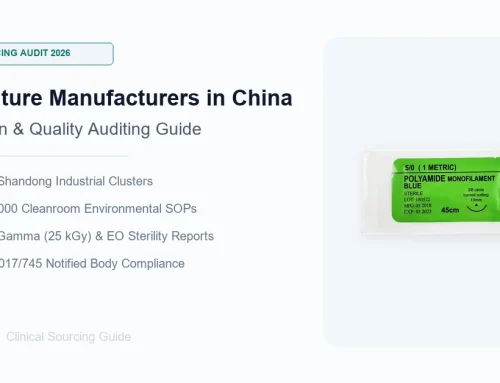




Surgical sutures are among the most critical clinical consumables in any hospital operating room. A minor defect—such as an insecure needle swage attachment, inconsistent thread tensile strength, or compromised sterile foil barrier—can lead to catastrophic intraoperative needle snapping or severe surgical site infections. In recent years, China has emerged as the premier manufacturing engine for sterile surgical consumables, producing billions of suture foils annually for global health authorities and private medical networks.
However, for international hospital procurement directors, biomedical engineers, and medical supply importers, navigating the vast ecosystem of Chinese suture manufacturers requires a discerning eye. Quality standards vary widely between tier-one automated cleanroom facilities and low-end component assemblers. Drawing on our role as an integrated medical supply chain partner, this guide outlines the 5 non-negotiable quality and regulatory checkpoints every hospital buyer must examine before contracting with Chinese suture suppliers, aligning with our comprehensive surgical consumables from China guide and international standards.
目次
- 1. Checkpoint 1: Automated Needle Swaging & Pull-Off Force Curves
- 2. Checkpoint 2: Silicone Coating Uniformity & Tissue Drag Resistance
- 3. Checkpoint 3: Sterilization Validation & Residual Gas Desorption
- 4. Checkpoint 4: Primary Aluminum Foil Barrier & Vacuum Bubble Testing
- 5. Checkpoint 5: Validating True Manufacturer vs. Middleman Scope
- 6. Hospital Tender Evaluation Matrix & Testing Standards
- 7. Frequently Asked Questions (FAQ)
1. Checkpoint 1: Automated Needle Swaging & Pull-Off Force Curves
The attachment junction where the surgical needle is crimped onto the suture filament is the single most vulnerable point during surgery. If a needle dislodges deep within a pelvic or thoracic cavity, retrieving it incurs prolonged anesthesia and heightened patient risk.
When auditing prospective suppliers, hospital buyers must inspect the swaging equipment. Elite Chinese facilities deploy laser-drilled needles with automated optical-sensor crimping presses rather than manual channel crimping. In addition, demand verified batch test records documenting compliance with United States Pharmacopeia (USP) tensile attachment limits:
- USP Minimum Pull-Off Force: For USP 4-0 sutures, minimum average pull-off force must exceed 4.4 N (0.45 kgf); for USP 2-0, it must exceed 10.8 N (1.10 kgf); and for USP 0, it must exceed 14.2 N (1.45 kgf).
- Deflection Resistance: Surgical needles made from inferior 420J2 stainless steel bend easily under thick fascia. Premier manufacturers utilize high-tensile AISI 302 or 420 martensitic alloys, ensuring optimal ductility without brittle fracture.
2. Checkpoint 2: Silicone Coating Uniformity & Tissue Drag Resistance
For braided sutures—such as silk braided sutures and synthetic polyglycolic acid—coating technology directly influences surgeon tactile feedback. Substandard suppliers cut costs by using uneven silicone or paraffin dips that flake off during knot rundown.
Top-tier Chinese manufacturers apply micro-dispersed silicone or polycaprolactone with calcium stearate in closed-loop ultrasonic coating chambers. This ensures:
- Consistent Knot Rundown: Knots slide smoothly into place without "chattering" or premature friction lockup.
- Zero Coating Flaking: Eliminates microscopic polymer particulate shedding into wound beds, preventing foreign-body micro-granulomas.
- Preserved Knot Security: The coating formula allows the braided core to compress under final tension, locking the square knot firmly with standard throws.
3. Checkpoint 3: Sterilization Validation & Residual Gas Desorption
A Certificate of Sterility is only as reliable as the physical cycle data behind it. Hospital buyers must understand which sterilization method matches each suture biomaterial:
- Ethylene Oxide (EO) Gas (ISO 11135): Standard for absorbable sutures (PGA, PDO) and braided silk. Because EO is a known mutagen, thorough aeration is vital. Ensure the supplier's test reports confirm residual EO gas below 10 ppm and ethylene chlorohydrin below 20 ppm per ISO 10993-7.
- Cobalt-60 Gamma Radiation (ISO 11137): Standard for nylon monofilament sutures and polypropylene. Verified Chinese export facilities guarantee a minimum absorption dose of 25 kGy, delivering a Sterility Assurance Level (SAL) of 10-6 without polymer embrittlement.
4. Checkpoint 4: Primary Aluminum Foil Barrier & Vacuum Bubble Testing
Synthetic absorbable sutures degrade through biological hydrolysis. If atmospheric humidity penetrates the primary pouch, moisture initiates premature polymer breakdown on the warehouse shelf, resulting in broken sutures at the time of clinical use.
Inspect the foil pouch construction: high-performance suture packs utilize tri-laminate medical aluminum foil (PET / AL / PE or Surlyn) with a Water Vapor Transmission Rate (WVTR) below 0.01 g/m²/24h. Top manufacturers conduct 100% online seal inspection and destructive vacuum bubble emission testing (ASTM D3078) to verify hermetic integrity.
5. Checkpoint 5: Validating True Manufacturer vs. Middleman Scope
A common pitfall for international hospital tender boards is contracting with shell trading entities that outsource production to unverified sub-tier workshops. Buyers must review certifications with precision:
- ISO 13485:2016 Scope: Confirm the certificate explicitly lists "Design, Development, Manufacture, and Distribution of Sterile Surgical Sutures with/without Needles." Certificates that state only "Sales" または "Trade" do not cover manufacturing quality oversight. Review our CE vs ISO 13485 vs FDA certification guide for detailed verification steps.
- Factory Location Alignment: Verify that the legal address matches the audited manufacturing cleanroom in Jiangsu (Taizhou/Changzhou) or Shandong (Weihai/Heze).
6. Hospital Tender Evaluation Matrix & Testing Standards
| Evaluation Parameter | Standard Verification Method | Acceptable Benchmark |
|---|---|---|
| Tensile Breaking Strength | Electronic Tensile Testing (USP/EP) | ≥ 100% of USP knot/straight tensile tables |
| Needle Attachment Force | Swage Pull-Off Test (ASTM F1840) | Zero detachment below USP minimum limits |
| Packaging Hermeticity | Vacuum Decay / Bubble Test (ASTM D3078) | Zero bubble release at -50 kPa for 30s |
| EO Residual Concentration | Gas Chromatography (ISO 10993-7) | Residual EO < 10 μg/g; ECH < 20 μg/g |
7. Frequently Asked Questions (FAQ)
Q1: How can hospitals ensure Chinese suture suppliers comply with European MDR regulations?
Request the official CE certificate issued under Regulation (EU) 2017/745 (MDR) by an active Notified Body. For manufacturers operating under extended MDD certificates pursuant to Regulation 2023/607, verify that the manufacturer filed a formal MDR application before May 2024 and executed a signed written agreement with an accredited Notified Body.
Q2: What is the typical shelf life of synthetic absorbable sutures from China?
When sealed in certified multi-layer aluminum foil packaging with active desiccant and stored under controlled hospital conditions (< 25°C, relative humidity < 60%), absorbable sutures maintain an official sterile shelf life of 3 to 5 years.
Evaluate Audited Chinese Suture Lines with Shevenmed
Eliminate sourcing risks with pre-audited, ISO 13485 and CE-certified surgical suture manufacturers. We provide third-party laboratory pull-off test reports, free hospital evaluation samples, and consolidated container freight.