



Pre-procedure skin antisepsis is the frontline defense against healthcare-associated infections (HAIs), surgical site infections (SSIs), and catheter-related bloodstream infections (CRBSIs). In modern healthcare delivery, sterile alcohol prep pads and disinfectant swabs are among the most frequently consumed disposable items. However, clinical protocols increasingly demand a clear distinction between standard 70% Isopropyl Alcohol (IPA) swabs and combination 2% Chlorhexidine Gluconate (CHG) with 70% IPA swabs.
While 70% IPA has served as the universal antiseptic for routine injections and blood sampling for decades, major clinical guidelines—including the US Centers for Disease Control and Prevention (CDC), the Infusion Nurses Society (INS), and the World Health Organization (WHO)—strongly advocate for CHG-alcohol formulations in vascular access and invasive sterile procedures. For hospital infection control committees, clinical directors, and international medical supply distributors, understanding the biochemical differences, kill-time kinetics, residual activity, and procurement logistics is essential. In this guide, we provide a complete comparative breakdown of IPA vs. CHG swabs backed by clinical evidence and international standards.
Table of Contents
- 1. Active Ingredients & Pharmacological Mechanisms
- 2. Immediate Kill Speed vs. Sustained Residual Antimicrobial Action
- 3. Comprehensive Clinical Comparison Matrix
- 4. Procedural Indications: When to Deploy IPA vs. CHG
- 5. Skin Tolerability, Contraindications & Safety Protocols
- 6. Packaging Integrity, Evaporation Barriers & Substrates
- 7. Dangerous Goods Regulations & SP 216 Maritime Exemption
- 8. B2B Sourcing Strategy & Tender Specification Checklist
- 9. Frequently Asked Questions (FAQ)
1. Active Ingredients & Pharmacological Mechanisms
The core difference between these two antiseptic wipes lies in their chemical formulation and mode of microbial destruction:
70% Isopropyl Alcohol (IPA)
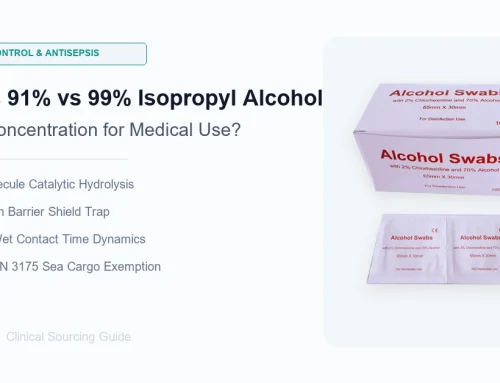
70% Isopropyl alcohol prep pads function through rapid membrane lysis and rapid cellular protein denaturation. As detailed in our clinical analysis on why 70% isopropyl alcohol is the clinical gold standard, the presence of 30% purified water acts as an essential catalytic conduit. Water slows alcohol evaporation, penetrates microbial cell walls via osmotic pressure, and allows alcohol molecules to cross-link with and coagulate structural intracellular proteins. IPA exhibits broad-spectrum, near-instantaneous bactericidal activity against gram-positive and gram-negative bacteria, mycobacteria, and lipophilic viruses.
2% Chlorhexidine Gluconate (CHG) + 70% IPA
Chlorhexidine alcohol swabs combine two potent active ingredients to create a synergistic antiseptic action. Chlorhexidine gluconate is a cationic bisbiguanide. Because bacterial cell membranes are negatively charged, the positively charged CHG molecules rapidly adsorb onto cell walls, displacing divalent cations (Mg2+, Ca2+) and destabilizing the osmotic barrier. At a 2% concentration, CHG causes irreversible precipitation of cytoplasmic contents. Concurrently, the 70% IPA solvent delivers rapid flash disinfection, allowing the two agents to achieve lethal microbial clearance in seconds.
2. Immediate Kill Speed vs. Sustained Residual Antimicrobial Action
The defining clinical divergence between IPA and CHG is residual activity (persistence on the skin surface):
- 70% IPA Has Zero Residual Activity: Isopropyl alcohol is highly volatile. Once applied to the skin and allowed to air-dry (typically 15 to 30 seconds), it evaporates completely. The moment the alcohol disappears, the antiseptic action ceases entirely. Any surviving bacteria in deeper follicular crypts or introduced by airborne settlement can immediately begin recolonizing the puncture site.
- 2% CHG Provides 48 to 72 Hours of Persistent Protection: Unlike alcohol, chlorhexidine binds tenaciously to the stratum corneum of human skin. Even after the alcohol solvent has completely evaporated, a durable microscopic reservoir of active CHG remains bound to the epidermis, continuing to kill proliferating bacteria for up to 48 to 72 hours. This sustained residual suppression is the key reason CHG reduces vascular access infections.
3. Comprehensive Clinical Comparison Matrix
The table below summarizes the core technical, clinical, and regulatory parameters of 70% IPA vs. 2% CHG/70% IPA swabs:
| Antiseptic Parameter | 70% Isopropyl Alcohol (IPA) | 2% CHG + 70% IPA |
|---|---|---|
| Active Composition | 70% v/v Isopropanol + 30% Purified Water | 2% w/v Chlorhexidine Gluconate + 70% v/v IPA |
| Onset of Action | Rapid (10-15 seconds) | Immediate flash kill from IPA |
| Residual Antimicrobial Effect | None (ceases upon evaporation) | Persistent for 48 to 72 hours |
| Blood/Organic Matter Resistance | Inactivated by organic matter/pus | Maintains activity in presence of blood/protein |
| Primary Target Spectrum | Broad: Vegetative bacteria, mycobacteria, viruses | Superior: Gram-positive (MRSA), gram-negative, fungi |
| Standard Clinical Focus | Routine subcutaneous/IM injections, capillary blood glucose | Vascular catheter placement (PIVC, CVC, PICC), blood cultures |
| Cost per Unit Ratio | Baseline (1x - high economic efficiency) | Premium (3x - 5x higher raw chemical cost) |
| Typical Pad Substrate | 2-ply or 4-ply spunlace non-woven (40-50 gsm) | Heavy-duty medical non-woven or sponge applicator |
4. Procedural Indications: When to Deploy IPA vs. CHG
Deploying the right antiseptic wipe for the right clinical task prevents both avoidable bloodstream infections and unnecessary supply cost inflation:
When to Deploy 70% IPA Swabs
- Routine Subcutaneous & Intramuscular Injections: Standard vaccination programs, insulin administration, and vitamin injections do not leave indwelling plastic foreign bodies inside the vascular lumen. In these brief procedures, a rapid 15-second wipe with a 70% IPA pad followed by air-drying is clinically sufficient and highly cost-effective. Consult our clinical alcohol pad aseptic skin guide for standardized techniques.
- Capillary Blood Sampling (Fingerstick): Rapid glucometer readings and point-of-care rapid diagnostic testing require clean skin free of tactile food residue without depositing chemical coatings that could interfere with biochemical reagents.
- Vial Stopper & Ampoule Disinfection: Disinfecting the rubber septa of medication vials prior to needle insertion ("scrub the hub" for clean utility carts).
When to Deploy 2% CHG + 70% IPA Swabs
- Peripheral Intravenous (PIV) Catheter Insertion: Because PIV catheters remain in the vein for 72 to 96 hours, any colonizing skin flora (such as Staphylococcus epidermidis o Staphylococcus aureus) can migrate along the external catheter tract. CHG's persistent residual barrier prevents catheter hub and tract contamination.
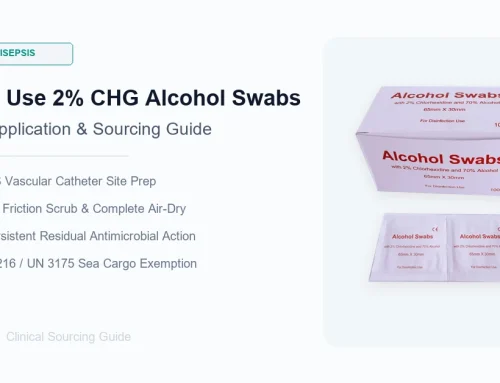
- Central Venous Lines (CVC & PICC): The CDC Guidelines for the Prevention of Intravascular Catheter-Related Infections assign a Category IA recommendation to skin antisepsis with a >0.5% chlorhexidine preparation with alcohol before CVC insertion and dressing changes. For clinical best practices, review our guide on how to use CHG alcohol swabs in hospital settings.
- Blood Culture Collection: False-positive blood culture contamination rates must remain under 1% to avoid inappropriate antibiotic regimens. Clinical trials prove that 2% CHG/70% IPA reduces blood culture contamination by over 50% compared to alcohol alone.
5. Skin Tolerability, Contraindications & Safety Protocols
Clinical teams must exercise caution with specialized patient populations:
- Premature & Low-Birth-Weight Neonates: Chlorhexidine can cause chemical cutaneous burns and severe contact dermatitis in premature infants under two months of age due to an immature epidermal stratum corneum. In neonatal intensive care units (NICUs), sterile saline or aqueous povidone-iodine is often preferred.
- Ophthalmic & Otic Procedures: CHG is directly neurotoxic and ototoxic. It must never be used in procedures involving the middle ear (risk of sensorineural deafness through a perforated tympanic membrane) or corneal contact.
- Mandatory Air-Drying Time: Both IPA and CHG/IPA swabs must be allowed to completely air-dry (at least 30 seconds for IPA; up to 2 minutes for CHG on hair-bearing skin) before needle puncture or electrosurgical incision. Never fan or blow on the skin. Allowing the prep to dry ensures complete microbial kill and prevents fire risks during electrosurgery.
6. Packaging Integrity, Evaporation Barriers & Substrates
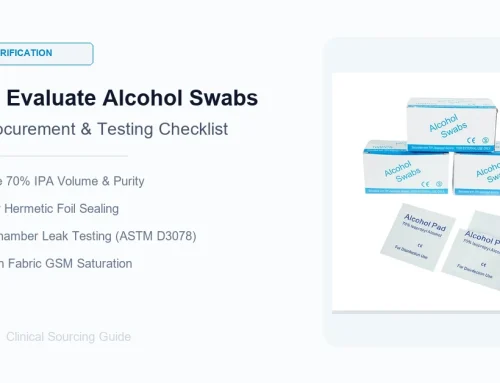
A disinfectant wipe is only as effective as its moisture retention. As outlined in our alcohol swab procurement checklist, package barrier engineering is vital:
- Tri-Laminate Aluminum Foil: Sterile swabs must be sealed inside airtight packets composed of Paper / Polyethylene / Aluminum Foil / Surlyn (or PET/AL/PE). Pure plastic pouches allow slow vapor transmission, resulting in dried-out, useless pads after 12 months. Genuine tri-laminate foil pouches guarantee a 3- to 5-year shelf life.
- Substrate GSM & Solution Saturation: High-grade medical pads use 45–60 GSM non-woven spunlace fabric capable of holding at least 3.5 to 4 times its dry weight in antiseptic solution, ensuring generous fluid transfer to skin during friction scrubbing.
7. Dangerous Goods Regulations & SP 216 Maritime Exemption
Because alcohol is flammable, bulk liquids are classified as UN 1219 Class 3 Dangerous Goods. However, individually wrapped alcohol wipes qualify for significant transport exemptions:
Maritime Transport Exemption (SP 216 / UN 3175): Under IMDG Code Special Provision 216 and IATA Special Provision A46, sealed packets containing small quantities of flammable liquid (< 10 ml) absorbed into a solid carrier matrix with zero free-standing liquid are exempt from Class 3 full dangerous goods regulations. Importers save substantial surcharges when shipping full container loads (FCL) of alcohol prep pads under certified non-restricted declarations.
8. B2B Sourcing Strategy & Tender Specification Checklist
Hospital purchasing groups and commercial distributors should adopt a dual-tier sourcing strategy:
- Volume Tier (70% IPA Swabs): Source in large-volume master cartons (e.g., 100 pcs/box, 100 boxes/carton = 10,000 pcs) for general ward injections and blood glucose monitoring. Target optimal cost-per-unit with verified ISO 13485 manufacturing lines.
- High-Value Critical Tier (2% CHG Swabs): Source specialized larger formats (such as 2-inch x 2-inch swabs or stick applicators) designated specifically for oncology wards, ICU central line dressings, and surgical pre-op suites.
- Consolidated Container Logistics: Combine palletized prep pads with complementary items such as surgical scalpel blades e silk braided sutures to streamline customs clearance and reduce freight handling overhead.
9. Frequently Asked Questions (FAQ)
Q1: Why does 2% CHG swab cost more than a standard 70% IPA pad?
Chlorhexidine gluconate is a highly regulated active pharmaceutical ingredient requiring complex synthetic manufacturing, strict raw material assays (EP/USP grade), and pharmaceutical-grade blending controls. In addition, CHG wipes frequently utilize larger non-woven substrates and heavier tri-laminate foil pouches to preserve chemical stability, resulting in higher raw material costs.
Q2: Can alcohol swabs be used to disinfect open lacerations or deep surgical wounds?
No. Neither 70% IPA nor 2% CHG should be applied to open, denuded, or deep wounds. Alcohol causes severe cellular toxicity to exposed fibroblasts, provoking extreme pain and delaying wound healing. For open wound irrigation and cleaning, sterile 0.9% normal saline or non-cytotoxic wound cleansers are medically indicated.
Q3: What quality test detects pinhole leaks in alcohol swab packaging?
Standard quality control incorporates vacuum decay bubble emission testing (ASTM D3078). Sealed foil packets are immersed in a vacuum chamber filled with water. As the vacuum pressure reaches -50 kPa to -70 kPa, any microscopic pinhole or defective heat seal will continuously emit air bubbles, flagging defective sealing batches prior to carton packing.
Order Certified Disinfectant Swabs in Wholesale Volumes
Shevenmed supplies global hospital networks with premium 70% IPA prep pads and 2% CHG/70% IPA swabs in leak-proof tri-laminate foil packaging. Benefit from competitive direct manufacturer pricing, full documentation support, and prompt container shipment.