



Description du projet
Nylon Monofilament Suture — Ethilon Equivalent | Bulk Supplier China | CE ISO13485
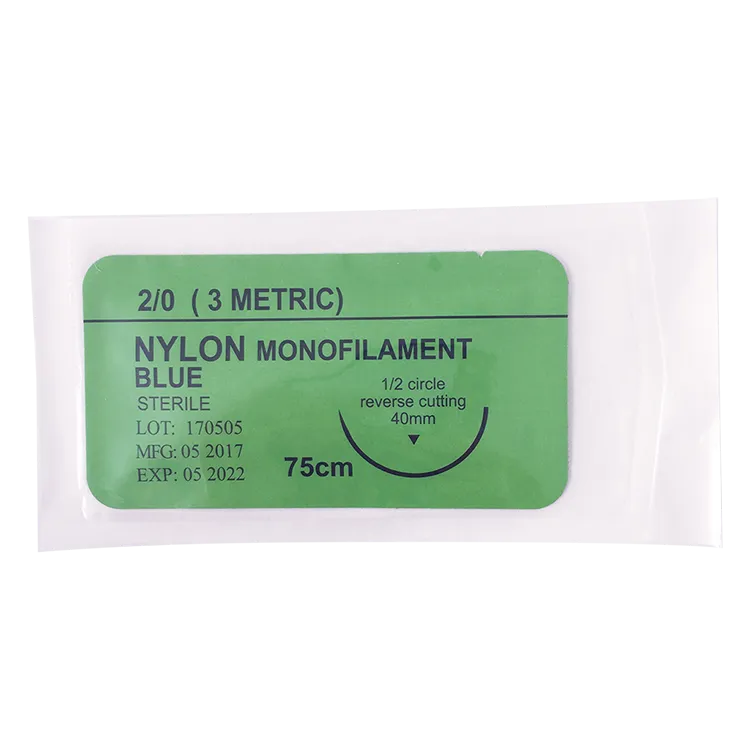
Shanghai Even Medical supplies CE and ISO 13485-certified Nylon Monofilament surgical sutures to medical distributors, hospital procurement teams, and surgical supply importers worldwide. An Ethilon equivalent offering smooth tissue passage and high tensile strength, available in black and blue, USP 6/0–2, sterilized by gamma radiation. OEM and private-label options available. Item No: E20003.
Key Features
- Ethilon Equivalent — Manufactured to equivalent specifications as Ethilon-type nylon monofilament sutures at competitive bulk pricing. CE certified, not a branded product.
- Smooth Monofilament Surface — Minimal tissue drag and low bacterial adhesion compared to braided alternatives, reducing infection risk in skin and plastic surgery applications.
- High Tensile Strength — Nylon offers excellent strength-to-diameter ratio, allowing finer sutures to be used without compromising wound security.
- Gradual In Vivo Degradation — Nylon undergoes slow hydrolysis in tissue, losing approximately 15–20% tensile strength per year — considered non-absorbable for clinical purposes but not truly permanent like polyester or polypropylene.
- Gamma Radiation Sterilization — Validated sterilization with no residue; batch sterility certificates available per order.
- CE & ISO 13485 Certified — Full regulatory documentation available for EU, Gulf, and ASEAN import submissions.
- OEM Available — Custom labeling, packaging design, and multi-language text for distributors and brand owners.
Specifications
| Item No | E20003 |
| Matériau | Nylon (Polyamide Monofilament) |
| Type | Non-Absorbable, Monofilament |
| Couleur | Black / Blue |
| USP Diameter | 6/0 – 2 |
| Thread Length | 45 / 60 / 70 / 75 / 90 / 100 / 125 / 150 cm, or customized |
| Stérilisation | Gamma Radiation |
| Absorption | Non-absorbable (slow hydrolysis ~15–20%/year) |
| Inner Pack | 1 pc / sterile foil pouch |
| Box | 12 pcs |
| Carton | 50 boxes / 600 pcs total |
| Taille du carton | 33 × 28 × 27 cm |
| Lester | 4 kg gross / 3.5 kg net |
| Certifications | CE, ISO 13485 |
Needle Options
Supplied needle-attached as standard. Available needle types:
- Cutting / Reverse Cutting / Taper (Round Body) / Taper Cutting / Blunt
- Needle size: 6 mm – 50 mm
- Curvature: 1/2 circle, 3/8 circle, 1/4 circle, straight
- Custom needle specs available for OEM orders
Clinical Applications
Nylon monofilament suture is the standard choice for skin closure and plastic surgery applications requiring smooth passage and minimal tissue reactivity:
- Skin closure and wound approximation
- Plastic and reconstructive surgery
- Ophthalmic surgery (finer USP sizes 6/0–10/0)
- Neurological surgery
- Microsurgery
- Retention sutures
- General surgery where suture removal is planned
The smooth monofilament surface and high strength-to-diameter ratio make nylon particularly suited to fine work in plastic and ophthalmic surgery.
Nylon vs Other Non-Absorbable Sutures
| Suture | Structure | Tissue Drag | Knot Security | Best For |
|---|---|---|---|---|
| Nylon (E20003) | Monofilament | Faible | Good | Skin, plastic, ophthalmic, neuro |
| Polypropylene (E20004) | Monofilament | Very Low | Modéré | Cardiovascular, hernia, plastic |
| Silk (E20001) | Braided | Modéré | Excellent | General, cardiovascular, oral |
| Polyester (E20002) | Braided | Modéré | Excellent | Cardiovascular, hernia, orthopedic |
Frequently Asked Questions
What is the MOQ for Nylon Monofilament sutures?
MOQ depends on specifications. Contact us via Quick Quote with your USP size, needle type, and quantity — we respond within 24 hours.
Is this the same as Ethilon?
Nylon Monofilament Suture (E20003) is manufactured to equivalent specifications as Ethilon-type nylon sutures (Ethicon). It is not a branded product — it is a CE-certified generic equivalent available at competitive bulk pricing.
What is the difference between Nylon and Polypropylene monofilament sutures?
Both are smooth monofilament non-absorbable sutures, but they differ in key properties. Nylon undergoes slow hydrolysis in tissue (~15–20% tensile loss per year), while polypropylene is completely inert and retains strength permanently. Polypropylene also has slightly lower tissue drag than nylon. For truly permanent applications such as cardiovascular surgery, polypropylene (E20004) is generally preferred. For skin closure and plastic surgery where sutures will be removed, nylon is the established standard. See our Polypropylene Suture page for comparison.
Why use Nylon instead of braided sutures for skin closure?
Monofilament nylon passes through skin tissue with minimal drag, reducing trauma and the risk of bacterial wicking along the suture tract — a significant advantage for skin and plastic surgery applications. Braided sutures like silk or polyester, while offering better knot security, carry higher infection risk in superficial wounds due to their multifilament structure.
What documentation is available for import?
CE Declaration of Conformity, ISO 13485 certificate, batch gamma radiation sterility certificate, COA, and MSDS. Additional market-specific documents available on request.
Can I order samples first?
Yes. Sample lead time is 5–7 business days. Request via Quick Quote form — specify USP size, color, and needle type needed.