



In soft tissue surgery, selecting the ideal non-absorbable monofilament suture is a fundamental balance between handling ergonomics and permanent mechanical stability. While both Polypropylène (e.g., Prolene equivalent) and Nylon / Polyamide (e.g., Ethilon equivalent) provide smooth monofilament tissue glide and low biological reactivity, their molecular structure, knot security, tensile retention in vivo, and handling memory diverge substantially. For operating theatre directors, vascular surgeons, plastic reconstructive specialists, and hospital tender committees, understanding these metallurgical and polymer differences is essential for clinical efficacy and procurement rationalization.
1. Polymer Chemistry & Molecular Architecture: Isotactic Polypropylene vs Polyamide 6/6,6
The clinical behavior of both materials originates in their underlying polymer configuration:
- Polypropylene Suture: Formed from extruded isotactic polypropylene, a crystalline hydrocarbon polyolefin. Its non-polar, hydrophobic chain contains zero hydrolyzable chemical bonds. As a consequence, polypropylene is biologically inert and completely impervious to human proteolytic enzymes and tissue moisture, maintaining its original mechanical tensile strength indefinitely in vivo.
- Nylon Suture (Polyamide 6 or Polyamide 6,6): Synthesized via the polycondensation of diamines and dibasic acids, yielding recurring amide bonds (\(-CO-NH-\)). Although classified as a non-absorbable suture, the amide linkage is susceptible to slow, progressive in vivo enzymatic hydrolysis. Longitudinal clinical studies demonstrate that nylon monofilaments lose approximately 15% to 20% of their tensile strength per year through cellular degradation, eventually fragmenting after several years in tissue.
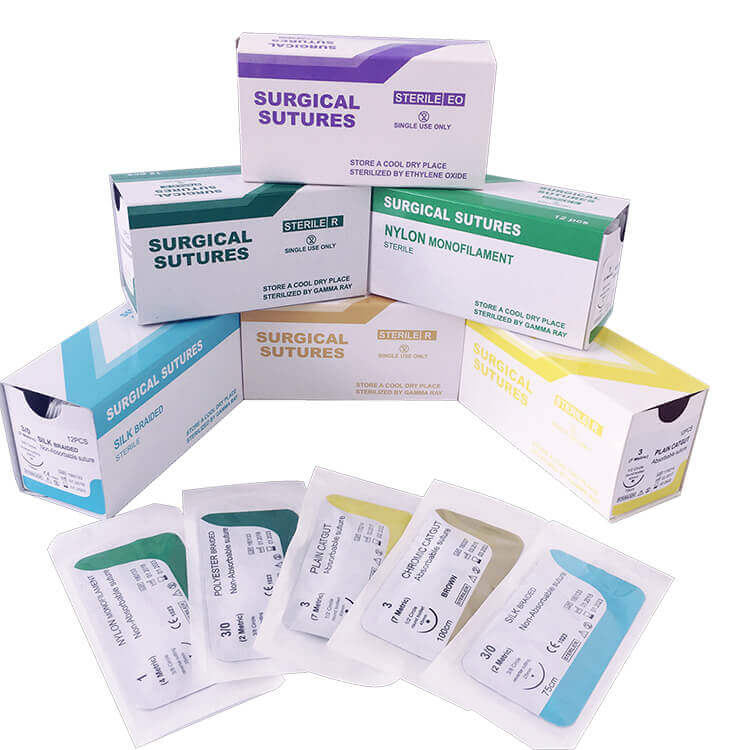
Explore Shevenmed's comprehensive surgical wound closure portfolio to review complete material datasheets and USP tensile specifications across our non-absorbable suture catalog.
2. Handling Dynamics: Pliability, Memory & Knot Security
Surgeons frequently select sutures based on "hand" and knot-tying tactile feedback. The physical characteristics between polypropylene and nylon create distinct clinical workflows:
| Clinical & Material Feature | Polypropylene Monofilament Suture | Nylon (Polyamide) Monofilament Suture | Surgical Performance Impact |
|---|---|---|---|
| Elastic Plasticity & "Memory" | High mechanical memory; tends to retain coil loops from packaging unless gently straightened prior to use. | Moderate to low memory; significantly more pliable and supple, facilitating smooth instrument ties. | Nylon is easier to handle in cosmetic subcuticular and facial plastic closures; polypropylene requires deliberate traction. |
| Elongation Under Tension | Plastic yield: stretches up to 25%–30% before breaking; accommodates acute postoperative wound edema without tearing tissue. | Elastic recovery: high initial modulus with immediate elastic snap-back; minimal permanent plastic stretching. | Polypropylene prevents cutting through friable tissue during acute wound swelling, returning to tension as edema subsides. |
| Coefficient of Friction & Knot Slippage | Extremely low surface friction; knots tend to slip unless secured with at least 5 to 6 square throws. | Moderate friction; amides exhibit greater surface drag, achieving dependable knot security with 4 to 5 throws. | Surgeons must strictly adhere to proper throw count when tying polypropylene to prevent catastrophic vascular ligature unraveling. |
| Flattening Upon Compression (Deformation) | High: under knotting pressure, polypropylene filaments deform and "flatten" against each other, creating an interlocking mechanical friction lock. | Low: nylon maintains its round cross-section under knot compression, relying primarily on surface friction. | When properly thrown with flat square knots, polypropylene knot security rivals braided sutures due to plastic cold-flow interlocking. |
3. Cardiovascular Anastomosis vs Cuticular Plastic Surgery: Clinical Specialization
These physical dynamics govern the definitive clinical indications for each suture material:
Vascular & Cardiac Surgery: The Gold Standard of Polypropylene
In aortic valve replacement, coronary artery bypass grafting (CABG), peripheral vascular bypass, and arteriovenous (AV) fistula creation for hemodialysis, polypropylene is non-negotiable. Its absolute resistance to biodegradation ensures that vascular anastomoses under continuous arterial pulsatile pressure do not fail months or years postoperatively. Furthermore, its ultra-smooth monofilament surface minimizes thrombogenicity, avoiding platelet activation at blood-contacting luminal margins.
Dermatological, Cuticular & Plastic Closure: The Strengths of Nylon
For facial lacerations, cosmetic skin approximation, and microvascular plastic procedures, nylon remains the premier choice. Its lower stiffness and superior pliability allow the surgeon to place precise interrupted cuticular stitches without causing loop distortion or tissue puckering. Because skin sutures are routinely removed within 5 to 14 days post-op (prior to the onset of any hydrolytic degradation), nylon's long-term strength loss is clinically irrelevant, while its low cost and exceptional cosmetic scar results provide optimal value. Learn more about silk, nylon, and polypropylene comparisons in hospital procurement.
4. Surgical Needle Attachment: 300 Series Stainless Steel & Swage Pull-Off Integrity
A suture is only as reliable as its needle attachment. Premature needle detachment during deep pelvic suturing or tough fascial passage creates hazardous lost-sharp incidents. International standards (USP and European Pharmacopoeia) mandate rigorous needle-to-thread attachment pull-off force testing:
- Laser-Drilled Hole Attachment: Modern precision sutures utilize laser-drilled needle ends rather than channel crimping, ensuring a perfectly smooth transition from needle to thread to minimize puncture hole bleeding in vascular walls.
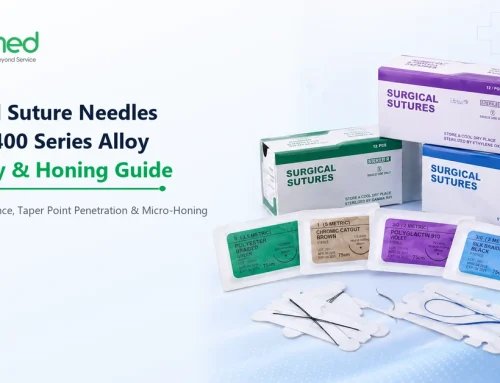
- Alloy Metallurgy: Shevenmed utilizes high-tensile 300-series (austenitic) and 400-series (martensitic) surgical stainless steel, offering superior ductility and bending resistance to prevent needle snapping in dense ligamentous or calcified tissue. Discover our surgical needle types and geometry guide for operating theatre purchasing.
5. Hospital Tender Procurement Checklist: Standards & Quality Control
Institutional hospital purchasing departments and medical consumable importers should enforce the following quality benchmarks during tender evaluations:
- Sterilization Integrity: Ethylene Oxide (EO) sterilization with validated chemical and biological indicators, ensuring a Sterility Assurance Level (SAL) of \(10^{-6}\).
- Hermetic Foil Pouch Sealing: Multi-layer medical-grade aluminum blister packaging guaranteeing a 5-year sterile barrier under tropical ambient warehousing (30°C / 75% RH).
- Regulatory Documentation: Valid ISO 13485 certification, CE MDR conformity, and lot-specific Certificates of Analysis (COA) verifying diameter tolerances, tensile strength, and needle detachment values.
6. Strategic Supply & Shevenmed Manufacturing Advantages
As a global B2B surgical consumable manufacturer, Shevenmed provides hospital-grade wound closure products engineered to match leading multinational brands (Prolene and Ethilon specifications) at substantial cost savings. With advanced cleanroom automated extrusion, laser-swaging technology, and dedicated OEM private-label capabilities, Shevenmed supports healthcare distributors and government ministries with reliable ocean container delivery, flawless customs clearance, and unwavering surgical reliability.