



The dental healthcare landscape across the Gulf Cooperation Council (GCC) and the wider Middle East—including Saudi Arabia, the United Arab Emirates, Qatar, Kuwait, and Egypt—is experiencing rapid modernization. With significant investments in dental centers, private clinical networks, and commercial milling laboratories, demand for reliable, high-volume dental consumables has grown substantially. Among daily consumables, dental alginate impression material remains an indispensable clinical workhorse.
However, dental distributors and laboratories in the Middle East face unique environmental and commercial challenges: scorching summer temperatures exceeding 45°C, high warehouse humidity along coastal shipping hubs, and rising shipping overhead. Consequently, procurement directors are increasingly partnering with specialized Chinese alginate manufacturers who engineer formulas specifically tailored to desert climates and high-throughput lab workflows. In this regional sourcing guide, we analyze the thermal stability chemistry, chromatic color indicators, dust-free manufacturing, and container logistics behind this growing commercial trend (alginate impression material product overview).
Índice
- 1. The Desert Climate Challenge: Thermal Degradation & Retarders
- 2. Chromatic Two-Phase Color Change for Consistent Chairside Timing
- 3. Dust-Free Micro-Encapsulation & Respiratory Safety
- 4. Packaging Engineering: Multi-Layer Hermetic Barrier Pouches
- 5. Maritime Logistics: Direct Shipping to Jebel Ali & Dammam
- 6. Middle East Dental Distributor Sourcing Checklist
- 7. Frequently Asked Questions (FAQ)
1. The Desert Climate Challenge: Thermal Degradation & Retarders
In standard European or North American climates, alginate powder is typically stored between 18°C and 24°C. In the Middle East, ocean containers sitting on quaysides in Dubai, Jeddah, or Dammam frequently experience ambient temperatures above 45°C, with cargo hold temperatures reaching 55°C.
Excessive heat accelerates chemical breakdown: high temperatures cause sodium alginate polymer chains to depolymerize and decompose trisodium phosphate retarders prematurely. When unadapted alginates arrive at a Riyadh or Abu Dhabi clinic, clinicians experience "flash setting"—where the material gels in 45 seconds instead of the rated 2 minutes, ruining impressions.
Leading Chinese exporters engineer thermally stabilized tropicalized formulas (complying with ISO 21563 Type 1 / Fast Setting and Type 2 / Regular Setting). By incorporating heat-resistant retarder blends and high-purity sodium alginate extracted from premium marine kelp, these powders maintain consistent gelation kinetics even after maritime transit through the Strait of Hormuz.
2. Chromatic Two-Phase Color Change for Consistent Chairside Timing
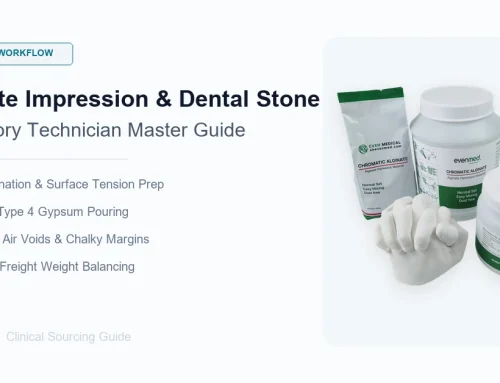
Middle Eastern dental clinics frequently employ multinational clinical teams with varied linguistic backgrounds. Chromatic color-changing alginates eliminate ambiguity through visual visual signaling:
- Phase 1 (Mixing - Violet / Magenta): Signals active incorporation of powder and water in the rubber bowl.
- Phase 2 (Tray Loading - Pink): Signals that the material has reached optimal thixotropic viscosity and is ready to load into the impression tray.
- Phase 3 (Insertion & Setting - Pure White): Signals that the hydrogel matrix has fully cross-linked and can be atraumatically removed from the patient's mouth.
3. Dust-Free Micro-Encapsulation & Respiratory Safety
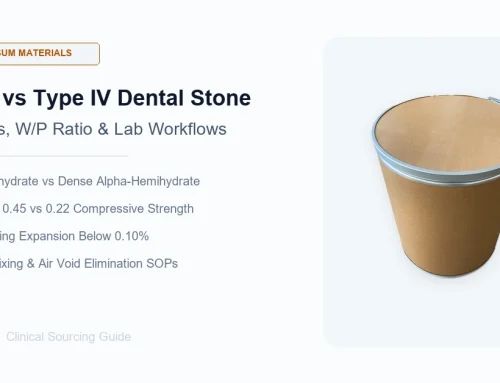
Traditional dental alginate powders contain fine diatomaceous earth particles that aerosolize during scooping, creating an airborne silica dust hazard for dental assistants and lab technicians. High-grade Chinese manufacturers employ surfactant liquid micro-encapsulation. Co-spraying organic wetting agents coats each diatomite particle, allowing the powder to drop cleanly into water with zero airborne dust, promoting workplace health and rapid sol dispersion.
4. Packaging Engineering: Multi-Layer Hermetic Barrier Pouches
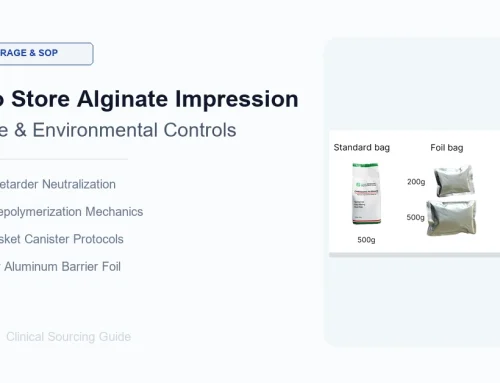
Coastal Gulf cities like Doha, Kuwait City, and Dubai experience high relative humidity alongside extreme temperatures. Alginate powder is hygroscopic; even minor moisture infiltration neutralizes phosphate retarders on the warehouse shelf.
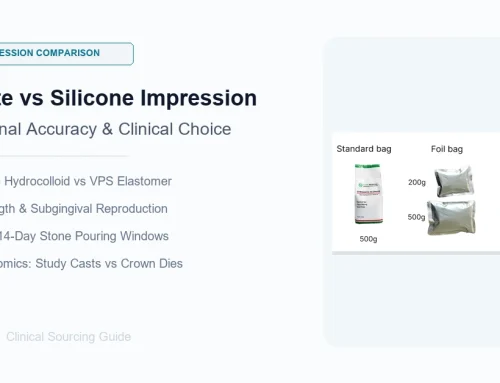
Export packaging features heavy-gauge tri-laminate aluminum pouches (PET / AL / PE) with an airtight heat seal. Pouches are purged with dry nitrogen gas prior to sealing, ensuring a certified 36-month shelf life in Middle Eastern regional supply depots. Formats range from standard 453g (1 lb) and 500g pouches to 25 kg drums for high-volume commercial labs.
5. Maritime Logistics: Direct Shipping to Jebel Ali & Dammam
Geographical proximity and direct maritime silk road routes make Chinese supply chains highly advantageous for Middle Eastern importers:
- Direct Transit Times: Container vessels sailing from Shanghai, Ningbo, or Qingdao reach Jebel Ali Port (UAE) in just 14 to 18 days, and Dammam (Saudi Arabia) in 18 to 22 days.
- Container Payload Balancing: Heavy alginate pouches and gypsum can be consolidated alongside lightweight sutures and PPE, maximizing gross container weight limits (24 to 26 metric tons) and lowering per-unit freight costs.
6. Middle East Dental Distributor Sourcing Checklist
| Specification Factor | Recommended Gulf Tender Benchmark |
|---|---|
| Regulatory Compliance | ISO 13485:2016, CE marking (Class I), and SFDA (Saudi FDA) registration ready |
| Setting Time Range | Fast Set (2 min 30s total) or Regular Set (3 min 30s) at 23°C |
| Elastic Recovery Rate | ≥ 96.5% per ISO 21563 |
| Pouch Barrier Material | Tri-laminate foil pouch (WVTR < 0.05 g/m²/24h) |
7. Frequently Asked Questions (FAQ)
Q1: How does water temperature affect alginate setting time in Middle Eastern clinics?
Alginate setting chemistry follows Arrhenius reaction kinetics: for every 10°C increase in water temperature, the setting reaction rate approximately doubles. In Middle East summer months where clinic tap water can reach 28°C to 30°C, using tap water drastically curtails working time. Clinicians must always use chilled distilled water (18°C–20°C) to maintain predictable 2-to-3-minute chairside working windows.
Q2: Can Middle East distributors obtain custom Arabic bilingual packaging?
Yes. Shevenmed provides full private label OEM services for Middle Eastern distributors, including Arabic/English bilingual pouch printing, SFDA medical device labeling compliance, and custom distributor branding.
Source High-Precision Dental Alginates for the Middle East
Partner with Shevenmed for heat-stabilized, chromatic, dust-free dental alginate powders engineered for Gulf climates. Benefit from competitive container freight, private label customization, and full documentation support.