



Dental distributors, clinic networks, and oral care brands evaluating private-label impression materials face unique technical and operational considerations. Unlike commodity plastic consumables, dental alginate impression materials are chemically reactive irreversible hydrocolloids that demand tight formulation stability, hermetic barrier packaging, and documented setting profiles. Partnering with an experienced Chinese medical supply chain and export partner like Evenmed allows distributors to access audited manufacturing capacity, consolidate dental and clinical consumables in single containers, and develop private-label lines backed by verifiable material parameters rather than generic catalog claims.
This RFQ checklist outlines the technical specifications, custom packaging tiers, chromatic timing options, and regulatory prerequisites required to successfully source private label alginate impression materials. For a comprehensive overview of dental alginate chemistry, handling variables, and comparative material behavior, consult our detailed dental alginate impression material guide. To explore existing manufacturing formats and baseline specifications, review our commercial alginate impression material portfolio.
The Technical Specification Framework for Private-Label Alginate
When issuing an RFQ for OEM dental alginate, procurement teams should define physical and mechanical performance targets across standard precision tiers. Evenmed supplies three standardized formulation tiers aligned with international standards (YY 0272 / ISO 21563):
| Specification Parameter | Universal (E50001) | High Precision (E50002) | Super High Precision (E50003) | Clinical & Commercial Significance |
|---|---|---|---|---|
| Clinical Indication | Study models, orthodontic diagnostics, jaw impressions | Crown & bridge prep, partial denture frameworks | High-detail prosthetic margins, master implant casts | Matches clinic budget and precision tolerance per procedural workflow |
| Detalle Reproducción | ≤ 50 μm continuous line | ≤ 48 μm continuous line | ≤ 45 μm continuous line | Ensures sharp gypsum margin replication without chalky surface interaction |
| Recuperación elástica | ≥ 97.0% | ≥ 97.0% | ≥ 98.6% (Exceeds 96.5% ISO benchmark) | Prevents irreversible distortion upon tray removal from pronounced anatomical undercuts |
| Compressive Strain | 5% – 20% | 6% – 22% | 7% – 24% | Optimal flexibility balance for comfortable patient tray extraction |
| Resistencia al desgarro | ≥ 0.38 N/mm | ≥ 0.40 N/mm | ≥ 0.48 N/mm | Prevents interproximal and sulcular margin tearing during fast extraction |
| Setting Time (23°C) | 2'30" – 3'00" | 2'30" – 3'00" | 2'30" – 3'00" | Standard clinical working window: 30" mix, 1'30" work, 1'00" in-mouth hold |
When issuing an RFQ for OEM alginate powder, procurement teams must define chemical and physical performance criteria rather than simply requesting "high precision" powder. Technical parameters should align with international consensus standards such as ISO 21563 (Hydrocolloid impression materials):
| Specification Parameter | Standard Target / Industry Benchmark | RFQ Verification Requirement | Impact on Clinical Workflow |
|---|---|---|---|
| Setting Profile | Regular Set (approx. 3.0 min) or Fast Set (approx. 1.5–2.0 min) | State precise water/room temperature (standard 23°C / 73°F) for declared setting windows | Dictates intraoral working time for chairside comfort versus high-volume impression speed |
| Powder Dust Behavior | Dust-controlled / dust-free formulation | Request dust-suppression formulation data and safety handling protocol | Minimizes inhalable airborne particulate exposure for dental assistants during dispensing |
| Elastic Recovery & Strain in Compression | Elastic recovery > 95.5%; Strain within 5%–20% (ISO 21563) | Batch test report confirming dimensional recovery after removal from oral undercuts | Prevents permanent distortion during tray extraction from pronounced coronal anatomy |
| Detalle Reproducción | 50 µm line reproduction on standard test block | Gypsum model compatibility test with Type 3 and Type 4 dental stones | Ensures accurate transfer of marginal contours to gypsum study and master casts |
| Tear Resistance | High tear strength formulation (> 0.5 N/mm) | Mechanical testing data under rapid removal strain rates | Prevents interproximal margin tearing during tray removal |
Chromatic Timing and Setting Indicator Formulation Options
Chromatic alginates incorporate pH-sensitive color indicator dyes that transition visibly across distinct procedural phases. For OEM distributors, chromatic formulations offer high commercial appeal and user-friendly chairside feedback:
- Three-Phase Chromatic Transition: Typically transitions from violet/purple during mixing, to pink/orange during tray loading and seating, to white or light blue when intraoral setting is complete. RFQ specifications should establish clear color boundaries and confirm that dye components meet destination market cosmetic and medical contact safety regulations.
- Monochromatic Formulations: Traditional single-color powders (e.g., standard blue, green, or yellow). Often favored by institutional buyers or dental schools where manual timing with digital stopwatches is standard clinical teaching protocol.
- Temperature Sensitivity Disclosure: Because alginate gelation kinetics accelerate significantly with increased ambient water temperature, OEM suppliers must supply temperature-vs-setting curve charts for packaging IFU inserts.
For distributors comparing elastomeric impression alternatives alongside hydrocolloids, examine our clinical overview of A-silicone impression material systems to structure a complementary impression catalog.
Custom Packaging Architecture: Pouches, Tins, and Bulk Master Cartons
Packaging integrity is arguably the most critical operational factor in alginate shelf life. Because alginate powder is hygroscopic and prone to premature cross-linking when exposed to ambient moisture, private-label packaging must provide high hermetic barrier properties:
| Packaging Format | Typical Net Weight | Material Construction | Distribution Channel Target |
|---|---|---|---|
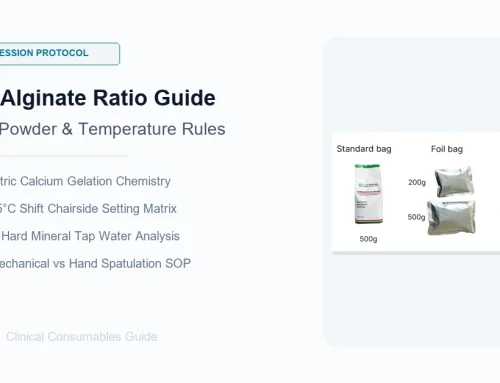
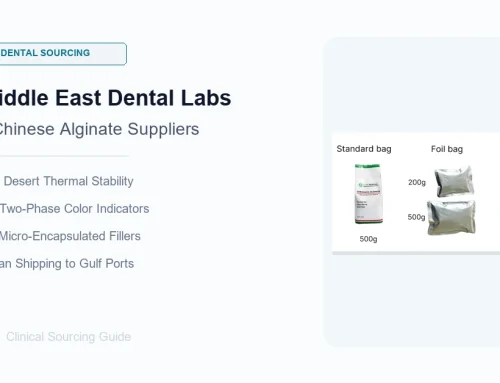
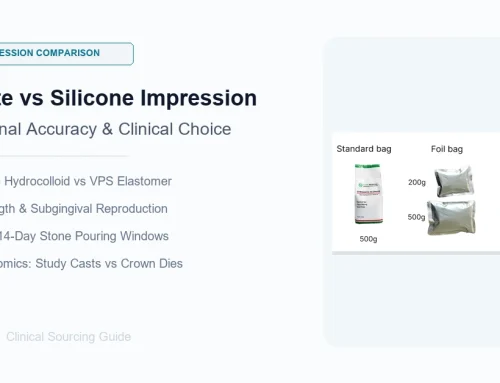
| Laminated Foil Pouch | 454 g (1.0 lb) or 500 g | Multi-layer barrier film (PET / Aluminum Foil / PE) with heat-sealed gusset | Standard dental clinics, private practices, and laboratory distributors |
| Rigid Canister / Tin | 454 g (1.0 lb) or 500 g | Food-grade tinplate or HDPE canister with airtight inner seal and scoop | High-end clinical branding; reusable storage dispensers |
| Institutional Bulk Pouch | 1.0 kg or 2.5 kg | Heavy-duty laminated foil bag with resealable airtight zip or clip | High-volume orthodontic clinics, dental university clinics, and casting labs |
| Master Export Shipper | 24 bags (12.0–12.5 kg net / 13.0 kg gross) | 5-ply export carton (43 × 33 × 22 cm) with moisture desiccant | Ocean container consolidation and palletized intercontinental freight |
| Industrial Bulk Raw Powder | 25 kg bag or 50 kg fiber drum | Multi-ply paper/PE moisture-barrier bag or sealed drum with airtight inner liner | Dental laboratory centralized mixing, local repackaging, or 3D life-casting studios |
OEM Minimum Order Quantities (MOQ): For custom full-color printed brand foil bags, standard production runs start at 10,000 pouches per artwork variant. For market trial orders, neutral silver/white barrier bags with custom full-bleed adhesive brand labels are supported starting at 5,000 pouches. Unopened pouches carry a shelf life of 3 years when stored below 25°C in a dry environment.
Distributors structuring comprehensive OEM contracts across consumable product lines can also review our general medical consumables portfolio for cross-category private labeling strategies.
Private-Label Artwork, Labeling, and UDI Compliance
Exporting private label dental alginate into regulated markets (such as the European Union, United States, Latin America, or Middle East) requires strict compliance with medical device labeling regulations:
- Multilingual Labeling: Instructions for Use (IFU) and outer pouch printing must provide target language versions covering mixing ratios (water-to-powder ratio by weight and volume), mixing times, working times, and intraoral setting intervals.
- Standardized Medical Symbols: Artwork must incorporate standardized graphical symbols in accordance with ISO 15223-1 (batch code, expiry date, storage temperature limits, keep dry, do not reuse).
- Unique Device Identification (UDI): For markets enforcing UDI mandates (such as US FDA and EU MDR), verify that master artwork supports GS1 DataMatrix or linear barcode formatting reflecting the distributor's or manufacturer's primary device identifier (UDI-DI).
- Batch Traceability & Date Coding: Packaging equipment must support crisp laser or inkjet batch printing directly on the heat seal area, ensuring traceability from bulk chemical batching to end-user delivery.
Model Pouring and Downstream Gypsum Compatibility
An alginate impression is only as valuable as the diagnostic or working cast poured from it. Sourcing teams must verify chemical compatibility between the OEM alginate formulation and standard dental stone grades:
When selecting alginates for orthodontic study models or diagnostic mounting, the impression surface must cleanly release without chalky surface degradation (syneresis exudate interaction). To ensure downstream laboratory success, buyers can reference our guide on dental stone materials Type 3 and Type 4 and evaluate technical specifications in our Type III & IV dental stone portfolio.
Step-by-Step OEM Alginate RFQ Submission Checklist
| Stage | Procurement Action Item | Specific Deliverables to Request | Key Risk Avoided |
|---|---|---|---|
| 1. Chemistry & Setting | Specify setting speed (regular vs fast), chromatic indicators, and dust-control requirement. | Technical Data Sheet (TDS) and documented setting times at 23°C. | Mismatched clinical working times and assistant dissatisfaction. |
| 2. Barrier Packaging | Select foil pouch laminate structure (PET/ALU/PE) and net weight (454g / 500g / 1kg). | Packaging barrier transmission rate specs (WVTR / OTR) and seal strength tests. | Powder clumping and premature expiration during sea transit. |
| 3. OEM Tooling & Print | Provide brand vector artwork and define cylinder/plate printing costs. | Pre-production color proof drawdown and cylindrical layout approval. | Color misalignment, blurry barcodes, or regulatory font size violations. |
| 4. Regulatory Dossier | Map classification (Class I / Class IIa) and request QMS documentation. | ISO 13485 certificate, Declaration of Conformity, and Safety Data Sheet (SDS). | Customs detention or regulatory audit non-compliance. |
| 5. Sample Evaluation | Order pilot batch samples for mechanical and gypsum pour testing. | Sample test protocol: mixing smoothness, tear resistance, model surface finish. | Bulk production failure with incompatible local dental stones. |
| 6. Commercial Terms | Define Minimum Order Quantities (MOQ) per SKU and container loading plan. | Itemized FOB/CIF quotation, carton palletization specs, lead time commitment. | Unexpected freight surcharges and damaged cartons due to inadequate stacking strength. |
Request an OEM Alginate Manufacturing Consultation
Customizing a private-label alginate line allows dental distributors and brand owners to build brand equity with recurring, high-margin consumable orders. By grounding your RFQ in verifiable physical benchmarks, airtight packaging barriers, and disciplined regulatory documentation, you ensure consistent product performance across every production batch.
To request technical data sheets, sample evaluation kits, or custom packaging mockups for your private-label dental alginate project, contact Evenmed's OEM dental manufacturing team. Our engineering specialists will assist you in refining formulations, validating chromatic timing curves, and streamlining container consolidation tailored to your market requirements.