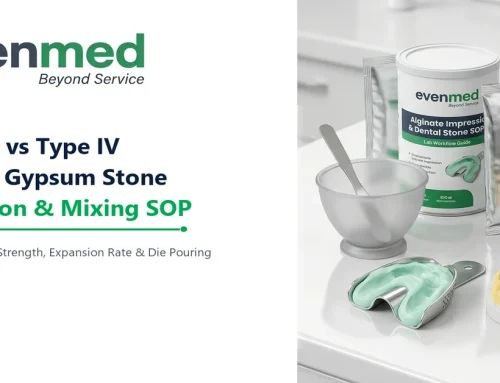




In fixed prosthodontics, implant dentistry, and precision partial dentures, the ultimate fit of a zirconia crown, cast titanium framework, or clear aligner depends on the accuracy of the working gypsum cast. If a master stone die undergoes uncontrolled setting expansion or develops surface voids, the final prosthesis will fail to seat intraorally. Under international standard ISO 6873 (Dental gypsum products), casting materials are categorized into five distinct types, each defined by specific calcination chemistry, compressive strength, and expansion tolerances.
For commercial dental laboratory managers, prosthodontists, and dental supply distributors, mastering gypsum material science is crucial for eliminating laboratory remakes. The structural transition from calcium sulfate hemihydrate to interlocking dihydrate crystals is influenced by the water-to-powder (W/P) ratio, mixing technique, and water purity. In this clinical guide, we compare Type III dental stone against Type IV/V high-strength stones, analyze mechanical vacuum mixing protocols, examine linear setting expansion control, and detail defect troubleshooting (dental stone product specifications).
Table of Contents
- 1. ISO 6873 Classification: Type I to Type V Gypsum Chemistry
- 2. Crystal Morphology: Beta-Hemihydrate vs. Modified Alpha-Hemihydrate
- 3. Water-to-Powder (W/P) Ratio: Gravimetric Precision Dynamics
- 4. Mechanical Vacuum Spatulation vs. Manual Bench Mixing
- 5. Setting Expansion Dynamics & Die Accuracy in Fixed Prosthetics
- 6. Gypsum Model Defect Troubleshooting Matrix
- 7. Frequently Asked Questions (FAQ)
1. ISO 6873 Classification: Type I to Type V Gypsum Chemistry
ISO 6873 designates dental gypsum products into five standardized classes:
- Type I (Impression Plaster): Rapid-setting formulation with minimal expansion; largely historical.
- Type II (Model Plaster): Produced via open-kettle calcination (Beta-hemihydrate). Irregular, porous crystals requiring 45–50 ml water per 100 g powder. Used for orthodontic study models and flasking.
- Type III (Dental Stone): Hydrothermally calcined under steam pressure (Alpha-hemihydrate). Denser crystals requiring 28–32 ml water per 100 g. Used for diagnostic casts and denture processing.
- Type IV (High-Strength, Low-Expansion Dental Stone): Calcined in calcium chloride solutions (modified Alpha-hemihydrate). Smooth, prismatic crystals requiring only 19–24 ml water per 100 g. Used for master dies in crown and bridge work.
- Type V (High-Strength, High-Expansion Dental Stone): Low W/P ratio (18–20 ml/100 g) with higher setting expansion (0.10% to 0.30%) engineered to compensate for solidifying shrinkage of base metal casting alloys.
2. Crystal Morphology: Beta-Hemihydrate vs. Modified Alpha-Hemihydrate
| Gypsum Parameter | Type II Model Plaster | Type III Dental Stone | Type IV Die Stone |
|---|---|---|---|
| Crystal Form | Porous, spongy Beta-crystals | Dense, prismatic Alpha-crystals | Ultra-dense, cuboidal Alpha-crystals |
| W/P Ratio (ml/100g) | 45 to 50 ml | 28 to 32 ml | 19 to 24 ml |
| 1-Hour Compressive Strength | ~9 MPa | ~20 MPa | 35 to 50 MPa |
| Linear Setting Expansion | 0.15% to 0.30% | 0.08% to 0.20% | 0.05% to 0.15% |
3. Water-to-Powder (W/P) Ratio: Gravimetric Precision Dynamics
In dental laboratories, estimating water volume by eye or using volume scoops introduces unacceptable variations. Excess water spaces the hemihydrate crystals further apart during crystallization, weakening the interlocking dihydrate network, reducing surface hardness, and causing die chipping during margin trimming. Water and powder must be weighed using an electronic gram scale.
4. Mechanical Vacuum Spatulation vs. Manual Bench Mixing
Manual hand spatulation in rubber bowls traps air bubbles in the slurry, which manifest as nodules or voids on critical preparation margins. Commercial laboratories deploy motorized vacuum mixers operating at 300 to 450 RPM under -0.85 bar vacuum for 45 to 60 seconds, eliminating microporosity and maximizing cast density.
5. Setting Expansion Dynamics & Die Accuracy in Fixed Prosthetics
All gypsum materials exhibit outward linear expansion during crystallization. For master dies in fixed prosthetics, Type IV stones are formulated with chemical grain-refiners and accelerators to restrict expansion to below 0.10%, ensuring crowns do not fit loose on the clinical abutment. Pour with our alginate impression material for clinical study cast fabrication.
6. Gypsum Model Defect Troubleshooting Matrix
| Observed Defect | Probable Root Cause | Corrective Action |
|---|---|---|
| Chalky, powdery surface | Residual disinfectant on impression; premature cast separation | Rinse impression thoroughly; allow full 45-60 min setting |
| Surface nodules & voids | Hand mixing trapped air; poured without vibrator | Use mechanical vacuum mixing; pour under gentle mechanical vibration |
| Weak, brittle die margins | Excessive water in mix (High W/P ratio) | Weigh powder & water gravimetrically to exact manufacturer ratio |
7. Frequently Asked Questions (FAQ)
Q1: How soon can a dental stone model be separated from an alginate impression?
Models should be separated between 45 and 60 minutes after pouring. Separating earlier causes fragile stone fracture, while leaving it in contact beyond 60 minutes causes alginate syneresis moisture to degrade stone surface detail.
Q2: What is the effect of slurry water on dental stone setting time?
Slurry water (suspension of calcium sulfate dihydrate crystals from cast trimming runoff) provides instant nucleation seeds, cutting setting time in half for rapid clinical pouring.
Source ISO 6873 Dental Stones in Wholesale Volume
Shevenmed supplies commercial dental laboratories and distributors worldwide with premium Type III and Type IV dental stones and impression consumables. Contact our dental materials export team today.