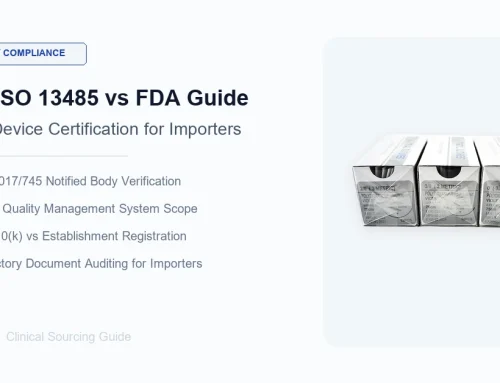




In international medical trade, regulatory compliance is the paramount factor governing market access, customs clearance, and patient safety. For medical device distributors, hospital purchasing organizations, and government healthcare tender evaluators, verifying that manufacturing partners maintain valid ISO 13485:2016 certification is not merely an administrative checkbox—it is a critical legal and commercial safeguard against import seizures, product recalls, and clinical liability.
While general commercial suppliers frequently hold standard ISO 9001 quality management certificates, medical consumables operate under an entirely different regulatory burden. ISO 13485 establishes rigorous controls over cleanroom bioburden management, sterilization cycle validation, medical-grade raw material traceability, and post-market clinical vigilance. In this comprehensive guide, we examine why ISO 13485 certification is essential when importing medical consumables from China, how to audit certificate scopes, and how to verify registrar legitimacy (medical device certification guide).
Оглавление
- 1. ISO 9001 vs. ISO 13485: Key Structural Differences
- 2. The 4 Pillars of ISO 13485 for Medical Consumables
- 3. How to Audit Certificate Scope Statements & Registrar Accreditation
- 4. Cleanroom Bioburden Controls & Sterility Validation Audits
- 5. Risk Management Integration: ISO 14971 & CAPA Protocols
- 6. Importer Compliance Liabilities Under EU MDR & US FDA
- 7. Frequently Asked Questions (FAQ)
1. ISO 9001 vs. ISO 13485: Key Structural Differences
Many commercial buyers assume that ISO 9001 and ISO 13485 are interchangeable. In medical procurement, this misconception carries serious regulatory risks:
- ISO 9001 (Customer Satisfaction Focus): Designed for general manufacturing across any industry. Focuses on continuous quality improvement and client satisfaction. It contains zero requirements for sterile barrier maintenance, cleanroom environmental monitoring, or clinical risk evaluation.
- ISO 13485:2016 (Medical Regulatory Compliance Focus): Tailored specifically for medical devices. Rather than focusing on customer satisfaction metrics, ISO 13485 prioritizes regulatory compliance, device safety, and clinical efficacy. It enforces rigid documentation standards, mandatory design history files (DHF), process validation, and adverse event reporting.
2. The 4 Pillars of ISO 13485 for Medical Consumables
When an offshore manufacturing facility operates under a certified ISO 13485 quality management system, international buyers gain audited verification across four core operational areas:
- Controlled Cleanroom Manufacturing: Validates that invasive products—such as хирургические швы and blades—are assembled in ISO Class 8 (100,000) or Class 7 cleanrooms with positive air pressure differentials and HEPA filtration.
- Sterilization Process Validation: Enforces adherence to ISO 11135 (Ethylene Oxide) or ISO 11137 (Radiation), guaranteeing that sterilization cycles consistently achieve a Sterility Assurance Level (SAL) of 10-6.
- Raw Material Traceability: Ensures complete batch tracking from raw medical-grade polymers and stainless steel coils to finished packaged lot numbers.
- Change Notification Control: Mandates that manufacturers cannot alter raw material suppliers, needle geometries, or packaging foils without prior formal notification and regulatory validation.
3. How to Audit Certificate Scope Statements & Registrar Accreditation
A significant percentage of certificate disputes involve valid certificates with invalid scopes. Hospital buyers should follow this auditing checklist:
Certificate Scope Audit Checklist
- Examine the Scope Wording: Does the scope state "Design, Development, Manufacture, and Distribution of Sterile Surgical Consumables"? If the certificate states only "Sales", "Trade", or "Non-Sterile Assembly", the manufacturer cannot legally produce sterile Class II devices under that certificate.
- Check Accreditation Body Symbols: Verify that the issuing registrar carries accreditation logos from recognized international bodies (e.g., UKAS, DAkkS, CNAS, ANAB, or JAS-ANZ) operating under the International Accreditation Forum (IAF) Multilateral Recognition Arrangement.
- Verify Online Registry Status: Search the certificate serial number on the issuing registrar's official verification portal to ensure it is currently active, suspended, or expired.
4. Cleanroom Bioburden Controls & Sterility Validation Audits
Under Clause 6.4 (Work Environment) and Clause 7.5.6 (Validation of Processes for Production), ISO 13485 mandates documented microbiological controls:
- Routine Bioburden Testing: Periodic membrane filtration sampling to measure pre-sterilization microbial counts on device surfaces.
- Environmental Settle Plates: Daily and weekly agar contact plates monitoring viable airborne bacterial and fungal colonies in cleanrooms.
- Dosimetric & Chemical Release: Sterilization loads released only after reviewing physical dosimeter strips, biological spore indicators (e.g., Bacillus pumilus for Gamma, Bacillus atrophaeus for EO), and parametric cycle records.
5. Risk Management Integration: ISO 14971 & CAPA Protocols
ISO 13485:2016 requires direct integration with ISO 14971 (Medical Device Risk Management). A certified supplier must maintain risk management files evaluating every conceivable clinical failure mode:
- FMEA Analysis (Failure Modes & Effects Analysis): Evaluates potential risks such as needle detachment, packaging pinhole leaks, and user error during foil opening.
- Robust CAPA Protocols: If a hospital reports a defective lot, the manufacturer must execute a formal Corrective and Preventive Action (CAPA) protocol, investigating root causes and implementing engineering fixes within defined timeframes.
6. Importer Compliance Liabilities Under EU MDR & US FDA
Under modern global medical device regulations—specifically Article 13 of the European Medical Device Regulation (EU MDR 2017/745) and US FDA 21 CFR 820—importers share direct legal responsibility for product quality. Importing from uncertified facilities can result in port-of-entry impoundments, civil fines, and criminal liability. Partnering with an experienced supply chain partner like Shevenmed ensures every product line is thoroughly vetted and documented (OEM medical consumables guide).
7. Frequently Asked Questions (FAQ)
Q1: Can an ISO 13485 certificate replace CE marking for European imports?
No. ISO 13485 is a standard for quality management systems, whereas CE marking indicates full product conformity with the European Medical Device Regulation (EU MDR 2017/745). While ISO 13485 compliance is a prerequisite for CE certification, both are legally required to market Class IIa and Class IIb medical devices within the European Union.
Q2: How often are ISO 13485 certified facilities audited?
Certified facilities undergo mandatory annual surveillance audits by accredited registrars, along with comprehensive recertification audits every three years to verify ongoing compliance.
Source ISO 13485 Certified Medical Consumables with Confidence
Protect your business with certified, fully audited medical consumables from China. Shevenmed verifies all factory certifications, cleanroom audit reports, and sterility dossiers prior to shipment.