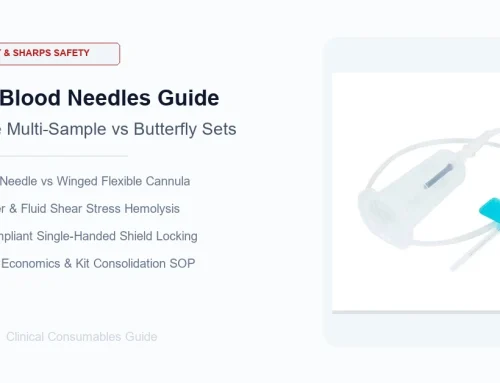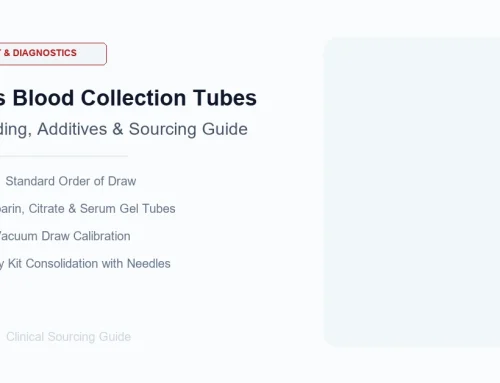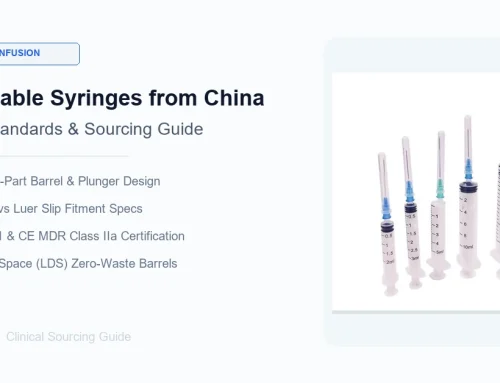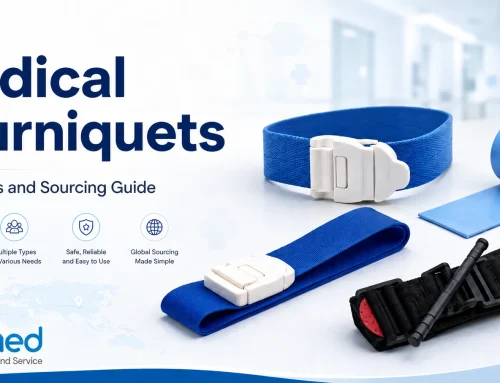




IV catheter sizes follow a simple color code that nurses, paramedics, and procurement teams rely on every day. This guide walks through the IV catheter color chart, gauge selection, flow rates, insertion technique, and what to check when you buy peripheral IV catheters in bulk. If you manage tenders, hospital formulary, or distributor stock, the details below are the ones your clinicians will ask about.
IV Catheter Color Chart (Gauge to Color)
| Couleur | Jauge | Outer Diameter | Flow Rate (gravity) | Typical Use |
|---|---|---|---|---|
| Orange | 14G | 2.0 mm | ~300 ml/min | Trauma, massive transfusion, rapid infusion |
| Gris | 16G | 1.7 mm | ~180 ml/min | Surgery, blood products, ED resuscitation |
| Vert | 18G | 1.3 mm | ~100 ml/min | Standard IV therapy, CT contrast, blood |
| Rose | 20G | 1.0 mm | ~60 ml/min | Routine ward IV, most medications |
| Bleu | 22G | 0.8 mm | ~35 ml/min | Pediatric, elderly, fragile veins |
| Jaune | 24G | 0.6 mm | ~20 ml/min | Neonatal, ICU, fragile access |
Color coding follows ISO 10555-5. Most manufacturers align with this. Always read the gauge printed on the hub, not just the color band. Flow rates are gravity-driven at roughly 1 m head height; pressure infusers push higher numbers, but the catheter lumen remains the limiting factor for viscous fluids and packed red cells.
How to Choose the Right IV Catheter Size
Emergency and Trauma
14G orange and 16G grey catheters are the workhorses of the ED and the ambulance. They deliver 180 to 300 ml/min, which is what hemorrhagic shock and rapid fluid bolus need. Two large-bore lines are standard in major trauma protocols. The trade-off is insertion difficulty. In a conscious patient, an 18G green is often the pragmatic compromise.
Surgery, Ward, and Pediatrics
18G green is the OR default. It handles blood products at a useful rate and is comfortable for induction meds. 20G pink is the most common peripheral IV catheter worldwide, handling maintenance fluids, antibiotics, and most IV pushes without hemolysis risk. 22G blue fits patients with rolling or fragile veins, but limits CT contrast rates. Children aged 1 to 12 take a 22G or 24G. Neonates need 24G yellow with careful site selection in the scalp, dorsum of the hand, or foot. A 24G flows slowly, so warming fluids and using a syringe pump is normal practice.
IV Catheter Insertion: A Quick Walkthrough
- Apply a tourniquet (see our medical tourniquet selection guide for tension and material specifications) 10 to 15 cm above the chosen site and palpate a soft, bouncy vein. The forearm and antecubital fossa are first choices.
- Prep the skin with 70% IPA or 2% chlorhexidine in 70% IPA and let it dry for at least 30 seconds.
- Hold the catheter hub bevel up. Enter the skin at 10 to 30 degrees, lower once you are in the tissue.
- Watch the flashback chamber. As soon as blood appears, stop advancing the needle, slide the catheter off the needle and into the vein until the hub sits at the skin.
- Release the tourniquet, withdraw the needle, and connect the primed extension set or closed system using needle-free connectors to prevent backflow and contamination.
- Flush with normal saline using a standard medical syringe to confirm patency. No resistance, no swelling, no pain means a clean line. Secure with a transparent semi-permeable dressing and document gauge, site, and time.
Two common mistakes: advancing the needle too far after flashback, which punctures the back wall of the vein, and failing to anchor the vein so it rolls away from the needle. Both lead to multiple sticks and early failure.
Safety Features to Look For
Needlestick injuries remain one of the top occupational risks in healthcare. A good IV catheter cuts that risk sharply. Look for these on the data sheet:
- Passive needle retraction - the needle withdraws into the hub the moment the catheter is advanced. No button to press, no step to forget.
- Needle guard - a plastic shield covers the bevel after withdrawal. Good as a backup, works best paired with retraction.
- Flashback chamber with anti-reflux valve - confirms venous entry and keeps blood from leaking out.
- Flexible wings - let the clinician tape the catheter flat against the skin without occluding the lumen.
- Injection port with self-sealing septum - Luer-activated or needle-free, allows intermittent meds without breaking the line.
Quality Standards and Certifications
For hospital tenders and international distribution, the documents buyers ask for most often are:
- ISO 10555 - sterile, single-use intravascular catheters. Covers design, materials, and biological testing.
- ISO 13485 - quality management system for the manufacturer. A facility audit against this is the standard expectation.
- CE marking under MDR 2017/745 - required for the EU, with a Declaration of Conformity and Notified Body number on file.
- FDA 510(k) clearance - required for US import. The K number lets you confirm the product code on the FDA database.
- ISO 10993 biocompatibility - cytotoxicity, sensitization, irritation, and hemolysis testing for blood-contact devices.
DEHP-free material is now standard in most public hospital tenders in the EU, the UK, Australia, and parts of Canada. Polyurethane and DEHP-free PVC are the two most common alternatives. For pediatric, neonatal, or oncology buyers, ask specifically for DEHP-free and TOTM-free formulations and request the test report.
Cost Drivers and Bulk Pricing
Standard peripheral IV catheters in 14G to 24G, bulk-packed, typically land between USD 0.12 and 0.30 per unit at 100,000-unit MOQ. Safety-engineered versions with FEP or PUR tubing sit between USD 0.25 and 0.55. DEHP-free material adds 15 to 25%. OEM private label, retail box printing, and a four-language IFU add another 5 to 12%. For a deeper walk on bulk ordering, the bulk procurement guide covers MOQ, packaging specs, and QC checkpoints that apply to catheters too.
Common Insertion Problems and Red Flags in a Product
Three issues show up most often in clinical feedback: vein rolling, infiltration, and catheter kinking at the hub. The first two are technique issues. The third is almost always a tubing or hub design problem on a low-cost batch.
When you evaluate a new supplier, look at the catheter after you cut it. A clean elliptical tip, smooth catheter-to-needle transition, and a kink radius below 8 mm are signs of a controlled extrusion line. Rough bevels, inconsistent color bands across the same box, and wings that pop off the hub are red flags. So is packaging that tears at the peel seam or shows pinholes on a water-entry test.
Sourcing IV Catheters from a Manufacturer
Most of the world's peripheral IV catheters are made in China, India, and a few plants in Malaysia and Mexico. In China, the main clusters are in Jiangsu, Zhejiang, Shandong, and Guangdong. A reliable partner will share an ISO 13485 certificate, audit report, biocompatibility data, sterilization validation, and free samples for hospital evaluation.
Expect an MOQ of 50,000 to 100,000 units for OEM private label, with a 30 to 45 day production lead time after sample approval. For stock SKUs, most factories ship a mixed-gauge container. A common split is 14G 5%, 16G 10%, 18G 25%, 20G 35%, 22G 20%, 24G 5%.
Even Medical produces peripheral IV catheters in 14G to 24G, in standard and safety-engineered versions, with FEP, PUR, and DEHP-free PVC options. We support OEM private label, retail box printing, and IFU localization in English, Spanish, French, Arabic, and Russian. Request a quotation or a sample pack to benchmark against your current supplier.
Related Products in the IV Starter Kit
A clean IV line needs more than the catheter. Most kits pair it with gravity IV infusion sets, 70% IPA swabs, or 2% chlorhexidine swabs for skin prep. Transparent dressings and hypodermic needles for flushes round out the tray. For blood work drawn at the same time, vacuum blood collection tubes handle the sample side.
FAQ
What gauge IV catheter is used for blood transfusion?
18G green is the minimum for routine packed red cell transfusion with filtered blood transfusion sets. For rapid or massive transfusion, 16G grey or 14G orange is preferred. Smaller gauges increase shear stress on red cells and hemolysis risk.
Can a 24G catheter be used for adults?
Yes, in patients with very small or fragile veins where larger access has failed. Flow is limited to about 20 ml/min, so 24G is not appropriate for resuscitation, contrast, or viscous medications.
Safety catheter vs standard catheter: what is the difference?
A safety catheter includes a mechanism that covers or retracts the needle after use, reducing needlestick injury risk. Standard catheters expose the needle for disposal. Safety versions cost more per unit but are mandatory in many countries and most public hospital tenders.
How long can a peripheral IV catheter stay in place?
Most guidelines recommend replacement every 72 to 96 hours, or sooner if there are signs of phlebitis, infiltration, or occlusion. Some facilities follow clinically indicated removal and replace only when the site fails, but that protocol requires strict daily assessment.
What is the typical shelf life of a peripheral IV catheter?
Most manufacturers validate a 3 to 5 year shelf life, based on real-time aging of the FEP or PUR tubing and accelerated aging of the packaging seal. Always check the expiry on the unit box and rotate stock FIFO.
For comprehensive infusion safety and closed vascular access, clinical staff pair IV lines with valved needle-free connectors to reduce bloodstream infection rates. When managing multi-line patients receiving concurrent enteral nutrition, learn about proper tubing protocols in our clinical overview of stomach tubes and their benefits, alongside central venous lines like the double lumen hemodialysis catheter kit.
For detailed product specifications, color gauge options, and bulk supply inquiries, explore our pen-like IV catheters, IV cannulas with injection valve & wings, and sterile catheter-access heparin caps.