



In hospital medication administration, intensive care unit (ICU) hemodynamic monitoring, and radiological contrast imaging, the physical interface between a hypodermic syringe and intravascular access devices is a vital control point. Selecting between Luer Lock y Luer Slip syringe designs is not merely a matter of nursing convenience—it directly governs connection integrity under hydraulic pressure, medication loss via dead space, clinician exposure to hazardous antineoplastic agents, and procurement economics across bulk hospital tenders. This clinical engineering guide analyzes the mechanics, ISO standards, fluid dynamics, and hospital purchasing metrics required to establish standardized syringe formularies.
1. The 6% ISO 80369-7 Luer Taper & Connection Mechanics
Both Luer Lock and Luer Slip mechanisms are engineered around a standardized 6% conical taper originally defined under ISO 594 and updated under ISO 80369-7 (Small-bore connectors for intravascular or hypodermic applications). The 6% taper creates an interference fit between the male cone of the syringe and the female hub of a needle, IV cannula, or stopcock manifold.
- Luer Slip (Friction-Fit Coupling): Relies solely on axial push force to engage the male and female conical surfaces. While rapid to attach and disconnect, retention depends entirely on surface friction, user insertion force, and plastic deformation tolerances. Under back-pressure exceeding 100–150 kPa (14.5–21.7 psi), radial hydraulic forces can overcome taper friction, causing sudden disconnects and fluid splatter.
- Luer Lock (Threaded Collar Retention): Encloses the 6% male taper within a dual-lead internal threaded collar. When mated with the winged lugs of a female hub, a quarter-to-half turn mechanically locks the taper surfaces together. The threaded collar withstands static and dynamic internal pressures exceeding 300–400 kPa without dislodgement, transforming a friction-dependent interface into a positive mechanical closure.
For procurement officers reviewing international bids from certified infusion and phlebotomy consumables manufacturers, verifying compliance with ISO 80369-7 dimensional tolerances is essential to prevent micro-leakage and hub cracking caused by dimensional mismatch.
2. Hydraulic Pressure, Fluid Viscosity & Disconnection Hazards
The clinical risk profile shifts sharply when injecting high-viscosity formulations or administering fluids through narrow-gauge vascular lines. According to the Hagen-Poiseuille equation, flow resistance increases exponentially as lumen radius decreases (\(R \propto 1/r^4\)) and is directly proportional to dynamic fluid viscosity:
| Clinical Application | Fluid Viscosity (cP) / Pressure Profile | Recommended Syringe Tip | Primary Risk of Luer Slip Failure |
|---|---|---|---|
| Subcutaneous Vaccination (0.5 mL) | Low (1.0–1.2 cP) / Low back-pressure | Luer Slip (Centric) | Negligible; rapid high-throughput needle exchange preferred |
| High-Viscosity Intramuscular (e.g., Ceftriaxone, Steroid Depots) | Moderate to High (5.0–15.0 cP) / 150–250 kPa | Luer Lock | Needle blowout during intramuscular tissue resistance, leading to dose loss and needle stick exposure |
| Central Venous & Arterial Blood Sampling | High dynamic suction / Pulsatile pressure | Luer Lock | Air entrainment into syringe during negative pressure aspiration; catheter hub disconnection under arterial pressure |
| Chemotherapy & Hazardous Drug Reconstitution | Variable / Critical zero-exposure environment | Luer Lock (Mandatory) | Splatter and aerosolization during pressure equalization; occupational biohazard exposure |
| Radiological Contrast Media Injection | Extremely High (20–50+ cP) / High manual force | Reinforced Luer Lock | Catastrophic high-pressure disconnect; severe fluid aerosolization and equipment contamination |
3. Dead Space Volume & High-Cost Pharmacotherapy Economics
One of the most consequential clinical and financial factors in syringe selection is residual dead space volume—the volume of fluid remaining trapped in the syringe nozzle and needle hub after complete plunger depression. Standard 3-part jeringuillas (both Luer Lock and Luer Slip) exhibit dead space ranging between 0.05 mL and 0.08 mL.
In high-throughput vaccination programs, pediatric oncology, or when administering high-cost biologics (such as monoclonal antibodies or botulinum toxin costing upwards of $1,000 per vial), dead space equates to direct financial waste. For these specialized applications, healthcare systems specify Low Dead Space (LDS) syringes, which incorporate an extended plunger tip (elastomeric piston projection) that enters the nozzle bore to expel trapped medication, lowering residual volume below 0.02 mL.
4. Clinical Formulation: 2-Piece vs 3-Piece Syringe Construction
When procuring hypodermic syringes across global tenders, procurement managers must evaluate mechanical design alongside tip architecture:
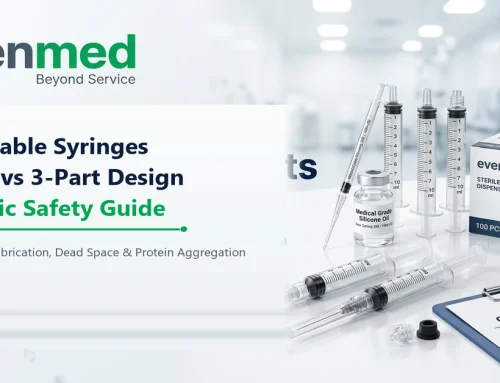
- 3-Piece Syringes: Composed of a transparent polypropylene barrel, polyethylene plunger stem, and a synthetic elastomeric (polyisoprene or halobutyl) piston gasket lubricated with medical-grade silicone oil (Dow Corning 360 compliant). They provide smooth plunger movement and superior hermetic seal integrity under dynamic hydraulic pressure, making them the worldwide gold standard for general inpatient care and infusion pump compatibility.
- 2-Piece Syringes: Composed strictly of a polypropylene barrel and a precisely molded high-density polyethylene (HDPE) plunger with an expanding seal ring. Because they contain zero synthetic rubber gaskets and zero silicone oil lubricants, 2-piece syringes eliminate chemical leaching risks in sensitive laboratory bioassays, IVF procedures, and ophthalmic injections where silicone oil droplets could induce ocular inflammation.
5. Hospital Tender Procurement Checklist: Standards & Quality Assurance
To avoid tender disqualifications and substandard deliveries, institutional procurement departments should mandate the following verification parameters:
- ISO 7886-1 Compliance: Sterile hypodermic syringes for single use—governing volumetric accuracy (tolerance within ±4% for volumes ≥ 5 mL), air aspiration limits, and barrel transparency.
- ISO 80369-7 Luer Connector Verification: Gauge testing for male taper dimensions, thread pitch integrity, and leak testing under 300 kPa hydrostatic pressure for 30 seconds.
- Ethylene Oxide (EO) Residual Limits: Residue testing ensuring EO and ethylene chlorohydrin levels remain below 4.0 mg/device in accordance with ISO 10993-7 biocompatibility standards.
- Secondary Packaging & Barrier Integrity: Medical-grade Tyvek or medical paper/plastic blister packaging guaranteeing a 5-year sterile shelf life under tropical storage (30°C / 75% RH).
6. Strategic Supply Chain & Shevenmed Manufacturing Advantages
For international medical distributors, private hospital chains, and regional health ministries, supply chain resilience is as critical as device precision. Shevenmed's comprehensive infusion and phlebotomy range delivers automated cleanroom production (ISO Class 8 / 100,000-level), ultra-clear virgin medical-grade polypropylene, high-contrast permanent graduations, and dual CE MDR / ISO 13485 certification. Whether shipping full 40ft high-cube containers of high-throughput Luer Slip syringes or sterile individually blistered Luer Lock safety syringes, our factory-direct export protocols ensure consistent regulatory documentation and seamless customs clearance worldwide.